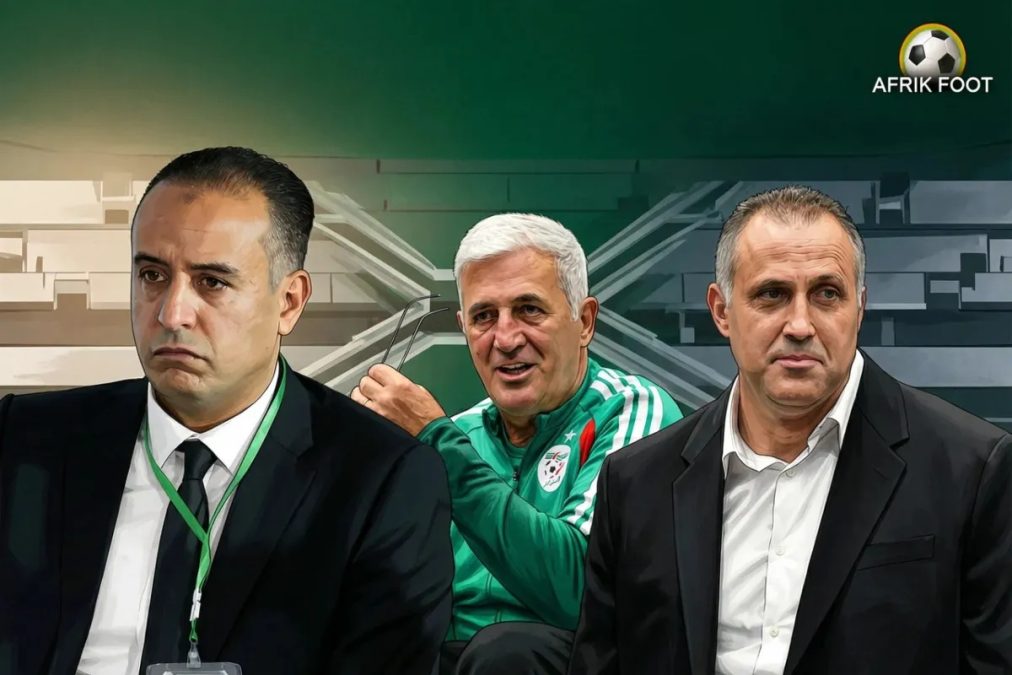
Vladimir Petkovic’s reputation has improved in hindsight after Algeria’s 3-0 defeat by Togo exposed the cost of the federation’s decision to dismiss him.
Only four months after his departure, the former Algeria manager no longer appears quite as unsuitable for the job. Calls of “Petkovic out” might even be replaced by “Petkovic back” – a prospect that seemed absurd after the 2026 World Cup defeat by Switzerland but looks less far-fetched after just two international camps under Brahim Hemdani.
Those camps ended with a historic humiliation in Lome and have forced the Algerian Football Federation (FAF) to reconsider its own choices.
Petkovic did not always produce attractive football and never fully won over Algeria’s supporters. His tactics could appear cautious, while his communication failed to establish a strong connection with the public. His record, however, was difficult to dismiss.
At the 2025 Africa Cup of Nations, Algeria won all three group matches, defeated DR Congo and then lost 2-0 to a stronger Nigeria in the quarter-finals. It was an improvement on the team’s first-round exits in 2021 and 2023.
Petkovic also guided Algeria to their first World Cup since 2014. When his contract was extended in June 2026, he had recorded 21 wins, four draws and three defeats in 28 matches. Those figures persuaded the FAF to keep him until July 2028, only days before the World Cup began. The decision was presented as a commitment to continuity.
A change of direction after the World Cup
The tournament in the United States changed that position. Algeria reached the last 32 but failed to show the necessary collective strength. Against Switzerland, a side previously managed by Petkovic, they produced a timid performance and lost 2-0 without seriously troubling an opponent considered beatable.
Tactical uncertainty, repeated changes to the starting line-up and a lack of understanding between players suggested the project had reached its limit. His dismissal could therefore be understood. The more troubling issue was the timing: why extend a manager shortly before the tournament if elimination in the last 32 was enough to overturn the decision?
In less than two months, the federation first identified Petkovic as the coach for the future, then made him responsible for a disappointing World Cup before appointing a manager with no experience at that level.
Under Petkovic, Algeria were not always convincing, but they generally knew how to avoid defeat. Even when they struggled, as in their match against Guinea in Morocco, the team did not lose its shape. The lines remained compact and players broadly understood their responsibilities.
That foundation disappeared within weeks. Against Burundi and in both matches against Togo, Algeria looked short of established patterns, vulnerable in transition and unable to respond when matches moved against them. It is difficult to imagine Petkovic’s side collapsing so easily in a qualifying fixture.
His departure also created a financial dispute. A figure of 3.84m euros, representing the 24 months remaining on his improved contract, was reported. The FAF rejected that account, while other sources said an amicable settlement worth about three months’ salary – nearly 480,000 euros – had been agreed.
Recalling Petkovic now appears unrealistic and undesirable for both sides. Walid Sadi must demand answers from the coaching staff after Lome, but he must also explain the sequence of extending Petkovic, dismissing him, appointing Hemdani in an emergency and potentially considering a fourth manager in fewer than three years.
-
 Algeria’s Petkovic gamble questioned after Togo humiliation Nov 20, 2026
-
Bayer Leverkusen target Borussia Monchengladbach teenager Wael Mohya Nov 20, 2026
-
Ouaddou says Orlando Pirates are not favourites against Stellenbosch Nov 20, 2026
-
Fadlu Davids targets winning run as Young Africans coach Nov 20, 2026


-
AFCON 2025: Fixtures, Results, Scores and Standings Jan 18, 2026
-
Match hero Taiwo Awoniyi reflects on team effort after Chelsea triumph May 5, 2026
-
Leadership and long-term vision key to rescuing Zamalek and inspiring Egyptian football – Hany Abou Rida Nov 5, 2025
-
South African giants Orlando Pirates set to lose influential forward Monnapule Saleng Mar 19, 2025




-
AFCON 2027 Qualifiers: Check out full group standings Nov 15, 2026
-
AFCON 2027 qualifiers matchday 3 & 4: All fixtures and results Nov 17, 2026
-
AFCON 2027 Qualifiers: Ethiopia edge Mozambique to claim first Group J victory Nov 13, 2026
-
Nigeria 3-1 Tanzania: Tolu Arokodare double seals 2027 Africa Cup of Nations qualifying win Nov 13, 2026