Munuera says artificial intelligence chooses disputed referee clips for review programme
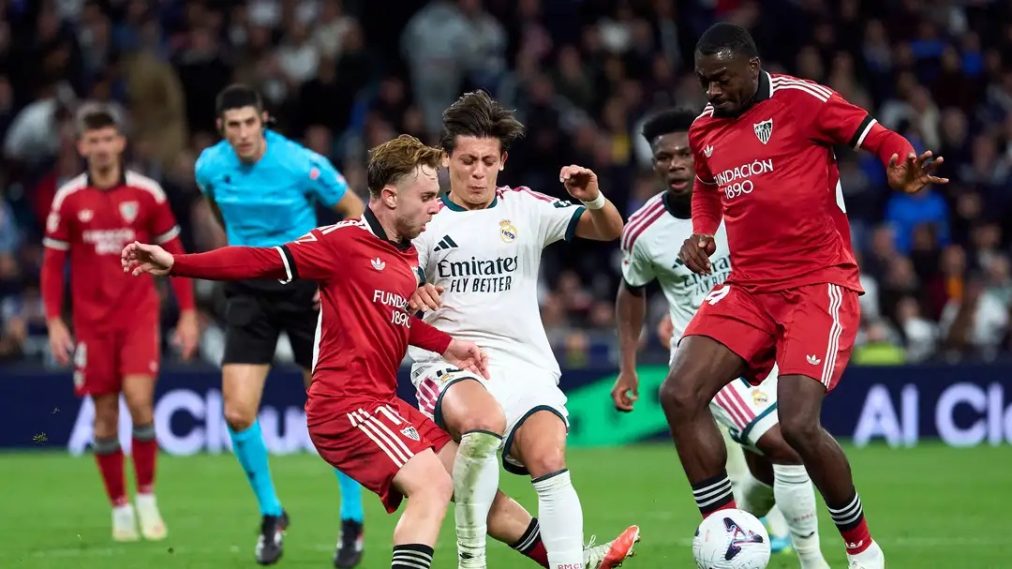
Spanish referees Jose Luis Munuera Montero and Jorge Figueroa Vazquez have defended their decisions amid growing criticism, insisting they apply football’s laws rather than create them.
Speaking at a meeting organised by the Association of Sports Journalists in Seville, and quoted by Cadena SER, Munuera said referees were working under demanding standards while accepting that mistakes could have serious consequences.
“We believe in accuracy and commitment. We are required to meet very high standards and have little room for error,” he said.
“Unfortunately, it is not understood that the referee is not the person committing the offences. We are responsible for applying the rules established by the International Football Association Board for their interpretation.”
Munuera added: “Until supporters understand that we are not the guilty party, the situation will remain extremely difficult. Everyone is responsible for their actions, whether it is a penalty or a red card. We work hard to preserve our credibility on the pitch.”
He said greater openness could help improve relations between officials, players and the public.
“Transparency helps all of us understand one another better. If we make a mistake, we are the ones who face the greatest consequences,” Munuera said.
“There is a points system and clear criteria. Our technical, physical, psychological and disciplinary aspects are closely assessed. Constructive criticism improves our performance.”
Munuera also said some players and managers had an impressive knowledge of the laws and that referees wanted to explain the reasoning behind their decisions.
“There are players who surprise us with their understanding of the game and their ability to debate, just as many managers do,” he said. “We are the first to want to explain the criteria we applied on the pitch.”
He added that the modern refereeing model was more open and encouraged contact with players, although communication was not always appropriate. “We know the players well, and they know us,” he said.
AI selects controversial clips
Munuera revealed that the disputed incidents shown on the “Review Time” programme are selected by artificial intelligence rather than by people.
“The clips for the Review Time programme are chosen by artificial intelligence; nobody selects them,” he said. “We are trying to reach as many people as possible. We give interviews and attend events so everyone can understand how we work.”
He called for referees to have a greater presence on radio and television so supporters could better understand how decisions were reached.
Figueroa Vazquez was asked about the controversy surrounding a Real Madrid-Sevilla incident involving Arda Guler and Gerard Fernandez at Santiago Bernabeu.
“There are clips that are not clear enough to make a decision,” he said. “If you see an image where you cannot establish whether the ball hit his chest, hand or shoulder, those cameras do not provide enough clarity.”
“They do not offer the guarantees required to make a decision according to the protocol. That is a question for the television broadcast team.”
Spanish refereeing is under intense pressure, with disputed decisions and criticism from clubs and supporters increasing from one round to the next. Munuera believes greater transparency and communication are needed to show that referees are human, can make mistakes, but do not make them deliberately.
“Our role is to protect the game, apply the laws fairly and preserve the credibility of the competition,” he said.
-
 REVEALED: AC Milan’s move for Noussair Mazraoui depends on Pervis Estupiñán’s departure Nov 19, 2026
-
Egypt’s Hamza Abdelkarim earns major praise as Barcelona assess attacking options Nov 19, 2026
-
Chelsea consider fresh move for Senegal midfielder Lamine Camara Nov 19, 2026
-
FIFA to inspect six Moroccan cities as 2030 World Cup preparations gather pace Nov 19, 2026


-
AFCON 2025: Fixtures, Results, Scores and Standings Jan 18, 2026
-
Match hero Taiwo Awoniyi reflects on team effort after Chelsea triumph May 5, 2026
-
Leadership and long-term vision key to rescuing Zamalek and inspiring Egyptian football – Hany Abou Rida Nov 5, 2025
-
South African giants Orlando Pirates set to lose influential forward Monnapule Saleng Mar 19, 2025




-
AFCON 2027 Qualifiers: Benni McCarthy likens Kenya’s clash with South Africa to ‘David versus Goliath’ Nov 13, 2026
-
Morocco aim to extend lead against Niger in 2027 Africa Cup of Nations qualifier Nov 13, 2026
-
AFCON 2027 Qualifiers: Pitso Mosimane warns South Africa against dangerous Kenya Nov 13, 2026
-
CAN 2027 qualifiers: Cote d’Ivoire edge Gambia as Senegal, Benin and Cameroon win Nov 13, 2026