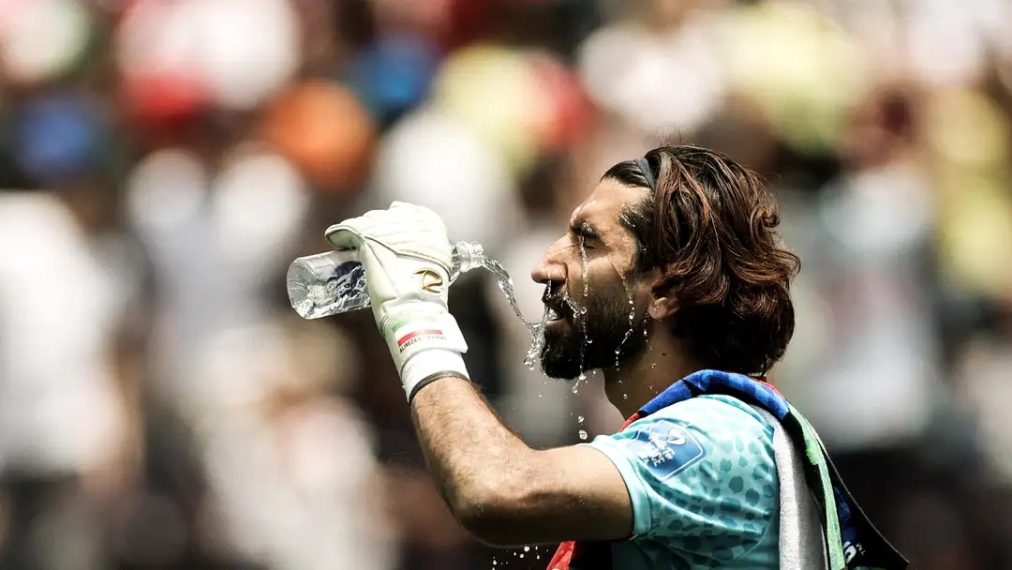
Alireza Beiranvand became the first goalkeeper to win the Asian Player of the Year award since its introduction by the Asian Football Confederation in 1994, beating Saudi Arabia forwards Firas Al-Buraikan and Salem Al-Dawsari.
The Tractor goalkeeper received the honour at Thursday’s Asian Football Confederation awards ceremony, held at the Aksra Theatre King Power in Bangkok, Thailand. The venue previously hosted the event in 2017, with awards presented across 19 categories.
Beiranvand was recognised for his performances for Tractor and Iran during the year. His victory also returned the main individual award to Iran for the first time in 22 years, following Ali Karimi’s success in 2004.
Why was Beiranvand’s win disputed?
The result surprised many observers, who had expected Al-Buraikan to win after an outstanding year with Al Ahli and Saudi Arabia.
Al-Buraikan helped Al Ahli win the AFC Champions League Elite for the second consecutive season and the second time in the club’s history. In the final, Al Ahli beat Japan’s Machida Zelvia 1-0, with the 26-year-old scoring the decisive goal in the sixth minute of added time after coming on as a substitute.
Beiranvand, by contrast, did not lead Tractor to continental success. The Iranian club were eliminated by Shabab Al Ahli in the last 16 of the AFC Champions League Elite after a 3-0 defeat. Beiranvand was sent off in the 52nd minute, making his red card a major factor in Tractor’s exit.
Al-Buraikan’s achievements also extended to international football. He helped Saudi Arabia win the 27th edition of the Gulf Cup, known as Gulf 27, in October. Saudi Arabia defeated the United Arab Emirates 2-0 in the final to claim their fourth title and first in 23 years, with Al-Buraikan scoring again.
He finished as the tournament’s leading scorer with three goals, having also scored twice against Oman in the group stage.
The striker’s only significant disappointment came at the 2026 World Cup in the United States, Canada and Mexico, where he failed to score despite starting all three of Saudi Arabia’s group-stage matches.
Beiranvand also started all three group games for Iran, but his tournament ended early, just like Saudi Arabia’s. He kept one clean sheet, in a goalless draw with Belgium in the second round of matches, while conceding twice against New Zealand and once against Egypt.
The award denied Al-Buraikan the chance to become the seventh Saudi Arabian winner since 1994. Saeed Al-Owairan was the first in 1994, followed by Nawaf Al-Temyat in 2000, Hamad Al-Montashari in 2005, Yasser Al-Qahtani in 2007, Nasser Al-Shamrani in 2014 and Salem Al-Dawsari in 2022 and 2025.
-
 Al Ahly grant Emam Ashour permission to film Ramadan advertisements and TV shows Nov 19, 2026
-
Boost for Zamalek as duo Abdel Rahim and Hossam Ashraf return for El Gouna clash Nov 19, 2026
-
Orlando Pirates coach Ouaddou warns Padime: ‘A career is not five games’ Nov 19, 2026
-
Letsholonyane’s Centre Chiefs making early progress under ‘Yeye’ Nov 19, 2026



-
AFCON 2025: Fixtures, Results, Scores and Standings Jan 18, 2026
-
Match hero Taiwo Awoniyi reflects on team effort after Chelsea triumph May 5, 2026
-
Leadership and long-term vision key to rescuing Zamalek and inspiring Egyptian football – Hany Abou Rida Nov 5, 2025
-
South African giants Orlando Pirates set to lose influential forward Monnapule Saleng Mar 19, 2025




-
AFCON 2027 Qualifiers: Benni McCarthy likens Kenya’s clash with South Africa to ‘David versus Goliath’ Nov 13, 2026
-
Morocco aim to extend lead against Niger in 2027 Africa Cup of Nations qualifier Nov 13, 2026
-
AFCON 2027 Qualifiers: Pitso Mosimane warns South Africa against dangerous Kenya Nov 13, 2026
-
Argentina v Uruguay: Rivals meet in Rio de la Plata friendly Nov 12, 2026