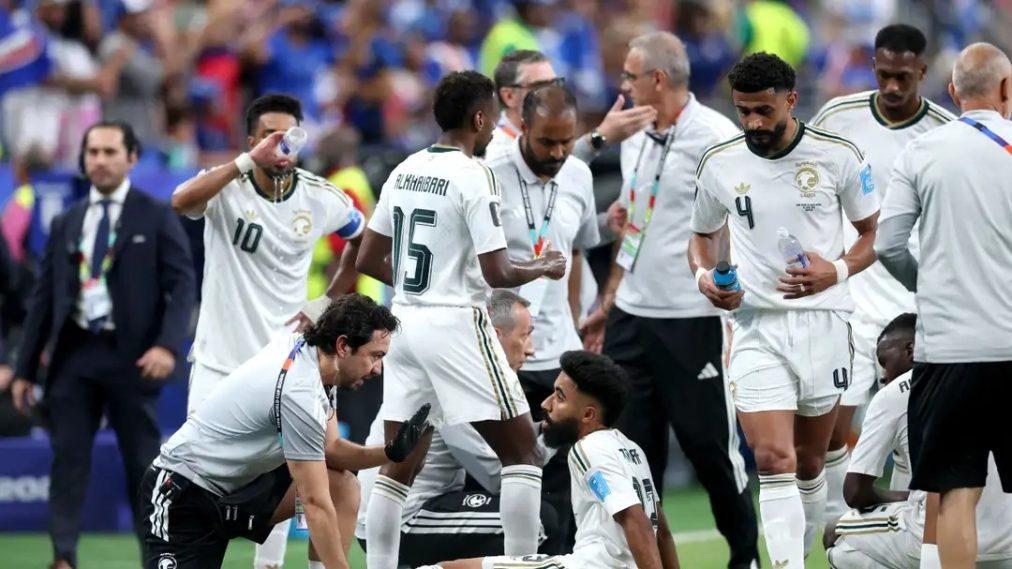
Saudi Arabia’s encouraging performances against South Korea and Uzbekistan were overshadowed by recurring defensive problems that must be addressed before the team’s next stage of competition.
Analyst Imad Al-Salmi said several weaknesses had persisted despite changes to the line-up, suggesting they were not linked to particular players or a single selection.
Speaking on Rotana Sport with Waleed, where he discussed Saudi Arabia’s 2-1 friendly defeat by Uzbekistan in Doha on Tuesday, Al-Salmi first examined the risks involved in building play from the back.
He focused on the goalkeeper’s role in possession, with the keeper effectively becoming an extra outfield player. Al-Salmi said the approach reflected the coach’s tactical ideas, but warned that it had to suit the abilities of the players involved or it could become a danger to the goal.
He added that he had previously warned Mohammed Al-Owais to be particularly alert in such situations. In his view, a coach should not insist on a specific style if the squad does not have the right tools to carry it out, and abandoning that approach would be a natural decision.
Saudi Arabia’s midfield protection
The most significant issue, according to Al-Salmi, was the ease with which opponents had been able to play through the centre of the Saudi Arabia team. That weakness was visible in both matches against South Korea and Uzbekistan.
He assessed the roles of Nasser Al-Dawsari, Abdullah Al-Khaibari, Mohammed Kanno and Musab Al-Juwair, arguing that the spaces left by the midfielders allowed opponents to reach dangerous areas and shoot without sufficient pressure.
Some players moved towards the flanks to press, he explained, while the central channel was left open for the player in possession. Al-Salmi questioned whether this was caused by poor positioning or instructions to direct the press towards particular areas.
Either way, he said, the outcome was the same: the most dangerous space was being left unprotected. The pattern had appeared repeatedly and required the coaching staff to review both the pressing structure and the team’s coverage of space.
Al-Salmi also highlighted problems when Saudi Arabia defended crosses. The issue emerged against South Korea and returned against Uzbekistan, when one delivery created a major threat before Abdul Quddus Atiyah intervened to prevent the danger.
He stressed that the problem could not be attributed to one player. Instead, it concerned the team’s positioning and collective response to balls delivered into the penalty area, requiring focused work in training rather than treating each incident as an isolated mistake.
Al-Salmi said identifying those shortcomings was not intended to diminish Saudi Arabia’s positive aspects. The purpose was to learn from the two matches and establish what needed improvement.
He concluded that correcting the repeated problems protecting the centre, defending crosses and building from the back was as important as developing the team’s strengths, otherwise opponents could exploit those weaknesses in future fixtures.
-
 2027 Women’s World Cup: Three-year tournament boom could transform players’ earnings – Maria Karlsson De Cecco Nov 18, 2026
-
Senegal coach Saliou Dia unfazed by Morocco challenge ahead of U23 AFCON decider Nov 18, 2026
-
Ivory Coast coach Hervé Renard admits The Gambia deserved victory Nov 18, 2026
-
Villarreal star Pape Gueye reaches 50-cap milestone with Senegal Nov 18, 2026



-
AFCON 2025: Fixtures, Results, Scores and Standings Jan 18, 2026
-
Match hero Taiwo Awoniyi reflects on team effort after Chelsea triumph May 5, 2026
-
Leadership and long-term vision key to rescuing Zamalek and inspiring Egyptian football – Hany Abou Rida Nov 5, 2025
-
South African giants Orlando Pirates set to lose influential forward Monnapule Saleng Mar 19, 2025




-
Morocco v Niger: Lions of the Atlas seek another win in CAN 2027 qualifying Nov 11, 2026
-
Nael El Aynaoui withdraws from Morocco squad for Niger clash over fitness issues Nov 11, 2026
-
AFCON 2027 Qualifiers: Benni McCarthy likens Kenya’s clash with South Africa to ‘David versus Goliath’ Nov 13, 2026
-
Morocco aim to extend lead against Niger in 2027 Africa Cup of Nations qualifier Nov 13, 2026