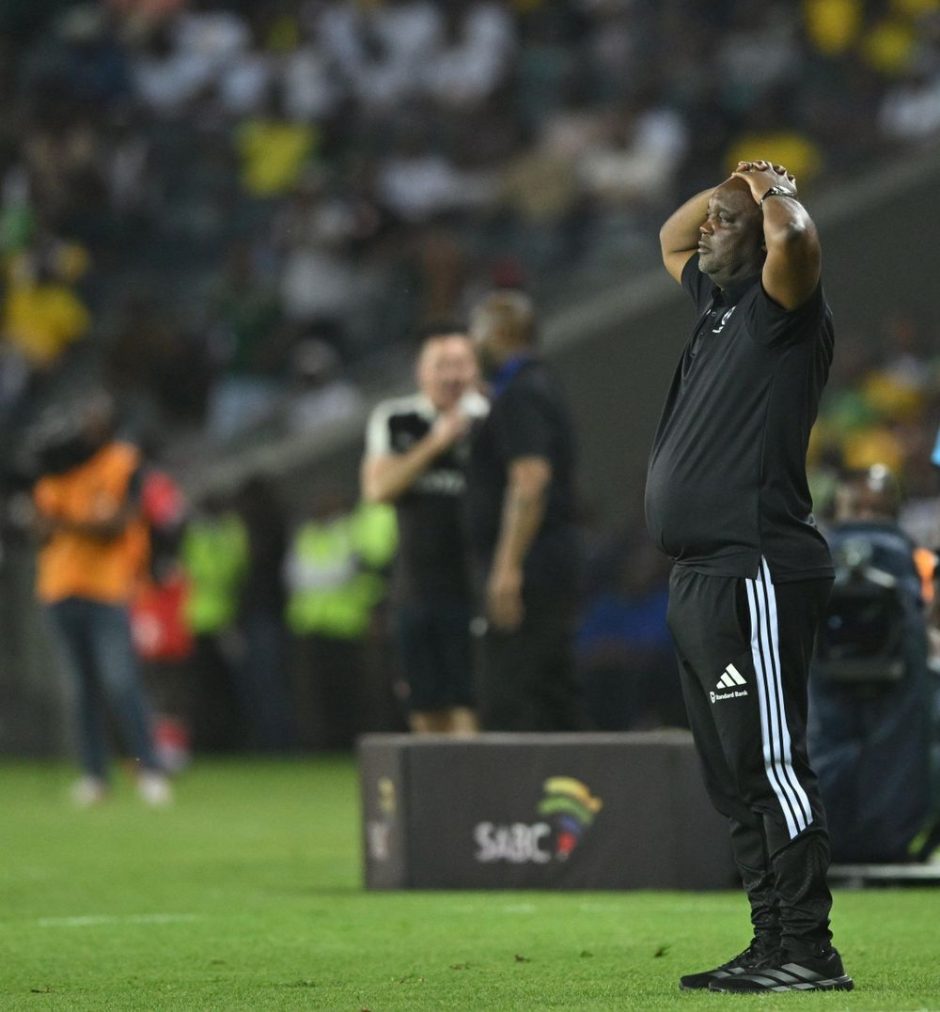
Pitso Mosimane is facing the same selection pressure that followed Hugo Broos during his time as Bafana Bafana coach, with questions already being raised over several high-profile omissions.
There was an element of irony in seeing Broos and his former assistant Helman Mkhalele in the stands at Orlando Amstel Arena on Friday night as Bafana Bafana played under Mosimane.
This time, the former technical team were observers rather than decision-makers. But they would have been familiar with the debate surrounding the national team’s selection, as supporters questioned the coach’s choices and called for certain players to be given opportunities.
Broos experienced similar scrutiny during his tenure. The Belgian was regularly asked to explain the omission of players such as Thembinkosi Lorch and Gift Links, despite their strong form at club level.
Other selection decisions were also challenged, although Broos was generally unwilling to allow public opinion to influence his choices. He repeatedly made clear that pressure on social media would not determine who was selected.
Mosimane is now dealing with a comparable situation.
His decision to leave out in-form defender Aden McCarthy and recall Mbekezeli Mbokazi attracted attention before the Kenya double-header. That discussion intensified on Friday, when Mbokazi remained on the bench during the 2-2 draw and supporters questioned whether the Chicago Fire defender should have started.
The omission of veteran midfielder Themba Zwane also became a talking point. Mosimane acknowledged that the decision had been difficult and said he had personally contacted Zwane to explain it.
The two coaches share strong convictions about the players they want to use and have both been required to defend decisions that were unpopular with supporters. They have also faced the broader question of how much importance should be placed on current club form when choosing an international team.
There is, however, an important difference in their circumstances.
Broos developed a clear selection approach based on technical ability, mentality and a player’s contribution to the team environment. He was willing to make difficult calls, and his results eventually gave him the authority to maintain those decisions.
Under Broos, Bafana Bafana reached the semi-finals of the 2023 Africa Cup of Nations and qualified for the 2026 FIFA World Cup.
Mosimane remains at the start of his latest spell with Bafana Bafana. His opening victories provided encouragement, but the draw against Kenya demonstrated that performances and selection decisions will be assessed together.
The presence of Broos and Mkhalele created an amusing subplot, with the former coaches able to watch a familiar set of selection questions unfold without having to answer for the starting XI at the post-match press conference.
Mosimane should not pick players simply to appease supporters. International football cannot be managed that way. But he must recognise that every omission will prompt discussion, especially when the player left out is performing well.
Broos eventually earned the benefit of the doubt through consistency and results. Mosimane will have to do the same.
He cannot avoid criticism, because no Bafana Bafana coach can. His challenge is to build a team strong enough for those arguments to become less significant.
-
 AFCON 2027 Qualifiers: Mosimane laments South Africa’s poor finishing after Kenya draw Nov 16, 2026
-
Senegal favourites to beat Sudan again in 2027 Africa Cup of Nations qualifier Nov 16, 2026
-
AFCON 2027 Qualifiers: McCarthy targets positive result as Kenya prepare for South Africa rematch Nov 16, 2026
-
AFCON 2027 Qualifiers: Pitso Mosimane explains Bafana Bafana’s early morning trip to Kenya Nov 16, 2026


-
AFCON 2025: Fixtures, Results, Scores and Standings Jan 18, 2026
-
Match hero Taiwo Awoniyi reflects on team effort after Chelsea triumph May 5, 2026
-
Leadership and long-term vision key to rescuing Zamalek and inspiring Egyptian football – Hany Abou Rida Nov 5, 2025
-
South African giants Orlando Pirates set to lose influential forward Monnapule Saleng Mar 19, 2025




-
Morocco v Niger: Lions of the Atlas seek another win in CAN 2027 qualifying Nov 11, 2026
-
CAN 2027 qualifying: Cote d’Ivoire-Gambia and Mali-Rwanda headline third round Nov 9, 2026
-
Nael El Aynaoui withdraws from Morocco squad for Niger clash over fitness issues Nov 11, 2026
-
AFCON 2027 Qualifiers: Benni McCarthy likens Kenya’s clash with South Africa to ‘David versus Goliath’ Nov 13, 2026