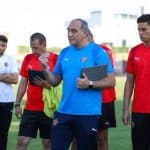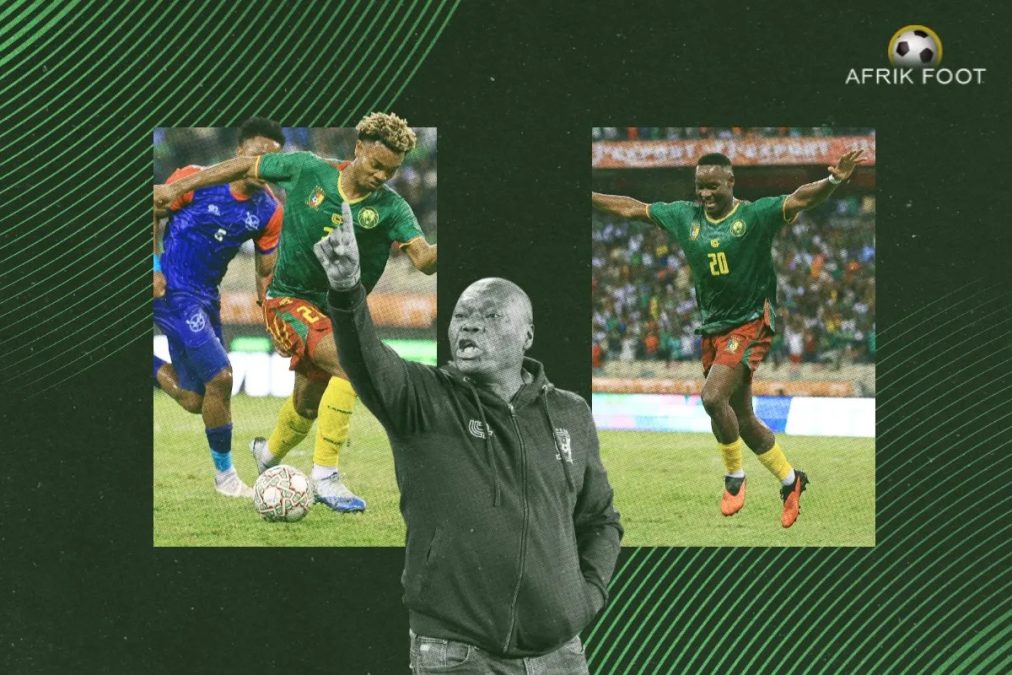
Since taking charge of Cameroon in December 2025, David Pagou has overseen a major overhaul of the Indomitable Lions, leaving established players out, promoting inexperienced youngsters and regularly changing his squads.
The results have largely supported his approach. But with seven players dropped between the September and November selections and nine newcomers added, questions remain about where the coach’s constant revolution will take Cameroon.
Pagou was appointed in a highly political context, shortly after Samuel Eto’o was re-elected as president of FECAFOOT and only weeks before the 2025 Africa Cup of Nations. He was initially dismissed by some as the president’s “puppet”.
He disproved those doubts in Morocco, building an attractive side which played in an energetic 3-4-2-1 system. The Lions found their “hemle” before being eliminated by the hosts in the quarter-finals after an encouraging campaign. However, his decisions have continued to divide opinion.
Some of the changes have been enforced by injuries. Carlos Baleba has not played for Cameroon for more than a year after suffering injuries at crucial moments, while Christian Kofane was unavailable with a thigh problem.
The team’s form, meanwhile, remains a strong argument in Pagou’s favour. Since his appointment, Cameroon’s only competitive defeat has been against Morocco in the Africa Cup of Nations quarter-finals. They have also impressed in qualification and defeated a much-changed Cote d’Ivoire 1-0 in a friendly in Abidjan.
Cameroon lead Group G with seven points from three matches and are moving closer to qualification. A draw against Congo showed there is still work to do, but the overall sporting momentum is positive.
A small core is beginning to emerge around Bryan Mbeumo, now the team’s leading figure, along with Arthur Avom, Mahamadou Nagida, Danny Namaso, Kofane when available, and Baleba, whose injuries have denied him international football for the past year.
The emergence of players such as Samuel Kotto and Junior Tchamadeu, whose profiles appear to appeal to Pagou, suggests there is at least some structure behind the changes.
Other decisions have been more difficult to understand. Nouhou Tolo, captain and an undisputed starter at the 2025 Africa Cup of Nations, has disappeared from the squad. Pagou has said he wanted to explore a different profile in that position while acknowledging his former captain’s qualities.
Harold Moukoudi’s continued absence has also attracted attention. He captains AEK Athens and plays in the Champions League, but has been outside the Cameroon set-up since 2024.
Pagou has instead selected players such as Angel Yondjo, from Lille’s reserve team, who had only just made his Ligue 1 debut before starting against Namibia and providing an assist. Ivan Jordan Nana, captain of the Under-20 side and still in development, has also been called up.
The inclusion of players from less prominent leagues, including Algeria, Tunisia, Latvia and the Czech Republic, has surprised some supporters. Pagou says he prioritises performances, attitude and the desire to “give everything for the shirt” over reputation.
One Cameroon supporter recently summarised the uncertainty on X: “Only this coach knows what he wants to do with our team.”
Cameroon’s history offers some support for Pagou’s strategy. The 2017 Africa Cup of Nations winners in Gabon relied on a united collective rather than a squad packed with major stars. Vincent Aboubakar and Nicolas Nkoulou, who scored in the final, had started most of the tournament on the bench.
Pagou’s principles are therefore defensible: promote youth, maintain competition and place no individual above the team. After the win over Namibia, he said he wanted to build cohesion so that “whatever players we select, the structure does not change”.
The challenge is to prove that this approach can last. A team needs more than constant changes; it also requires established relationships, continuity and a clear hierarchy. Cameroon must now show that the Lions are building towards something permanent rather than starting again at every international break.
-
 Cameroon: David Pagou’s bold rebuild delivers results but raises questions Nov 15, 2026
-
CAN 2027: 11 nations could book their places in the finals this week Nov 15, 2026
-
Algeria lose Maza and Hadj-Moussa for Togo return Nov 15, 2026
-
Gambia v Cote d’Ivoire: probable line-ups for 2027 Africa Cup of Nations qualifier Nov 15, 2026



-
AFCON 2025: Fixtures, Results, Scores and Standings Jan 18, 2026
-
Match hero Taiwo Awoniyi reflects on team effort after Chelsea triumph May 5, 2026
-
Leadership and long-term vision key to rescuing Zamalek and inspiring Egyptian football – Hany Abou Rida Nov 5, 2025
-
South African giants Orlando Pirates set to lose influential forward Monnapule Saleng Mar 19, 2025




-
Ali Maher names first Egypt squad for 2027 Africa Cup of Nations qualifiers Nov 9, 2026
-
Morocco v Niger: Lions of the Atlas seek another win in CAN 2027 qualifying Nov 11, 2026
-
CAN 2027 qualifying: Cote d’Ivoire-Gambia and Mali-Rwanda headline third round Nov 9, 2026
-
FIFA U17 World Cup 2026: TV channels, streaming and full match schedule Nov 8, 2026