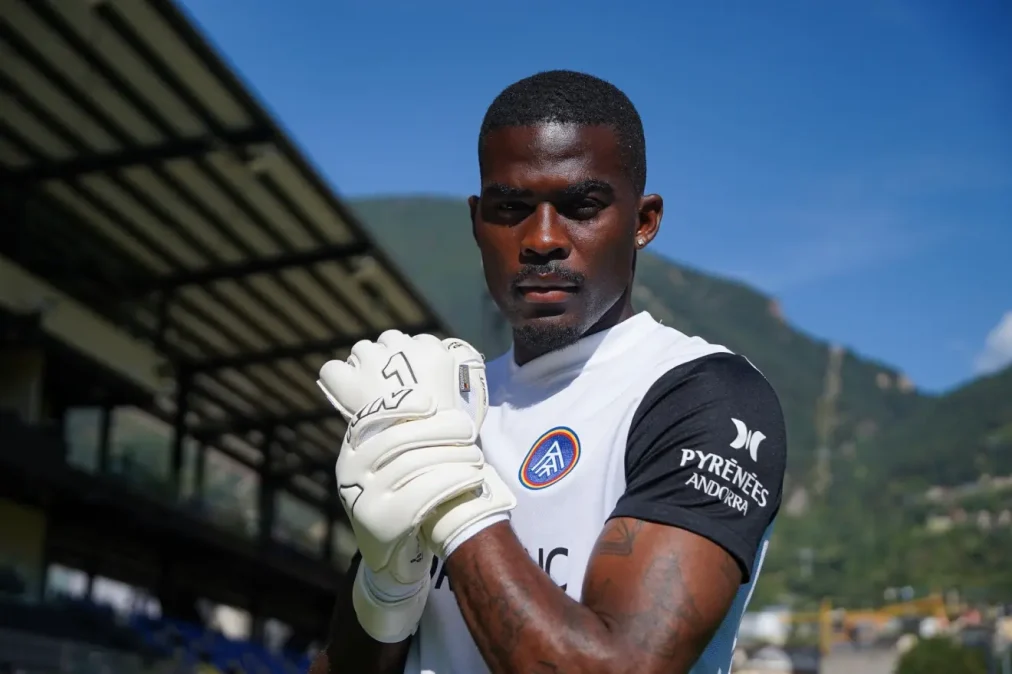
Tenerife manager Alvaro Cervera has admitted that the 12-match suspension handed to FC Andorra goalkeeper Jesus Owono may appear lenient following the death of Tenerife forward Jesus de Miguel, but insists the Spanish football authorities were restricted by existing disciplinary regulations.
Owono, 25, was sent off after colliding with De Miguel during the closing stages of the Spanish second-tier encounter between FC Andorra and Tenerife on November 2.
De Miguel, 30, tragically died the following day, with the incident sending shockwaves through Spanish football.
The Spanish Football Federation’s disciplinary committee confirmed Owono’s 12-match suspension on Friday, imposing the maximum punishment available under the regulations.
However, the committee clarified that its decision was based strictly on the offence committed on the pitch and could not take into account the tragic outcome of the incident.
Speaking ahead of Tenerife’s fixture against Ceuta on Sunday, their first match since De Miguel’s passing, Cervera acknowledged that the punishment might not satisfy everyone.
“I think that, just as in other areas of life, there are rules or laws that must be followed,” Cervera said.
“Since the current regulations don’t specifically account for what happened, I believe they have simply adhered to the rules and imposed the number of matches permitted by the regulations.
“Anything else I might say would just be my own personal opinion, which I’ll keep to myself. It might seem a bit light when compared to other cases, but in reality, I don’t think the rules allow for anything else.”
The disciplinary committee also explained that it had to base its decision “on the facts expressly recorded in the referee’s report”.
According to the referee’s report, Owono was dismissed for “violently striking an opponent in the chest with his leg, using excessive force, while the ball was in play”.
Beyond the disciplinary proceedings, Cervera revealed that Tenerife have been dealing with the emotional consequences of De Miguel’s death as the squad gradually attempts to return to football.
The 61-year-old described the process of resuming training and preparing for competitive action as “tough” and “complicated”, acknowledging that players are coping with the tragedy in different ways.
“When we’re together, we’re fine, during our sessions, we’re doing well,” he said.
“It feels like the group is gradually getting back to normal. What we don’t know is how everyone is doing when we’re apart and that’s a significant factor.
“Everyone has their own way of coping and their own thoughts; some have people at home to support them, while others are more on their own.
“We’re making progress, a very slow process, but we are moving forward – it’s tough, it’s complicated.”
Cervera also admitted uncertainty over whether his players were emotionally ready to return to competitive football, noting that while some could welcome the distraction, others might need more time.
“Both positions are reasonable,” he added.
“On one hand, you want to return to some sense of normality though you know that true normality isn’t something you’ll find right now.
“This isn’t something you can just set aside or push to the back of your mind to focus on your own work; it’s not like other life events you might encounter. It’s always there, constantly on your mind, yet we have to keep going.”
-
 Tenerife boss admits Jesus Owono’s 12-match ban may feel ‘light’ Nov 15, 2026
-
Brooklyn Poggenpoel says Bafana selection is about performances, not clubs Nov 15, 2026
-
Mdaka praises South Africa U23s for crucial win against Madagascar Nov 15, 2026
-
Pitso Mosimane dismisses ‘Mbokazi factor’ after Bafana Bafana draw with Kenya Nov 15, 2026


-
AFCON 2025: Fixtures, Results, Scores and Standings Jan 18, 2026
-
Match hero Taiwo Awoniyi reflects on team effort after Chelsea triumph May 5, 2026
-
Leadership and long-term vision key to rescuing Zamalek and inspiring Egyptian football – Hany Abou Rida Nov 5, 2025
-
South African giants Orlando Pirates set to lose influential forward Monnapule Saleng Mar 19, 2025




-
Ali Maher names first Egypt squad for 2027 Africa Cup of Nations qualifiers Nov 9, 2026
-
Morocco v Niger: Lions of the Atlas seek another win in CAN 2027 qualifying Nov 11, 2026
-
CAN 2027 qualifying: Cote d’Ivoire-Gambia and Mali-Rwanda headline third round Nov 9, 2026
-
FIFA U17 World Cup 2026: TV channels, streaming and full match schedule Nov 8, 2026