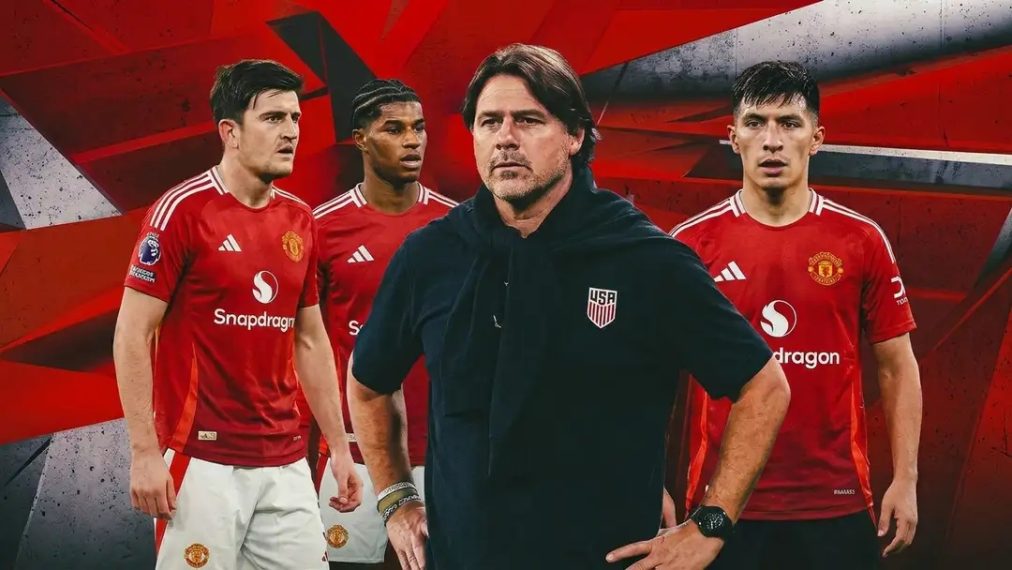
Mauricio Pochettino has taken charge of Manchester United after Michael Carrick, returning to the Premier League with a reputation for developing young players, demanding intense pressing and encouraging direct attacking football. His immediate challenge at Old Trafford is to establish whether the current squad can deliver those demands.
Pochettino has rarely been a manager tied to one rigid formation. From Southampton and Tottenham Hotspur to Paris Saint-Germain, Chelsea and the United States, he has adapted his methods to the players available to him. That flexibility will be essential at Manchester United, where a rebuild must be balanced against the limitations of the squad he has inherited.
The lessons from previous clubs
At Southampton, where he replaced Nigel Adkins, Pochettino retained the team’s broad structure but transformed its approach. His preferred 4-2-3-1 was built around an aggressive press designed to force mistakes close to the opposition goal. Rather than relying on major signings, he improved existing players, including Adam Lallana, Morgan Schneiderlin, Jay Rodriguez, Luke Shaw and Nathaniel Clyne, while adding players such as Dejan Lovren and Victor Wanyama.
Lallana later recalled that he had previously been given greater freedom on the left or as a number 10, but that Pochettino made every player work, run and press without special treatment. That policy could prove significant at United, particularly for influential players such as Bruno Fernandes. Sky Sports reported that Pochettino will expect his most important players to lead the work without the ball.
At Tottenham Hotspur, he developed a young, energetic side that attacked through quick vertical passing and rapid transitions. Dele Alli, Christian Eriksen and Son Heung-min operated close to Harry Kane, while Eric Dier often dropped into defence to create a back three in possession. Tottenham reached the UEFA Champions League final and finished in the Premier League’s top three for three consecutive seasons.
The eventual decline of that side also offered a warning. As the players’ energy levels fell, and without enough suitable reinforcements, the pressing system lost its intensity. Pochettino left in November 2019 after five years.
At Paris Saint-Germain, working with Lionel Messi, Neymar and Kylian Mbappe, he used a 4-3-3 and allowed for less collective pressing. At Chelsea in 2023, he switched between 3-4-2-1 and 4-2-3-1. Cole Palmer scored 22 Premier League goals and provided 11 assists, but Pochettino struggled to establish the required collective effort. Chelsea finished 2023-24 as the third-lowest team in the league for distance covered, unlike his high-running Tottenham side.
With the United States, he used both back-three and back-four systems and favoured 4-3-3 at the World Cup. The team recovered the ball in opponents’ areas an average of eight times per match, beat Paraguay, Australia and Bosnia and Herzegovina, and were eliminated by Belgium.
What awaits at Old Trafford?
A rapid tactical revolution is unlikely because Carrick also used 4-2-3-1. Leny Yoro’s pace, Patrick Dorgu’s physical qualities and Carlos Baleba’s ball-winning ability could suit Pochettino’s approach, while Bruno Fernandes will be central to creating chances and linking the lines.
The major concern is fitness. Manchester United are 19th in the Premier League for distance covered this season, while the starting group’s average age does not naturally fit a system built on constant movement. Chido Obi could provide youthful energy, but greater physical and tactical development across the squad will be required.
Pochettino has said: “If you do not change, you die.” At Manchester United, success will depend on adapting his previous ideas to a new squad rather than simply recreating the Tottenham model.
-
 Yassine Bounou reaches 100 appearances for Morocco in Niger victory Nov 14, 2026
-
Senegal FA apologises after digital ticketing problems at Leopold Sedar Senghor Stadium Nov 14, 2026
-
Medhi Benatia accuses Pablo Longoria of lying over Marseille finances Nov 14, 2026
-
Man United beat rivals to sign England youth international Tyler Adjei from Reading Nov 14, 2026


-
AFCON 2025: Fixtures, Results, Scores and Standings Jan 18, 2026
-
Match hero Taiwo Awoniyi reflects on team effort after Chelsea triumph May 5, 2026
-
Leadership and long-term vision key to rescuing Zamalek and inspiring Egyptian football – Hany Abou Rida Nov 5, 2025
-
South African giants Orlando Pirates set to lose influential forward Monnapule Saleng Mar 19, 2025




-
Ali Maher names first Egypt squad for 2027 Africa Cup of Nations qualifiers Nov 9, 2026
-
Morocco v Niger: Lions of the Atlas seek another win in CAN 2027 qualifying Nov 11, 2026
-
CAN 2027 qualifying: Cote d’Ivoire-Gambia and Mali-Rwanda headline third round Nov 9, 2026
-
FIFA U17 World Cup 2026: TV channels, streaming and full match schedule Nov 8, 2026