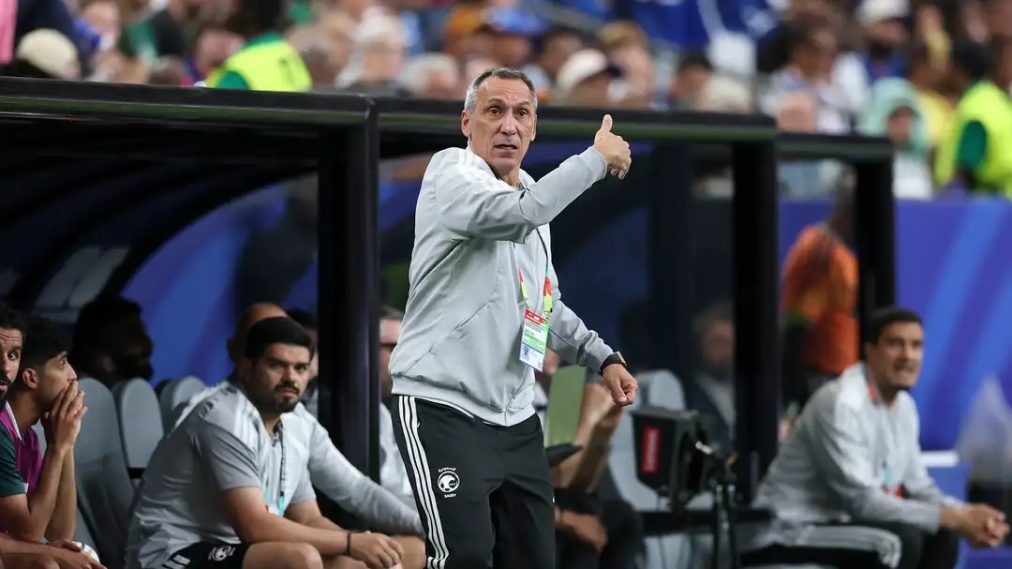
Georgios Donis has placed possession, set-pieces and passing at the centre of his work with Saudi Arabia, while introducing high pressing as a new feature of the team’s preparations for upcoming international commitments.
The Greek coach has overseen more than 42 training sessions since taking charge, beginning with the camp in the United States and continuing through the current gathering in Qatar. The programme has offered a clear indication of the tactical approach he wants to establish with the Green Falcons.
According to Saudi newspaper Asharq Al-Awsat, possession has been the main focus, with the coaching staff devoting 22 sessions to improving the team’s ability to keep the ball and control the tempo of matches.
Set-pieces have received the second-highest level of attention, accounting for 15 training sessions. The work has produced noticeable progress in both attacking and defensive situations, with Saudi Arabia increasingly able to use dead-ball situations as an important part of their overall approach.
The value of that preparation was highlighted during Saudi Arabia’s participation in the 2026 World Cup, when Abdul Elah Al-Amri scored against Uruguay from a set-piece. The goal underlined the potential importance of the area in difficult matches.
Passing is another key part of Donis’ plans. The coach is focusing particularly on building play from the back and ensuring his players can exchange passes under pressure, rather than relying repeatedly on long balls to escape the opposition’s press.
The Qatar camp has now added a new element. During the second training session, Saudi Arabia worked on high pressing tactically for the first time, reflecting Donis’ desire to broaden the team’s options and prepare it to face stronger opponents with different styles.
Saudi Arabia face South Korea and Uzbekistan
Saudi Arabia will play two friendlies against South Korea and Uzbekistan on 13 and 17 November respectively. Both matches will be held at Jassim bin Hamad Stadium in Doha as part of the preparation programme for future international commitments.
The meeting with South Korea will provide a significant test because of the Korean side’s technical and physical qualities, as well as its speed in attacking transitions and ability to play at a high tempo. The match should assess how well Saudi Arabia’s defence can cope with sustained pressure.
Uzbekistan will offer a different challenge. The team has developed considerably in recent years and combines physical strength with tactical organisation, giving Donis an opportunity to examine how his players respond to alternative defensive approaches and find ways through well-structured opponents.
The two friendlies are also expected to be used to assess tactical options, the understanding between the different sections of the side and the readiness of individual players. That will help Donis form a clearer view of his preferred starting XI and the alternatives available to him.
After the Qatar camp, Donis is expected to submit a technical report to the Saudi Arabian Football Federation’s technical administration. It will assess the work completed, the players’ performances and the areas requiring further improvement.
At the same time, the federation is preparing different plans for the future in case Donis remains in his post or leaves. The aim is to maintain continuity across the national teams and age groups, ensuring any future coaching change does not force the development project to begin again.
-
 AFCON 2027 Qualifiers: Cameroon face injury concerns ahead of Namibia clash Nov 12, 2026
-
Morocco vs Niger: Ticket sales open ahead of November 17 clash Nov 12, 2026
-
AFCON 2027 Qualifiers: Mosimane targets top spot as South Africa prepare for Kenya double-header Nov 12, 2026
-
Anthony Da Silva: Mali coach targets historic Africa Cup of Nations and World Cup breakthrough Nov 12, 2026




-
AFCON 2025: Fixtures, Results, Scores and Standings Jan 18, 2026
-
Match hero Taiwo Awoniyi reflects on team effort after Chelsea triumph May 5, 2026
-
Leadership and long-term vision key to rescuing Zamalek and inspiring Egyptian football – Hany Abou Rida Nov 5, 2025
-
South African giants Orlando Pirates set to lose influential forward Monnapule Saleng Mar 19, 2025




-
Manchester United host Aston Villa as both sides seek a Premier League lift Nov 6, 2026
-
Ali Maher names first Egypt squad for 2027 Africa Cup of Nations qualifiers Nov 9, 2026
-
Atletico Madrid host Barcelona in Liga summit clash with history at stake Nov 6, 2026
-
Nottingham Forest v Manchester City: City Ground hosts clash at opposite ends of the table Nov 6, 2026