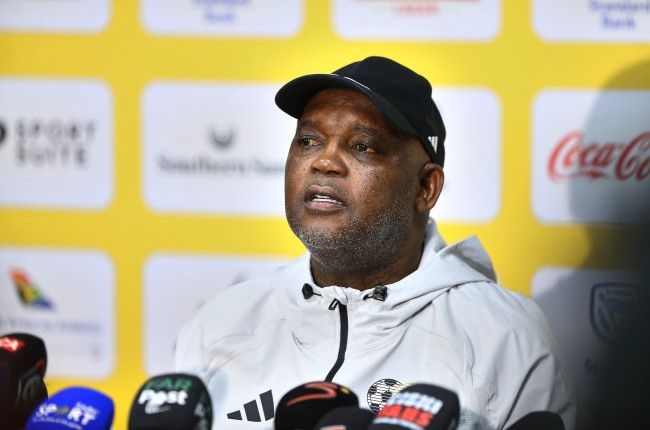
Bafana Bafana coach Pitso Mosimane says supporting his players means addressing emotional and personal challenges as well as their training, tactics and physical preparation.
Most of Mosimane’s 27-man squad is made up of Mamelodi Sundowns players, who joined the national team after Sunday afternoon’s disappointing 3-1 defeat by USM Alger in the CAF Super Cup.
With the players having little time to recover mentally before reporting for international duty, Mosimane was asked on Monday how he helps them move on from difficult club results.
He said the process could be particularly challenging when players from opposing teams arrived in camp together, sometimes sitting next to one another despite one having won and the other having lost.
“Yeah, it’s a bit tough. You’ve got to, sometimes you have two teams that play each other and the other one won, the other one, they lost to the same, you know, two matches. They played against each other and you find them sitting in one next to each other,” Mosimane told reporters.
The coach said honesty and fairness were central to creating the right environment, warning that players would quickly recognise insincerity from the coaching staff.
“You have to make sure that first be honest and be fair because players will see through you if you’re not honest. If you say what you want to say and not being honest, they’ll see through you. But what’s important is to give a proper welcome, a proper feedback.”
Mosimane said some issues were dealt with in private, while more informal conversations, including humour and friendly banter, could also help players feel comfortable after arriving in camp.
However, he stressed that the support available to Bafana Bafana extended beyond the technical staff. A psychologist is regularly present to help players facing deeper emotional or personal difficulties.
“If it’s deeper, we have a psychologist all the time with us. The lady is always with us,” he said.
Players could arrive carrying problems unrelated to football, including family difficulties, bereavements or illness involving loved ones. Mosimane said such circumstances required patience and specialist support, rather than simply focusing on whether a player was physically ready to train.
“And that’s beyond training. That’s beyond talent. That’s beyond tactics. It’s emotional support. And sometimes it’s not sitting on us. We don’t know how long it will take. Depends how deep it is, right?”
Mosimane said coaches had a responsibility to understand the wider circumstances affecting their players instead of assessing them only by their physical condition.
“That’s our job as coaches. We don’t check only the body. We have to check also the social side of the game.”
He added that although the technical team did its best to help, coaches were not qualified to handle every personal or psychological issue.
“We do our best to try and support. And, yeah, it’s so good to have a person who’s clinically or academically the right person to handle things beyond us. Because we’re not psychologists.”
-
 Mosimane reveals how Bafana Bafana support players beyond football Nov 10, 2026
-
Tunisia’s U23s face Gabon test on route to 2027 Africa Cup of Nations Nov 10, 2026
-
Senegal aim to strengthen Group J position against Sudan in 2027 Africa Cup of Nations qualifying Nov 10, 2026
-
Kelechi Iheanacho linked with Fenerbahce move after prolific Bursaspor start Nov 10, 2026




-
AFCON 2025: Fixtures, Results, Scores and Standings Jan 18, 2026
-
Match hero Taiwo Awoniyi reflects on team effort after Chelsea triumph May 5, 2026
-
Leadership and long-term vision key to rescuing Zamalek and inspiring Egyptian football – Hany Abou Rida Nov 5, 2025
-
South African giants Orlando Pirates set to lose influential forward Monnapule Saleng Mar 19, 2025




-
Manchester United host Aston Villa as both sides seek a Premier League lift Nov 6, 2026
-
Real Sociedad and Lyon name probable line-ups for Europa League meeting Nov 3, 2026
-
Atletico Madrid host Barcelona in Liga summit clash with history at stake Nov 6, 2026
-
Nottingham Forest v Manchester City: City Ground hosts clash at opposite ends of the table Nov 6, 2026