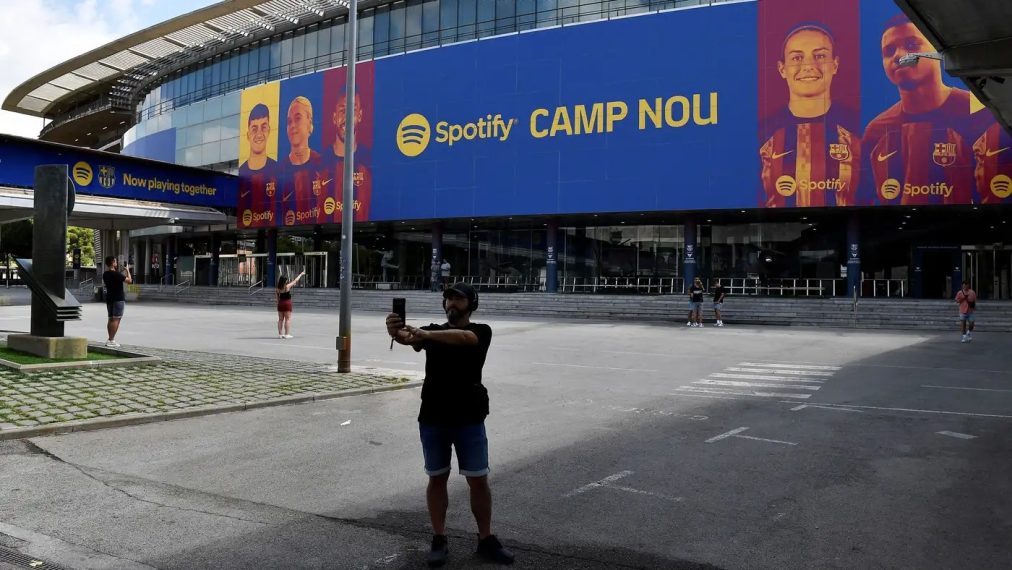
The redevelopment of Santiago Bernabeu and the renovation of Spotify Camp Nou are two of European football’s largest infrastructure projects, but their differences extend well beyond architecture and seating capacity.
An analysis by journalist and architect Cesar Augusto Londono has highlighted contrasting approaches to roof construction, energy generation, underground facilities and the future use of each stadium.
Londono examined the projects in a video posted on his X account, comparing their engineering systems, planned capacities and costs.
Spotify Camp Nou’s new roof is based on a lightweight cable network that transfers the load to the outer edge of the stadium, with spans reaching 90 metres. The design combines a light membrane at the front with a stronger rear structure capable of supporting solar panels.
The project includes photovoltaic panels covering 18,000 square metres. According to Londono, the roof is intended to protect spectators while leaving the pitch exposed. Its purpose is therefore not to enclose the entire playing surface, but to shelter the stands and use the structure to generate renewable energy.
Santiago Bernabeu, by contrast, has a retractable roof capable of covering the whole pitch. Its main structure rests on two enormous triangular supports, each measuring 176 metres. The opening and closing system uses additional 72.5-metre supports that move along rails, extending inflatable membranes across the stadium.
Capacity and stadium use
Londono’s comparison, reported by Sport, puts the proposed capacity of the Barcelona stadium at about 105,000 spectators, compared with almost 80,000 at Real Madrid’s ground.
However, he noted that a larger capacity brings extra demands, including more entrances, evacuation routes, toilets and internal circulation space. The number of seats alone does not determine how many people a stadium can safely accommodate; the supporting facilities and systems needed to manage the flow of supporters are equally important.
One of the clearest differences lies in how the stadiums can be used beyond football. Real Madrid’s ground contains an advanced underground system known as the “hypogeum”, which divides the pitch into six movable sections. These can be transported and stored beneath the stadium in an underground facility resembling a greenhouse.
That system allows the central area to be cleared for concerts and other events, rather than limiting the stadium’s use to football matches.
Barcelona’s redevelopment has forced the team to play temporarily at Estadi Olimpic Lluis Companys, also known as Montjuic. The club’s plan involves reopening Spotify Camp Nou in stages while construction work continues.
Different financial measures
Londono also compared the financial figures, while warning that they should not be treated as directly equivalent.
The Santiago Bernabeu redevelopment began with an initial budget of 525 million euros. By June 2026, Real Madrid had announced that cumulative investment in the project had reached 1.4077 billion euros.
The initial contract for Spotify Camp Nou was worth about 960 million euros. In September 2026, a further 510 million euros in financing was approved to complete the work and address the consequences of delays.
Londono stressed that an initial contract, cumulative investment and additional loan are different financial concepts, and combining them as though they were comparable could produce misleading conclusions.
His assessment gave Spotify Camp Nou a clear advantage in capacity and solar-energy integration. Santiago Bernabeu, however, currently offers greater flexibility because of its retractable roof and underground pitch-storage system.
-
 Rayan Ait-Nouri faces uncertain Manchester City future amid January transfer interest Nov 10, 2026
-
Achraf Hakimi makes history as first African to earn three FIFPRO World 11 selections Nov 10, 2026
-
Senegal call up Arouna Sangante after Krepin Diatta injury Nov 10, 2026
-
Brentford reject January exit for sought-after Senegal defender Malick Diouf Nov 10, 2026




-
AFCON 2025: Fixtures, Results, Scores and Standings Jan 18, 2026
-
Match hero Taiwo Awoniyi reflects on team effort after Chelsea triumph May 5, 2026
-
Leadership and long-term vision key to rescuing Zamalek and inspiring Egyptian football – Hany Abou Rida Nov 5, 2025
-
South African giants Orlando Pirates set to lose influential forward Monnapule Saleng Mar 19, 2025




-
Manchester United host Aston Villa as both sides seek a Premier League lift Nov 6, 2026
-
Real Sociedad and Lyon name probable line-ups for Europa League meeting Nov 3, 2026
-
Atletico Madrid host Barcelona in Liga summit clash with history at stake Nov 6, 2026
-
Nottingham Forest v Manchester City: City Ground hosts clash at opposite ends of the table Nov 6, 2026