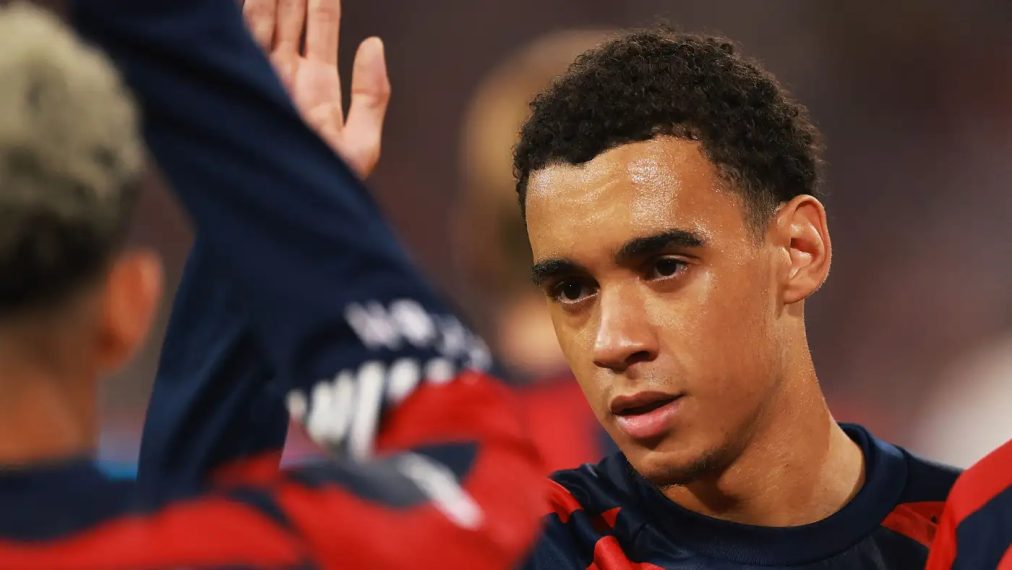
Comments by Bayern Munich honorary president Uli Hoeness about Jamal Musiala’s health have caused dissatisfaction within the club as the Germany international continues his recovery from injury.
Hoeness attracted particular attention on Sunday after questioning whether Musiala would be able to return to his best form, referring to the player’s neurological diagnosis and repeated injury problems.
Speaking on BR, Hoeness said: “Imagine if Bayern Munich now decided to question his contract and said to him: what you can currently offer no longer corresponds to what was agreed in the contract.”
According to German publication TZ, there is a feeling within Bayern that the concerns raised by the 74-year-old are understandable in substance, but that the way he expressed them was unnecessary.
The main source of anger is understood to be Hoeness highlighting Musiala’s neurological condition again, despite the fact it is not connected to his current absence. The 23-year-old is recovering from a muscle tear.
Musiala lost consciousness twice earlier in the season, but has not experienced another episode in the past two months after his medication dosage was adjusted. His condition is therefore considered to be largely under control.
The Germany international remains the player most capable of changing the course of a match for Bayern manager Vincent Kompany, who has consistently offered him public support and encouragement.
If Hoeness was also attempting to motivate Musiala, his approach was markedly different from Kompany’s, according to TZ.
Matthaus offers a different view
Bayern Munich great Lothar Matthaus said he believed there must be more behind Musiala’s extended absence.
“Something must have happened,” Matthaus said. “It is not possible for a player to be out for seven weeks because of a muscle tear. Perhaps there was a second tear, or perhaps the injury was more serious. Bayern Munich know this well: Musiala already suffered a setback in his rehabilitation programme. He felt pain again during one training session and, as a result, the workload was reduced immediately.”
Matthaus also offered a more sympathetic interpretation of Hoeness’ remarks.
“Perhaps he wanted to motivate Musiala a little, to push him to give his best in the coming weeks and months and return strongly,” he said. “If I were Jamal Musiala, that would be enough motivation to show Uli: I am back. Then Uli would be the happiest of all, because Jamal would return as a valuable addition to the team.”
-
 Rayan Ait-Nouri faces uncertain Manchester City future amid January transfer interest Nov 10, 2026
-
Achraf Hakimi makes history as first African to earn three FIFPRO World 11 selections Nov 10, 2026
-
Senegal call up Arouna Sangante after Krepin Diatta injury Nov 10, 2026
-
Brentford reject January exit for sought-after Senegal defender Malick Diouf Nov 10, 2026




-
AFCON 2025: Fixtures, Results, Scores and Standings Jan 18, 2026
-
Match hero Taiwo Awoniyi reflects on team effort after Chelsea triumph May 5, 2026
-
Leadership and long-term vision key to rescuing Zamalek and inspiring Egyptian football – Hany Abou Rida Nov 5, 2025
-
South African giants Orlando Pirates set to lose influential forward Monnapule Saleng Mar 19, 2025




-
Manchester United host Aston Villa as both sides seek a Premier League lift Nov 6, 2026
-
Real Sociedad and Lyon name probable line-ups for Europa League meeting Nov 3, 2026
-
Atletico Madrid host Barcelona in Liga summit clash with history at stake Nov 6, 2026
-
Nottingham Forest v Manchester City: City Ground hosts clash at opposite ends of the table Nov 6, 2026