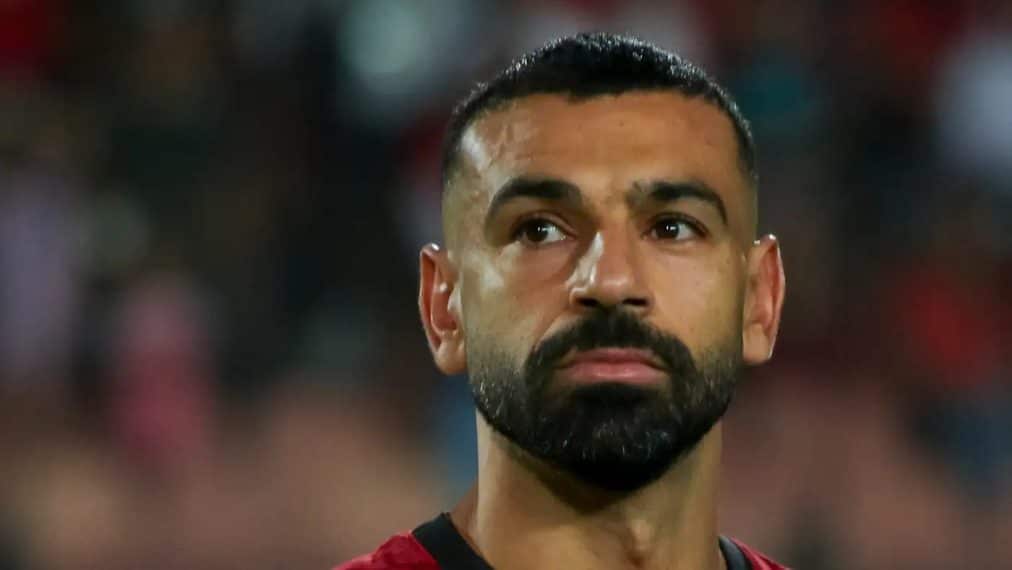
Mohamed Salah’s outstanding career in European football should not place him beyond criticism or automatically make him a national role model, according to an impassioned assessment of the Egypt forward.
Salah has earned widespread respect for his achievements at Liverpool and on the European stage. However, the article argues that a clear distinction must be drawn between being a world-class player, a national sporting icon and a role model.
It claims that criticism of Salah is often treated as unacceptable, with supporters and commentators routinely searching for explanations to defend his actions. In doing so, it says, some have created an idealised image of a player who is treated as though he cannot make mistakes or be questioned.
One example cited is the 2019 Africa Cup of Nations, when Salah supported Amr Warda during the midfielder’s controversial disciplinary crisis. The article argues that a player with Salah’s influence should have taken a clearer position, and says the episode raised questions about what it means to present him as a role model.
It also refers to periods when Salah was absent from or distanced himself from the Egypt squad, which led to questions from supporters. On each occasion, the writer says, some people volunteered explanations for him, creating the impression that representing the national team was an obligation for everyone except its biggest star.
Salah’s response to the war in Gaza is also criticised. Many people, the article says, expected a statement or gesture from one of the Arab world’s most influential public figures. Instead, they regarded his silence as disappointing and out of keeping with the scale of his fame.
The writer acknowledges that no-one can force Salah to adopt a particular political position, but argues that the public must retain the right to express disappointment about his decisions. The benefits of fame and influence, it says, bring scrutiny of a player’s conduct as well as his performances and goals.
Dispute with Egypt manager
The article also highlights Salah’s relationship with Hossam Hassan. It says the dispute began with a disagreement involving the former Egypt manager, followed by Salah leaving the squad before the match against South Sudan.
After Hassan was dismissed, Salah posted a photograph in which he appeared to be sticking out his tongue. The article argues that the image was provocative and asks whether that was appropriate behaviour for a player of Salah’s stature, regardless of the nature of his disagreement with the manager.
The central question, however, is what Salah has achieved with Egypt to justify the scale of the mythology surrounding him. He played a role in qualification for the 2018 World Cup and contributed to reaching the 2026 edition, but the writer rejects the idea that qualification can be credited to one player.
Salah did not play the qualifying campaigns alone, the article argues, and his team-mates were not merely supporting characters in an individual story. It also questions whether he was Egypt’s most influential player at the latest World Cup, noting that others performed strongly and deserved recognition.
His status at Liverpool and global commercial profile, the writer says, cannot give him credit for achievements that belong to the team. Egypt, it concludes, is bigger than any individual player, whatever his reputation, market value or goalscoring record.
The article does not deny that Salah is among the greatest Egyptian footballers. It argues instead that European success should not shield him from criticism, insisting that a legend is defined by conduct as well as statistics, while a role model carries responsibility beyond fame.
-
 Why has Algeria called up Abderrahmane Rebbach despite his lack of goals and assists? Nov 9, 2026
-
Oumar Solet offers Herve Renard a new defensive option for Cote d’Ivoire Nov 9, 2026
-
Salah, Jackson and African Ballon d’Or nominee Gueye named in weekend XI Nov 9, 2026
-
Luca Zidane overlooked again as Algeria turn to Rayane Yesli Nov 9, 2026



-
AFCON 2025: Fixtures, Results, Scores and Standings Jan 18, 2026
-
Match hero Taiwo Awoniyi reflects on team effort after Chelsea triumph May 5, 2026
-
Leadership and long-term vision key to rescuing Zamalek and inspiring Egyptian football – Hany Abou Rida Nov 5, 2025
-
South African giants Orlando Pirates set to lose influential forward Monnapule Saleng Mar 19, 2025




-
AEK Athens v Real Madrid: Champions League date, kick-off time and viewing details Nov 2, 2026
-
Manchester United host Aston Villa as both sides seek a Premier League lift Nov 6, 2026
-
Real Sociedad and Lyon name probable line-ups for Europa League meeting Nov 3, 2026
-
Atletico Madrid host Barcelona in Liga summit clash with history at stake Nov 6, 2026