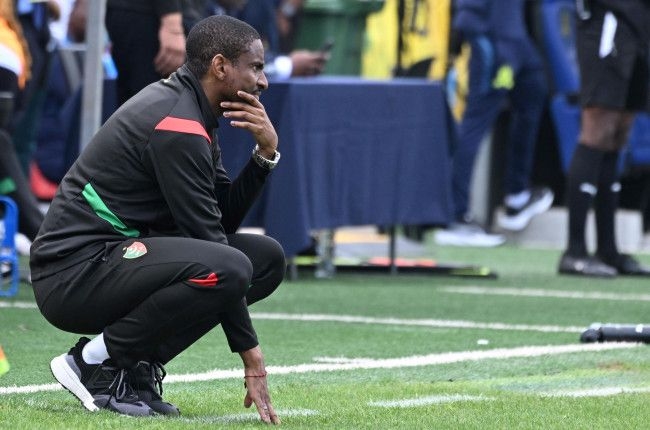
Rulani Mokwena has rejected the suggestion that moving between four North African clubs makes him a “journeyman”, saying his career has been shaped by a deliberate desire to test his football ideas in different leagues and cultures.
The Pyramids FC coach has moved from Wydad Athletic Club in Morocco to USM Alger in Algeria, then Al Ittihad Tripoli in Libya and finally Egypt’s Pyramids FC.
In an exclusive interview with the South African Football Journalists Association (SAFJA), the former Mamelodi Sundowns coach said each position had offered lessons that could not have been gained by remaining at one club.
“One of the things that I would really like to start a little bit before I take a sabbatical… I want to work in different leagues, I want to work with different players, I want to work with different cultures,” said Mokwena.
The 39-year-old said he wanted to learn from different people while challenging and refining his approach to the game.
“I want to improve my ideas about football and challenge my ideas on football and see whether or not there are some things that can work in different parts and different areas of the African, maybe even many other parts of the world,” he added.
Shorter coaching spells
Mokwena argued that frequent managerial changes are increasingly common across football and that traditional expectations of long-term club service no longer reflect the modern game.
“Contrary to what many people think and believe, the coaching and this is based on the latest researches and the coaching spend, the duration that coaches spend in football clubs now is getting shorter and shorter and shorter.”
He said coaches now spend an average of eight or nine months at a club.
“I think you’re averaging 8 months, nine months now that if you really take it into consideration.”
Mokwena acknowledged that stable working environments such as Mikel Arteta’s Arsenal and Luis Enrique’s Paris Saint-Germain can provide the platform for long-term success. However, he said such circumstances were unusual.
“You are only lucky as a coach if you get this type of environments where there’s a lot of stability, there’s a lot of proper foundations laid out for the coach to be able to look at the long-term and the successes of the football club in a long-term perspective.”
He believes his age and current stage of his career give him time to experiment across different clubs. Mokwena has been able to examine whether principles developed at Mamelodi Sundowns and Orlando Pirates can be transferred elsewhere or need to be adapted.
“But in my case, and maybe I am fortunate in that sense from an age perspective, where I do feel that from a coaching football age perspective, I have a little bit more years for these experiments.”
Experience across Africa
Mokwena said working in several countries had exposed him to leading African players with contrasting qualities, while allowing him to discard ideas that did not work.
“There’s not a lot of coaches who can say they have the years to accept going from club to club, challenging their ideas, crushing some of their ideas and throwing them away and formulating different ideas to develop so that they can win games,” he said.
“You don’t get this experience, you don’t get this exposure to some of the best talent, to some of the best players, if maybe you stay in one club. And I’m privileged that I was able to move from different clubs to work with different players who in their own right are some of the best players in Africa, but who possess different qualities.”
Mokwena added that the longer tenures currently enjoyed by Arteta, Luis Enrique, Pep Guardiola and Jurgen Klopp showed the value of stability, but were no longer the standard path for coaches.
-
 Rulani Mokwena: Frequent club changes reflect modern coaching Oct 9, 2026
 -
Egyptian football: Mohamed Hany open to Pyramids move as Zamalek receive derby warning Oct 9, 2026
-
Nigeria’s DR Congo protest dismissed over technicalities, source claims Oct 9, 2026
-
Senegal’s AFCON title appeal decision expected within days, CAS says Oct 9, 2026




-
AFCON 2025: Fixtures, Results, Scores and Standings Jan 18, 2026
-
Match hero Taiwo Awoniyi reflects on team effort after Chelsea triumph May 5, 2026
-
Leadership and long-term vision key to rescuing Zamalek and inspiring Egyptian football – Hany Abou Rida Nov 5, 2025
-
South African giants Orlando Pirates set to lose influential forward Monnapule Saleng Mar 19, 2025




-
Croatia face Spain with Nations League hopes on the line in Split Oct 5, 2026
-
France v Belgium: Probable line-ups for Nations League clash Oct 3, 2026
-
Morocco coach Mohamed Ouahbi refuses to single out player after Mali draw Oct 4, 2026
-
Noussair Mazraoui leaves Morocco squad early after injury Oct 2, 2026