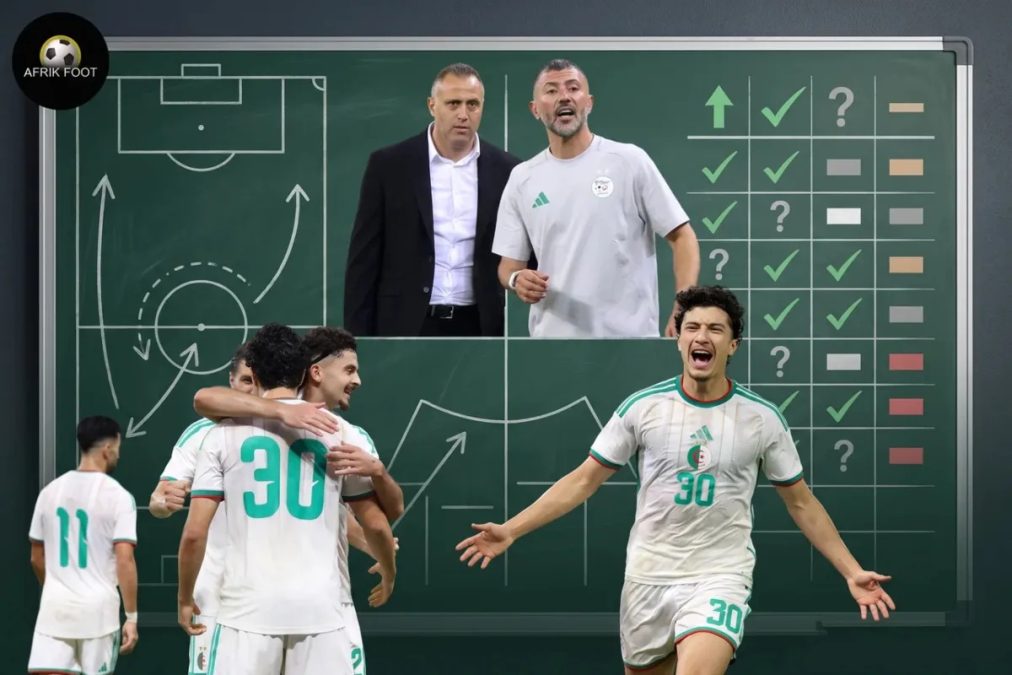
Brahim Hemdani’s first Algeria gathering produced two wins, one draw and a reshaped pecking order. Victories over Zambia and Niger were separated by a difficult 2-2 draw against Burundi, with several players strengthening their claims while others left the September-October camp facing fresh doubts.
Belloumi leads the way
Mohamed Bachir Belloumi was arguably the biggest winner. Making his first appearances for the senior side, the winger quickly showed that his qualities could translate to international football.
He impressed against Zambia, scored his first Algeria goal against Burundi and then transformed the match against Niger. Replacing Ibrahim Maza shortly before half-time, Belloumi equalised with an excellent direct free-kick before continuing to threaten. Two goals in three games have also created genuine competition with Anis Hadj Moussa on the right.
Maza also enhanced his reputation. His performance against Zambia was probably the outstanding individual display of the camp. He was constantly available, drove the team forward, broke lines, scored and played a direct part in the third goal.
Although he found conditions more difficult on the artificial surface in Bujumbura, Maza’s overall contribution confirmed his growing importance as Algeria’s principal technical leader. His third appearance ended after 40 minutes because of injury, but his status as a playmaker has clearly strengthened.
Achref Abada benefited from regular football. After making only a brief appearance in the final seconds against Zambia, he played the whole game in Burundi and 30 minutes against Niger. He was eliminated too easily on one occasion in Bujumbura, but his aggression, energy and generally clean play made a positive impression. With the defence still taking shape, he made significant progress.
Credit retained
Mohamed Amoura supplied two assists against Zambia and rediscovered his efficiency despite missing several chances. His introduction in Burundi and performance against Niger were less convincing, but his pace, work-rate and commitment continue to give him an advantage on the left.
Adil Boulbina remains behind him in the pecking order, although his camp was encouraging. He sometimes appeared cautious and attempted unnecessary touches, but he equalised with a free-kick against Burundi and won the penalty that secured victory over Niger. Greater confidence is still needed for him to impose himself consistently.
Anis Hadj Moussa was used sparingly but made an immediate impact after coming on against Zambia. His 19 minutes provide limited evidence, but his standing has not suffered.
Adem Zorgane enjoyed a solid return. He was not outstanding against Zambia, but his introduction in Burundi brought greater balance and accuracy to the midfield. Fares Chaibi was effective in the opening match before struggling badly in Bujumbura, yet his experience and ability to perform several midfield roles remain valuable.
Adil Aouchiche’s start against Niger was also promising. His performance was understated rather than spectacular, but he moved intelligently, used the ball well and regularly made himself available to teammates. He deserves another opportunity.
Defensive questions
Samir Chergui played only against Zambia, where his partnership with Ramy Bensebaini was broadly sound despite some difficulties. Ahmed Touba produced a serious performance against Niger.
Zineddine Belaid was made captain against the Mena but struggled more, including being directly involved in Niger’s opening goal. However, it was his only appearance and came in a new position on the right side of the central-defensive partnership, so it is too early to reach a firm verdict.
Ramy Bensebaini remains difficult to dislodge and now wears the captain’s armband, but his camp was far from flawless. He looked nervous in Burundi and was directly involved in the second goal conceded. Those lapses are more concerning given his new leadership role. His appearance against Niger was more controlled and included the penalty that decided the match.
Jaouen Hadjam scored against Zambia and remains dangerous when attacking from his flank, but he continues to leave too much space behind him. With Rayan Ait-Nouri removed from the squad, the opportunity to establish himself was there, but he did not fully take it.
Ilan Kebbal had been waiting for a genuine chance, but his 17 minutes in Burundi and subsequent start against Niger produced a largely neutral impression. The team’s circumstances did not help him and he merits another assessment.
Sohaib Nair was introduced against Niger at right-back, away from his natural position at centre-back. His average performance therefore offers little evidence from which to judge him.
Concerns at both ends
Amine Chiakha was the player most likely to leave the camp disappointed. Amine Gouiri’s early injury gave him a major opportunity: he played almost 70 minutes against Zambia, started in Burundi and featured during the final 30 minutes against Niger.
His movement and willingness were evident, but his attacking contribution remained extremely limited. He created few chances, made little difference and struggled to influence games even when Algeria dominated possession. His first start in Burundi had produced the same sense of an opportunity missed, and doubts over his ability to establish himself at this level have consequently increased.
Monsef Bakrar also failed to make the expected impact. Starting against Niger was meant to help him challenge for a place, but he was largely anonymous before being substituted. His profile differs from Chiakha’s, yet he too offered too little presence in the penalty area and provided too few options for his teammates.
Saadi Radouani had an opportunity at right-back but paid a heavy price for retreating during Fashion Sakala’s equaliser against Zambia. Four days later, the USM Alger defender again struggled against Burundi, particularly in duels and when opponents accelerated. His commitment was not in question, but his technical and tactical limitations were more exposed.
Himad Abdelli was expected to bring strength and aggression to midfield but again found it difficult to express himself for Algeria. He had little influence on the game, made poor decisions and did not protect the defence sufficiently. An ankle injury in Burundi offers some mitigation, but his display against Niger did not remove the concerns. The energetic impact of Adil Bouraba’s introduction was noticeable by comparison.
The goalkeeping hierarchy is also less clear. Melvin Mastil started the two official matches and was not solely responsible for the goals conceded, but he never looked entirely secure. Abderrahmane Ramdane, tested against Niger, did not take his chance either, with a handling error contributing immediately to the opening goal. Hemdani therefore ends the camp with more questions than answers in that position.
Amine Gouiri had no opportunity to defend his place after being injured 20 minutes into the match against Zambia and leaving the camp without playing again.
Adil Bouraba had only the final 29 minutes against Niger to make his senior debut. That was too short a period for a full assessment, but his energy, desire to win the ball and personality suggested there may be more to see. The Le Mans midfielder was called up after Nabil Bentaleb withdrew and at least opened the door to further involvement.
Killian Belazzoug did not play and cannot be assessed. Rayan Ait-Nouri was not used against Zambia and was then released from the camp by Brahim Hemdani after his outburst. His assessment on the pitch therefore never began.
-
 Belloumi and Maza emerge as major winners from Hemdani’s first Algeria camp Oct 7, 2026
 -
Ali Maamar faces battle to secure Morocco place after senior debut Oct 7, 2026
-
Barcelona lead Arsenal and Chelsea in race for Borussia Dortmund teenager Justin Ehikioya Ejodamen Oct 7, 2026
-
Fenerbahçe target Morocco star Brahim Díaz ahead of winter window Oct 7, 2026



-
AFCON 2025: Fixtures, Results, Scores and Standings Jan 18, 2026
-
Match hero Taiwo Awoniyi reflects on team effort after Chelsea triumph May 5, 2026
-
Leadership and long-term vision key to rescuing Zamalek and inspiring Egyptian football – Hany Abou Rida Nov 5, 2025
-
South African giants Orlando Pirates set to lose influential forward Monnapule Saleng Mar 19, 2025




-
Croatia face Spain with Nations League hopes on the line in Split Oct 5, 2026
-
France v Belgium: Probable line-ups for Nations League clash Oct 3, 2026
-
Morocco coach Mohamed Ouahbi refuses to single out player after Mali draw Oct 4, 2026
-
Noussair Mazraoui leaves Morocco squad early after injury Oct 2, 2026