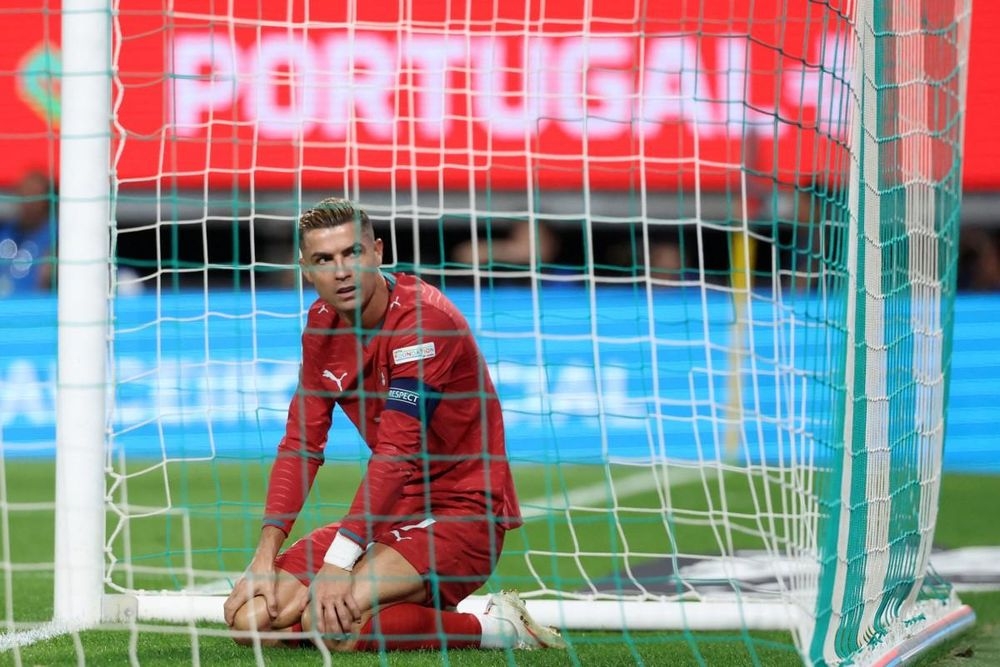
Cristiano Ronaldo’s early departure from Portugal’s training camp has raised fresh questions about whether he can accept a reduced role as his international career approaches its conclusion.
The 41-year-old left the squad in Copenhagen after head coach Jorge Jesus confirmed he would be on the bench for Thursday night’s match against Denmark. Ronaldo had reportedly been unhappy after remaining unused in Portugal’s 2-1 UEFA Nations League victory over Norway.
His decision came despite Pedro Proenca making an emergency landing in Denmark, and has been interpreted as another example of Ronaldo struggling to accept that his most influential years are behind him.
For much of his career, Ronaldo has been treated as a footballing figure of almost mythical status. His technical ability, goalscoring and achievements have attracted praise across the world. But his latest actions suggest a player increasingly unwilling to accept that international football must now move beyond him.
Football is a team sport, and there is no “I” in the team – even when that team contains one of the greatest players in the history of the game.
The timing of Ronaldo’s departure is also striking. His long-time rival Lionel Messi is preparing for what is scheduled to be his final Argentina appearance, against Benin on October 6 at the Estadio Monumental in Buenos Aires.
Messi is not being forced out by Argentina. Instead, he appears ready to recognise the moment when it is right to leave the stage and allow the next generation to take responsibility.
That may also reflect a sense of fulfilment. Messi will leave international football having won both the Ballon d’Or and the World Cup, trophies he pursued throughout his career. Ronaldo, by contrast, has five Ballon d’Or awards but has been surpassed by Messi, who won three more before moving to MLS.
Ronaldo has tried to win the World Cup with Portugal but never achieved that goal. Although he may argue that his career cannot be judged by one trophy with his country, equating European Championship success with winning the World Cup would be unrealistic.
He is, however, entitled to pursue personal ambitions. Ronaldo is 21 goals short of reaching 1,000 in his career, while last season he won the Saudi Pro League with Al Nassr under Jorge Jesus. There had been little doubt that the pair had discussed working together to move Portugal forward.
But Jesus and the national team have more immediate priorities, including winning trophies and adapting quickly to life without Ronaldo, whether or not he remains involved.
Ronaldo could have chosen to support the integration of Portugal’s emerging players, a role that might have earned him greater respect. Instead, his actions have made the situation about himself and risk slowing the progress of one of the most talented national teams in world football.
Jesus has been praised for holding his position, despite the pressure that could have followed from appearing to turn against Portugal’s greatest modern star. Ronaldo remains one of the game’s outstanding figures, but his belief that he must remain central to everything is increasingly appearing misplaced.
Messi is preparing to make his final bow in Buenos Aires on his own terms. Ronaldo, by contrast, now risks leaving the international stage through the back door.



-
 AFCON 2025: Fixtures, Results, Scores and Standings Jan 18, 2026
 -
Match hero Taiwo Awoniyi reflects on team effort after Chelsea triumph May 5, 2026
-
Leadership and long-term vision key to rescuing Zamalek and inspiring Egyptian football – Hany Abou Rida Nov 5, 2025
-
South African giants Orlando Pirates set to lose influential forward Monnapule Saleng Mar 19, 2025




-
AFCON 2027 Qualifiers: McCarthy warns South Africa to expect tough test against Eritrea Sep 29, 2026
-
AFCON 2027 qualifiers: Algeria, Morocco and Nigeria among winners on opening matchday Sep 26, 2026
-
Denmark v Portugal: Nations League kick-off time, TV channel and match prediction Sep 29, 2026
-
AFCON 2027 qualifiers: Burkina Faso held by Benin in Group F Sep 25, 2026