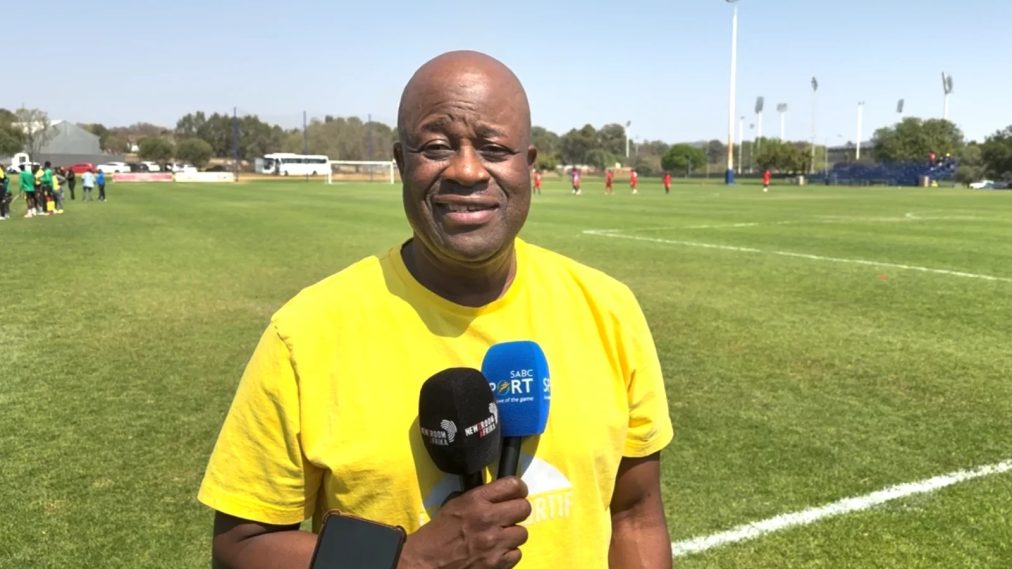
South Africa U23 coach Raymond Mdaka says the two international friendlies against Algeria will provide valuable preparation for a demanding period that includes U23 Africa Cup of Nations and Olympic qualifying matches.
South Africa will begin their U23 AFCON qualifying campaign next month against Madagascar, who advanced to the next stage after Comoros withdrew from the competition.
The Algeria matches will also help Mdaka assess his squad before another round of Olympic qualifiers that will follow the current qualifying programme.
“We really felt it’s a very good opportunity for us to have a friendly match before we could go for the official qualifying games,” Mdaka said.
“On the basis that normally when we would have loved to talk about proper progression we would be saying the group that played in the previous World Cup or AFCON or the previous group of the under 20 would be 80% or 90% of the players would be part of this team.
“But at the same time we need to understand the dynamics and what happens in between. We felt it’s a better opportunity for us to do justice to some of the players that were there who gave us good results but at the same time open a bit of an eye to look at those who were not there.
“Those that we feel can be able to close the gaps that are there. Going forward obviously we might have given somebody a chance who was in the AFCON but you find that there are those that can do much better than him, then we proceed with him for the sake of the national team.”
The first meeting with Algeria takes place at the Dr Petrus Molemela Stadium, with Mdaka facing a difficult selection decision after assembling a squad containing several high-profile players.
The coach, who guided Amajita to an African title at U20 level, accepts that choosing a balanced team from the available options will be one of the most demanding aspects of the camp.
“There’s people who always say it’s a very good headache but it’s one of the difficult challenges that we are facing because there’s no way you’ll have to do what we call squad composition and balance it,” he said.
“You’ll find that in one area you have more than four players but you cannot take the four players in one position on the basis that you balance the team.
“So, we go deep into profiling to say who can do best in that particular spot and in relation to who in terms of how we want to play. So it’s a very good but very bad, difficult challenge but I think it’s something that we’ll always try to work on and make sure that we get the best combination that can be able to give us good results.”
-
 Enppi defender Ahmed Kalousha explains failed Zamalek move Oct 1, 2026
 -
Algeria star Riyad Mahrez reportedly close to Al Shamal move after Al Ahli exit Oct 1, 2026
-
Moriri: Players should use flair to help their teams Oct 1, 2026
-
South Africa coach Pitso Mosimane celebrates Bafana Bafana’s perfect AFCON qualifiers start Oct 1, 2026
-
AFCON 2025: Fixtures, Results, Scores and Standings Jan 18, 2026
-
Match hero Taiwo Awoniyi reflects on team effort after Chelsea triumph May 5, 2026
-
Leadership and long-term vision key to rescuing Zamalek and inspiring Egyptian football – Hany Abou Rida Nov 5, 2025
-
South African giants Orlando Pirates set to lose influential forward Monnapule Saleng Mar 19, 2025




-
AFCON 2027 Qualifiers: McCarthy warns South Africa to expect tough test against Eritrea Sep 29, 2026
-
AFCON 2027 qualifiers: Algeria, Morocco and Nigeria among winners on opening matchday Sep 26, 2026
-
AFCON 2027 qualifiers: Burkina Faso held by Benin in Group F Sep 25, 2026
-
South Sudan vs Egypt: Where to watch AFCON 2027 qualifier Sep 29, 2026