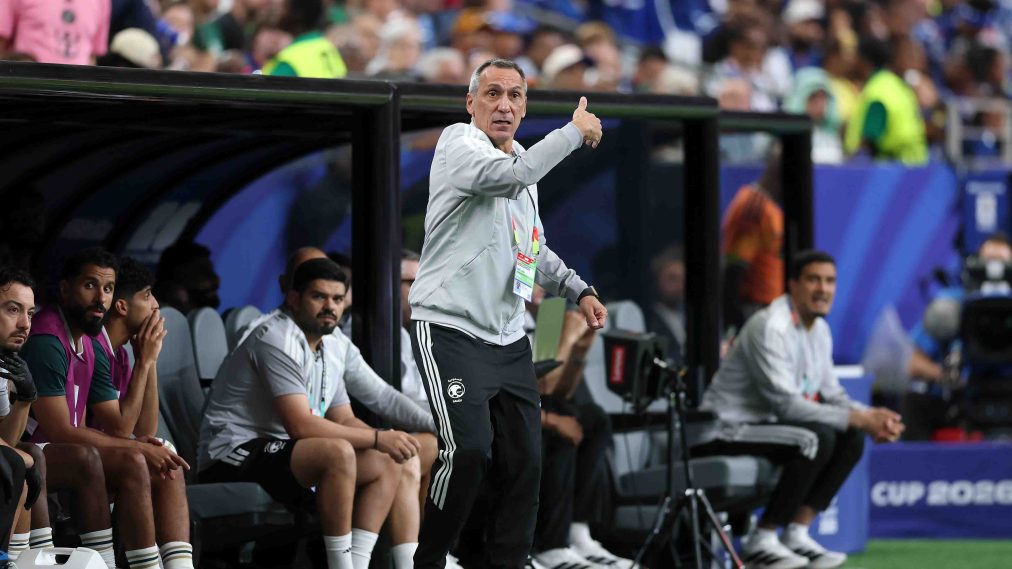
Saudi Arabia’s Gulf Cup semi-final against Qatar could determine far more than who reaches the final, with defeat likely to reignite questions over the future of manager Georgios Donis and the direction of the national team.
The match is being billed as a major Gulf football rivalry between two sides who know each other well. But for Saudi Arabia, the consequences extend beyond a place in the final. Victory would move the hosts closer to the title and ease some of the criticism surrounding the team, while elimination could bring the manager, players and administrators under renewed scrutiny.
Saudi Arabia are not treating the game as an ordinary knockout tie. An exit at this stage would give critics greater scope to question the team’s performances and overall direction, as well as whether the appointment of Donis was the right decision.
The Greek coach’s appointment was closely linked to the previous administration led by Yasser Al-Misehal. That connection means a defeat by Qatar could quickly prompt wider debate: has Donis built a side capable of competing, how much responsibility should the players accept, and should the current administration continue with the same project or seek another change?
Those questions would arrive quickly if Saudi Arabia’s campaign ended in the semi-finals. Supporters rarely allow much time after a failure, particularly when the team is expected to challenge for the trophy while playing at home in front of its own fans.
Donis facing a significant test
For Donis, the match represents one of the most sensitive challenges of his time in charge of Saudi Arabia. Reaching the final would not only keep the team’s title hopes alive but also help demonstrate that his appointment was more than a continuation of a decision made under the former administration.
He must show that Saudi Arabia have a clear identity and can handle the demands of a knockout match against a strong opponent. Any uncertainty in his decisions or decline in performance could provide fresh material for his critics.
Donis is therefore facing two opponents: Qatar on the pitch and the pressure to prove that his work with Saudi Arabia deserves to continue. Defeat would place many of his decisions under examination, whereas qualification would give him greater room to work without the same level of criticism.
Qatar, however, will not be defined by Saudi Arabia’s internal pressures. The team have their own motivation and know that victory would take them into the final and keep them in contention for the Gulf Cup.
Matches between Saudi Arabia and Qatar often carry a particular intensity, demanding concentration and the ability to cope with the crowd, pressure and small details. Neither side is likely to enjoy an easy evening in a semi-final where every ball matters and one mistake could change the course of the match.
Saudi Arabia appear to hold the advantage on paper, with their recent form and home support offering encouragement. A quick goal could turn the crowd’s backing into positive momentum, but a slow start or a period of Qatar dominance could make that support a burden.
The task for Donis and his players is to convert their theoretical advantage into control of the match. If they do so, they may secure their route to the final. If pressure affects their decisions, the hosts could face a difficult night, with defeat potentially placing the futures of Donis, the players and previous administrative decisions under question.
-
 Kaizer Chiefs move Stellenbosch fixture as CAF Confederation Cup schedule tightens Oct 1, 2026
 -
Guinea v Kenya: kick-off time, broadcast details and key Africa Cup of Nations qualifying storylines Oct 1, 2026
-
Morocco youngster Moncef Zekri returns to Sporting Lisbon training Oct 1, 2026
-
Lille dealt injury blow as Ethan Mbappé faces three-week lay-off Oct 1, 2026




-
AFCON 2025: Fixtures, Results, Scores and Standings Jan 18, 2026
-
Match hero Taiwo Awoniyi reflects on team effort after Chelsea triumph May 5, 2026
-
Leadership and long-term vision key to rescuing Zamalek and inspiring Egyptian football – Hany Abou Rida Nov 5, 2025
-
South African giants Orlando Pirates set to lose influential forward Monnapule Saleng Mar 19, 2025




-
AFCON 2027 Qualifiers: McCarthy warns South Africa to expect tough test against Eritrea Sep 29, 2026
-
AFCON 2027 qualifiers: Algeria, Morocco and Nigeria among winners on opening matchday Sep 26, 2026
-
AFCON 2027 qualifiers: Burkina Faso held by Benin in Group F Sep 25, 2026
-
South Sudan vs Egypt: Where to watch AFCON 2027 qualifier Sep 29, 2026