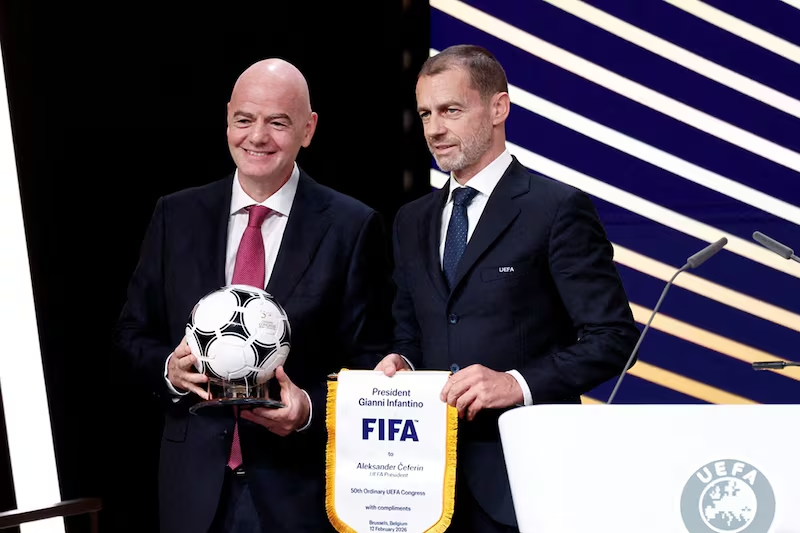
Uefa president Aleksander Ceferin has launched a fierce attack on Fifa president Gianni Infantino, saying “the emperor is naked” after Infantino’s plan to sell a stake in football’s commercial rights was abandoned.
Speaking at the European Football Clubs General Assembly in Copenhagen on Tuesday, Ceferin compared the episode to Hans Christian Andersen’s tale The Emperor’s New Clothes.
“Almost 200 years ago, he wrote The Emperor’s New Clothes,” Ceferin said.
“We all know the story. An emperor is persuaded that he is wearing magnificent clothes, clothes which he is told only the foolish or unfit cannot see.
“His court goes along with it until a child simply says aloud what everybody can see. The emperor is naked.”
Fifa were approached for comment.
Infantino’s proposed FIFA Forward Enterprise would have established a Fifa-controlled commercial subsidiary. The company would have held the rights to competitions including the men’s and women’s World Cups and Club World Cup.
Private investors would have been permitted to acquire up to 20% of the entity.
Infantino presented the initiative as a way of raising additional funds for football development. He also said the proposal would be subject to a democratic consultation involving Fifa’s 211 member associations.
The plan was abandoned after widespread opposition, with Ceferin challenging the terms used to defend it.
“Perhaps the moral of the story is convenient words cannot change uncomfortable realities,” he said.
“Now world football has heard some very convenient words recently. Development, democratization, consultation, words used in fact to describe the opposite.
“Selling part of football’s future does not become development because you say it’s development.
“Putting a fait accompli in front of national associations does not mean democratisation, even if you call it democratisation. However big the check is.
“And secrecy does not become consultation because you call it consultation.”
Ceferin then asked club executives to consider how they would respond if a senior official secretly negotiated away control of their “crown jewels” without informing the board, players or supporters.
He described a situation in which the deal was almost complete by the time those groups became aware of it, and asked: “What would your board do?”
The Uefa president also outlined a separate hypothetical example, involving the same official creating an award for a politician. Soon afterwards, the politician makes a phone call and “the rules are not the same anymore.”
“How many times would this have to happen at your clubs before the world says ‘enough’?” Ceferin said.
“Well, my friends, I think it’s time to say enough.”
He concluded by accusing unnamed decision-makers of changing rules when they became inconvenient, shutting out people who were meant to have a say and treating football’s future as “just another bargaining chip”.
-
 ‘Encouraging Victor Osimhen in his prime to just go for money is foolishness’ – Peter Odemwingie blasts Ighalo Sep 30, 2026
 -
AFCON 2027 qualifiers: Pitso Mosimane warns Bafana Bafana about Ali Sulieman threat ahead of Eritrea clash Sep 30, 2026
-
Former Nigeria star Osinachi Ohale leaves Pachuca after three seasons Sep 30, 2026
-
Trabzonspor plot permanent move for Manchester United goalkeeper Andre Onana Sep 30, 2026



-
AFCON 2025: Fixtures, Results, Scores and Standings Jan 18, 2026
-
Leadership and long-term vision key to rescuing Zamalek and inspiring Egyptian football – Hany Abou Rida Nov 5, 2025
-
Match hero Taiwo Awoniyi reflects on team effort after Chelsea triumph May 5, 2026
-
South African giants Orlando Pirates set to lose influential forward Monnapule Saleng Mar 19, 2025




-
AFCON 2027 Qualifiers: McCarthy warns South Africa to expect tough test against Eritrea Sep 29, 2026
-
AFCON 2027 qualifiers: Algeria, Morocco and Nigeria among winners on opening matchday Sep 26, 2026
-
AFCON 2027 qualifiers: Burkina Faso held by Benin in Group F Sep 25, 2026
-
South Sudan vs Egypt: Where to watch AFCON 2027 qualifier Sep 29, 2026