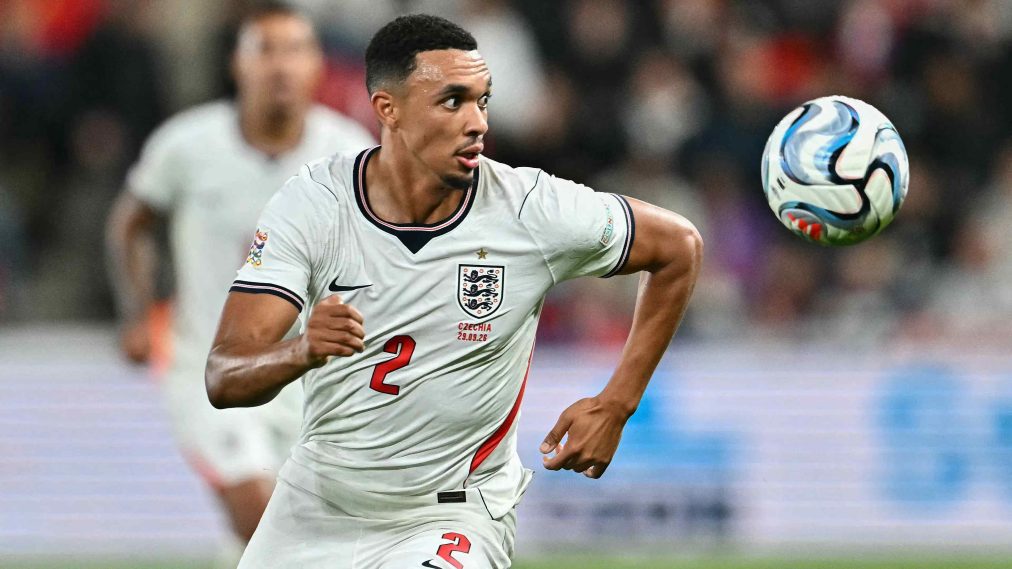
England’s Nations League campaign began with a 2-0 victory and a clean sheet as Thomas Tuchel found a way to bring Trent Alexander-Arnold’s qualities to the fore against the Czech Republic.
The hosts played for more than an hour with 10 men, providing Tuchel with a useful test as he continued to shape his side. Alexander-Arnold made his first start under the German manager, having appeared to become the obvious choice for a match in which England were expected to dominate possession.
That prediction proved correct, with the Czech Republic sitting deep and England pushing both full-backs high and wide. The approach sometimes left the wide areas too congested for Bukayo Saka and Anthony Gordon to operate effectively on the right.
England posed a far greater threat from the left in the first half, where Lewis Hall and Gordon developed an understanding that Saka and Alexander-Arnold did not replicate on the opposite flank.
“We never doubted his ability to produce this type of decisive pass,” Tuchel said of Alexander-Arnold. “Playing from a deeper position in the second half suited him better than pushing forward in the first half.”
Tuchel added: “Overall, I think we gave a good and professional performance. Of course, the red card, as always, has a major impact on the game, and an early red card can sometimes make the task more complicated psychologically.”
Tactical change gives Alexander-Arnold freedom
Tuchel introduced Eberechi Eze for Myles Lewis-Skelly at half-time, switching England to a 4-1-4-1 formation with Eze and Morgan Rogers operating as two number 10s behind Harry Kane.
Elliot Anderson became the team’s sole holding midfielder. The immediate benefit was the space created for Alexander-Arnold to move inside alongside Saka, giving him access to more dangerous areas.
He exploited that opening to deliver an excellent cross towards the far post, where Gordon attacked the ball and headed England in front. Gordon deserved full credit for the finish, having made the decisive run to meet the delivery.
The tactical adjustment also created ideal conditions for Alexander-Arnold. With the Czech Republic a player down, he was largely freed from defensive duties and given greater licence to influence the game.
He responded by helping England take control and by assuming a senior role when teenage forward Rio Ngumoha came on in the 71st minute.
Gordon was among England’s best performers, particularly in the opening period, and his partnership with Hall was one of the most effective features of the team’s display. His goal reflected the confidence he appears to have gained since his move to Barcelona, with his movement and composure in front of goal both evident.
Tuchel resisted the temptation to introduce Jude Bellingham in search of a goal. Instead, he turned to Eze’s creativity and ability to produce unexpected solutions, while encouraging England to circulate the ball at greater speed.
That sharper movement disrupted the Czech defensive shape. After Gordon’s goal, the hosts began attacking sporadically and the match opened up again.
England doubled their advantage before Bellingham entered the game, replacing Kane shortly after the captain had scored his 87th international goal.
“Kane proved he does not need to produce a brilliant performance to influence a game,” the Daily Mail analysis concluded, “which is a sign of his ability as a great striker and goalscorer.”
-
 Fabrice Shema resigns as president of Rwanda Football Federation Sep 30, 2026
 -
Morocco seek alternative opponents as Ghana friendly faces uncertainty Sep 30, 2026
-
US Concarneau send Matheo Ntumi to Dinan Lehon FC on season-long loan Sep 30, 2026
-
Rodolfo Aloka double earns Benin victory over Mauritania in AFCON 2027 qualifying Sep 30, 2026




-
AFCON 2025: Fixtures, Results, Scores and Standings Jan 18, 2026
-
Leadership and long-term vision key to rescuing Zamalek and inspiring Egyptian football – Hany Abou Rida Nov 5, 2025
-
Match hero Taiwo Awoniyi reflects on team effort after Chelsea triumph May 5, 2026
-
South African giants Orlando Pirates set to lose influential forward Monnapule Saleng Mar 19, 2025




-
AFCON 2027 Qualifiers: McCarthy warns South Africa to expect tough test against Eritrea Sep 29, 2026
-
AFCON 2027 qualifiers: Algeria, Morocco and Nigeria among winners on opening matchday Sep 26, 2026
-
AFCON 2027 qualifiers: Burkina Faso held by Benin in Group F Sep 25, 2026
-
South Sudan vs Egypt: Where to watch AFCON 2027 qualifier Sep 29, 2026