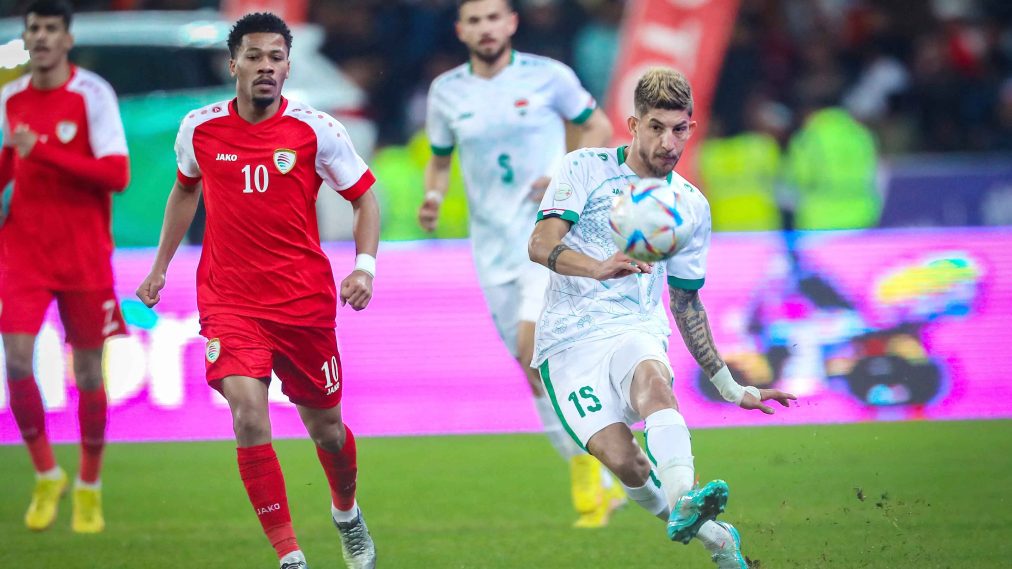
Oman qualified for the semi-finals of the Arabian Gulf Cup “Gulf 27” after winning a draw against Iraq, despite FIFA regulations favouring the higher-ranked team when sides are level in every group-stage criterion.
The unusual outcome came after Iraq and Oman finished Group A with identical records. Both teams collected four points, drew their opening match 1-1, scored four goals and conceded five. They also received eight yellow cards each, with neither team shown a red card.
The Gulf Cup Football Federation held the deciding draw at a hotel in Jeddah to determine which side would join group winners Saudi Arabia in the last four. Oman were selected, becoming the second team from Group A to reach the semi-finals.
The decision prompted controversy, with Iraq manager Graham Arnold arguing that his side should have progressed directly under FIFA’s regulations. Iraq were ranked higher than Oman in the international rankings and would therefore have benefited from the system introduced by FIFA.
The issue dates back to the 2025 Arab Cup in Qatar, when FIFA changed the criteria used to separate teams level on points, goals scored, goals conceded and fair-play records. The previous final criterion had been a draw, but that provision was removed. Instead, the team with the higher position in FIFA’s monthly world rankings would advance.
Iraq are ranked 63rd in the world and eighth in Asia. Oman are 80th globally and 11th in Asia.
Although the revised system was applied at the 2026 World Cup in the United States, Canada and Mexico, the Gulf Cup Football Federation did not adopt the change. It retained the provision allowing a draw to decide the final qualifying place when teams remained level in all other categories.
The deadlock was confirmed after the final Group A matches were played simultaneously.
Saudi Arabia secured a 2-0 victory over Iraq at Alinma Stadium in Jeddah, a result that left them top of the group with a perfect nine points.
At the same time, Oman produced a late comeback against Kuwait. They overturned a 1-0 deficit to win 3-1, scoring the goals that secured the victory in the closing stages.
That result left Oman and Iraq level across every measure used in the group standings. Under the Gulf Cup regulations, the draw was then held, with Oman emerging as Saudi Arabia’s semi-final opponents.
The outcome has raised questions over whether the competition’s regulations should have followed FIFA’s updated procedure, which would have sent Iraq through on the basis of their superior world ranking.
-
 AFCON 2027 Qualifiers: Congo and Cameroon share spoils Sep 29, 2026
 -
AFCON 2027 qualifiers: Gabon beat Niger to claim first three points Sep 29, 2026
-
AFCON 2027 qualifiers: Ivory Coast score two late goals to overcome Somalia Sep 29, 2026
-
Cote d’Ivoire leave it late to beat Somalia in Africa Cup of Nations qualifying Sep 29, 2026




-
AFCON 2025: Fixtures, Results, Scores and Standings Jan 18, 2026
-
Leadership and long-term vision key to rescuing Zamalek and inspiring Egyptian football – Hany Abou Rida Nov 5, 2025
-
Match hero Taiwo Awoniyi reflects on team effort after Chelsea triumph May 5, 2026
-
South African giants Orlando Pirates set to lose influential forward Monnapule Saleng Mar 19, 2025




-
AFCON 2027 qualifiers: Algeria, Morocco and Nigeria among winners on opening matchday Sep 26, 2026
-
South Sudan vs Egypt: Where to watch AFCON 2027 qualifier Sep 29, 2026
-
AFCON 2027 qualifiers: Burkina Faso held by Benin in Group F Sep 25, 2026
-
AFCON 2027 Qualifiers: McCarthy warns South Africa to expect tough test against Eritrea Sep 29, 2026