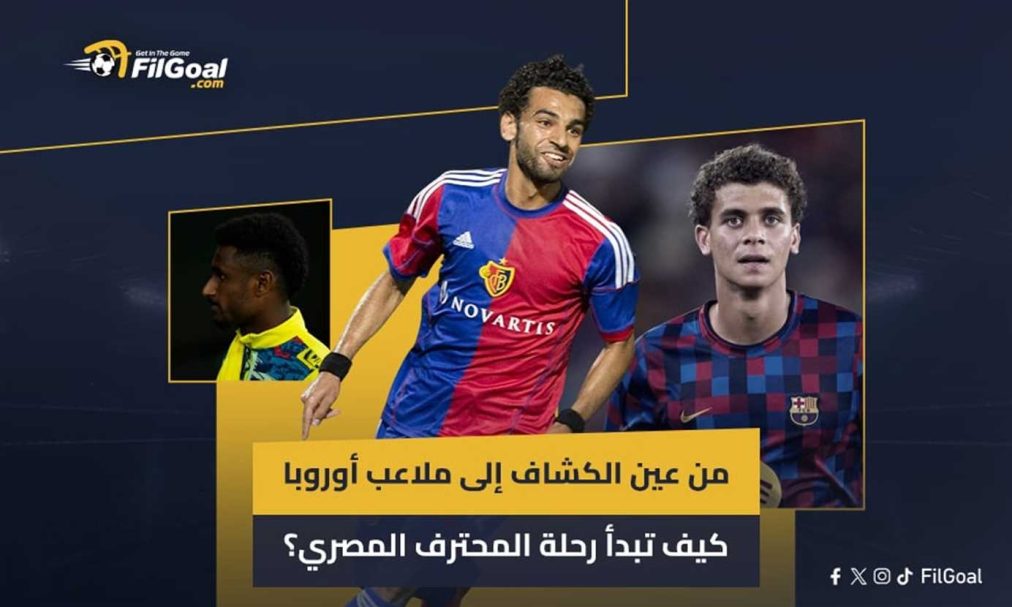
For more than a century, Egyptian players have pursued careers abroad, beginning with Hussein Hegazi and continuing through Ahmed Hossam Mido, Hossam Ghaly, Mohamed Salah, Omar Marmoush, Haissem Hassan and Hamza Abdelkarim.
The question has changed from whether an Egyptian can succeed in Europe to which player will become the next to attract attention from major clubs. Behind every move is a longer process involving a scout, a club willing to take a chance and a player prepared to start again far from home.
Amr Zaki’s impressive spell at Wigan Athletic, when he briefly topped the Premier League scoring charts, revived interest in Egyptian players. Mohamed Salah’s unexpected move to Basel then gave a new generation an example to follow.
But Salah’s route to Switzerland began before his transfer. Ruedi Zbinden, still a scout at Basel and the man involved in completing the deal, told FilGoal.com that a Barcelona scout first watched Salah during the 2011 FIFA U-20 World Cup in Colombia.
“When the Egyptian league stopped for around six months in 2012 after tragic events at a stadium, an agent in Cairo contacted an agent in Germany and asked whether he would be interested in inviting one or two players for a trial in the Swiss league,” Zbinden said.
“The German agent then contacted Basel to ask whether we were interested in signing Egyptian players. We already knew Salah from the World Cup, so we agreed immediately. He came to Switzerland and needed only a few days to convince us completely of his ability. The deal was then completed quickly and smoothly.”
Salah was not the only Egyptian to attract Basel’s attention. “We invited Mohamed Elneny to join our training camp in Marbella for a trial, but he impressed us straight away in his first friendly in Spain,” Zbinden added.
“With Salah and Elneny, we reached the semi-finals of the Europa League, which was an exceptional achievement for Swiss football. We later tried to sign other Egyptian players. They were good, but they did not reach the same level as the first two.”
Salah made 79 appearances for Basel, scoring 20 goals and providing 14 assists. He also won the Swiss league twice.
What European scouts look for
Spanish talent scout David Pelaez said clubs initially look for a player who stands out among others of the same age and within the competitive environment in which he plays.
“But talent alone is not enough,” he told FilGoal.com. “We need to understand the player’s daily life, family and social environment, habits and mentality, and whether he already behaves like a professional footballer.”
Pelaez said a player’s background helps clubs assess whether he can cope with moving to Europe at a young age. Social and economic circumstances are considered not to judge the player, but to understand the conditions in which he developed and how he may respond to major change.
He added that football’s global reach and modern scouting and analysis tools allow clubs to identify talent almost anywhere. However, moving to Europe requires adaptation to a different style of football, as well as a new country, culture, language and lifestyle.
Nutrition, rest, physical and mental care and everything a player does away from training all affect performance, Pelaez said. Talent alone does not guarantee success; the real challenge is turning it into consistent performances while maintaining professional habits throughout a career.
European clubs are now more open to discovering and signing young players from Arab football and are increasingly prepared to give them opportunities early. Mohamed Salah is the clearest example, although Mido, Ramadan Sobhi and others have also reached Europe.
“Hamza Abdelkarim’s move to Barcelona has renewed interest in the young Arab player,” Pelaez said. “A young player at a club such as Barcelona is a major gateway and confirms that Egyptian and Arab football contains much talent worthy of attention.”
Michael Reschke, the former European football chief at Stellar, an agency that previously represented Omar Marmoush, said the decisive factors were “sporting and mental: talent and mentality”.
He added that belief in a young player could grow quickly if they excelled for their country or at a FIFA U-17 or FIFA U-20 World Cup.
European clubs have monitored Egyptian players for many years, Reschke said, but Salah and Marmoush have given Egypt greater prominence among clubs and agencies. Players were being watched 20 years ago, he added, but world-class figures such as Salah and Marmoush naturally increase attention on the country.
The journey to Europe therefore starts long before a contract is signed, with years of scouting, assessment and preparation for life in a new environment.
-
 AFCON 2027 qualifiers: Senegal face Ethiopia as Zambia meet Togo in second round Sep 26, 2026
 -
AFCON 2027 qualifying: Algeria, Morocco and Cote d’Ivoire among opening-day winners Sep 26, 2026
-
AFCON 2027 qualifiers: Algeria, Morocco and Nigeria among winners on opening matchday Sep 26, 2026
-
Kenya held by Eritrea in opening 2027 Africa Cup of Nations qualifier Sep 26, 2026




-
AFCON 2025: Fixtures, Results, Scores and Standings Jan 18, 2026
-
Leadership and long-term vision key to rescuing Zamalek and inspiring Egyptian football – Hany Abou Rida Nov 5, 2025
-
Match hero Taiwo Awoniyi reflects on team effort after Chelsea triumph May 5, 2026
-
South African giants Orlando Pirates set to lose influential forward Monnapule Saleng Mar 19, 2025




-
AFCON 2027 Qualifiers: Matchday 1 & 2 fixtures, kick-off times and venues confirmed Sep 22, 2026
-
Sierra Leone step up AFCON 2027 preparations ahead of Zimbabwe opener Sep 22, 2026
-
Mohammed Kudus withdraws from Ghana squad ahead of AFCON qualifiers Sep 20, 2026
-
Nigeria lose Victor Osimhen for Madagascar, Guinea-Bissau AFCON 2027 qualifiers Sep 20, 2026