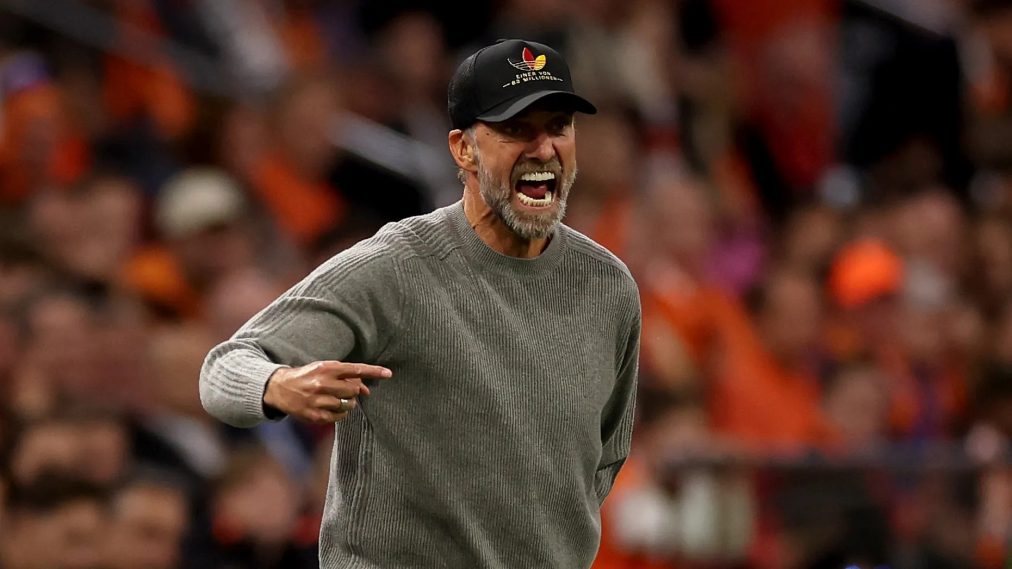
Jurgen Klopp’s first match in charge of Germany ended in a 1-1 draw with the Netherlands, but the performance offered little evidence that the new manager can quickly revive a national team in serious decline.
Klopp was expected to bring the influence that marked his successful spells with Borussia Dortmund and Liverpool. Instead, Germany produced an unconvincing display that reflected the difficulties seen repeatedly over the past decade.
It is too early to judge Klopp’s tenure after only one match, but the performance reinforced concerns that German football is facing a deep and historically unusual problem in producing elite young players.
Klopp did not simply rely on the same players selected by previous managers. He introduced changes and gave opportunities to new faces in an attempt to find different solutions. Germany, however, remained vulnerable at both ends of the pitch.
The midfield was particularly exposed. Joshua Kimmich returned to the centre after playing at right-back under former manager Julian Nagelsmann, but he was unable to impose control alongside Lukas Nmecha and Nadiem Amiri.
The Netherlands repeatedly attacked through the middle, eventually finding an equaliser and coming close to winning the game. Germany were indebted to goalkeeper Marc-Andre ter Stegen, who made nine saves from the hosts’ attempts.
The substitutes did little to change the pattern of the match. Experienced forward Serge Gnabry was instead involved in the Netherlands’ goal, losing possession with an inaccurate pass which Ruben van Bommel intercepted before setting up Cody Gakpo.
Germany’s academy problem
The disappointing start has renewed attention on the shortage of top-level talent emerging from Germany’s youth system. While France, England and Spain continue to produce highly rated players from one generation to the next, German academies have appeared increasingly unproductive in recent years.
Jamal Musiala and Florian Wirtz are regarded as the future of the national team, but neither has yet delivered consistently at the level expected. Musiala’s development has also been affected by a succession of injuries.
Figures suggest German clubs are increasingly choosing established foreign players rather than giving academy graduates regular first-team opportunities. In the French league, players aged 21 or under account for about 17% of total playing minutes, the highest proportion among Europe’s major leagues.
The Bundesliga reached a similar figure in 2017-18, when players under the age of 22 played 17.2% of the league’s minutes. That share fell to only 9.6% in 2024-25, the lowest figure recorded across the past 17 seasons.
Marc Lenz, chief executive of the German Football League, described Germany’s youth development system as “good and with room for improvement”. He also noted that only nine German clubs appear among Europe’s top 100 academies, while the number of young talents in the Bundesliga is “clearly lower” than abroad.
The evidence suggests Germany’s problems cannot be attributed to one manager. Without fundamental changes to the way young players are developed, the national team’s difficult period is likely to continue, leaving Klopp or anyone else with the task of reviving a side that currently appears close to lifeless.
-
 AFCON 2027 qualifiers: Moin Chaabani fails major Tunisia test after Uganda draw Sep 26, 2026
 -
Mbappe, Musiala, Brobbey and Semenyo among injury casualties as international break bites Sep 26, 2026
-
AFCON 2027 qualifiers: Herve Renard starts second Ivory Coast spell with victory Sep 26, 2026
-
2026 World Cup: ‘Perhaps I regret not being more involved’ – Mauricio Pochettino on Folarin Balogun saga Sep 26, 2026



-
AFCON 2025: Fixtures, Results, Scores and Standings Jan 18, 2026
-
Leadership and long-term vision key to rescuing Zamalek and inspiring Egyptian football – Hany Abou Rida Nov 5, 2025
-
Match hero Taiwo Awoniyi reflects on team effort after Chelsea triumph May 5, 2026
-
South African giants Orlando Pirates set to lose influential forward Monnapule Saleng Mar 19, 2025




-
AFCON 2027 Qualifiers: Matchday 1 & 2 fixtures, kick-off times and venues confirmed Sep 22, 2026
-
Sierra Leone step up AFCON 2027 preparations ahead of Zimbabwe opener Sep 22, 2026
-
Italy, Spain reach Women’s Under-20 World Cup semi-finals Sep 19, 2026
-
Mohammed Kudus withdraws from Ghana squad ahead of AFCON qualifiers Sep 20, 2026