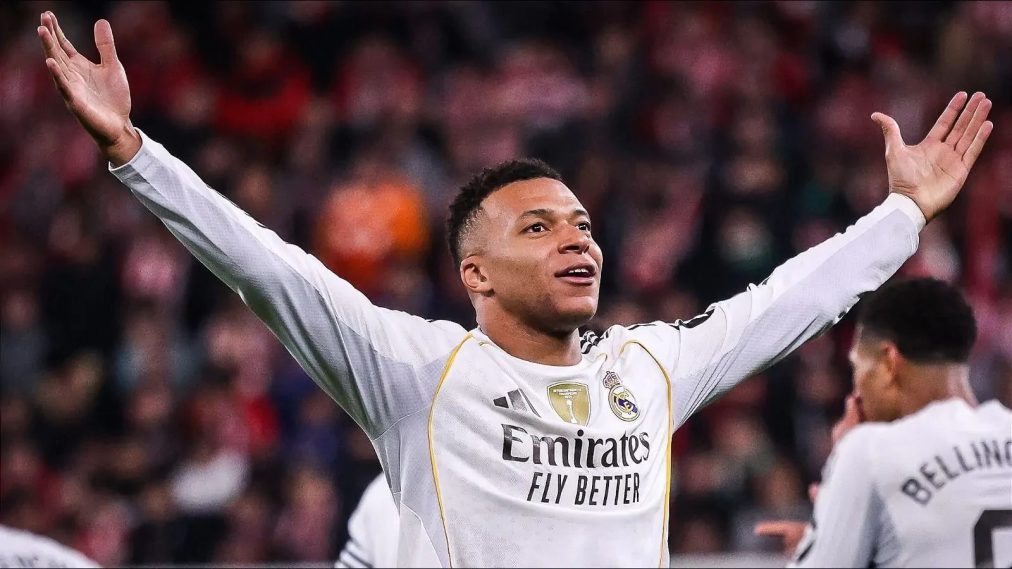
Kylian Mbappe says his African heritage remains central to his identity and that he would dedicate his first Ballon d’Or, if successful, partly to the continent.
The Real Madrid and France forward, whose father is Cameroonian and mother Algerian, was speaking to RFI before the 2026 Ballon d’Or ceremony in London on 26 October.
Mbappe was born and raised in France and has represented the country throughout his international career, but says he has retained a strong connection with his family’s roots.
“I have never cut ties with my roots, my origins,” Mbappe said, describing African culture as an important influence during his upbringing.
That connection has also been evident through his visits to Africa and his support for football on the continent. In 2023, Mbappe travelled to Cameroon, visiting Yaounde, Douala and Djebale, where his father’s family originates.
During the trip, he also visited schools supported by his foundation. He continued his links with Africa by attending the 2025 Africa Cup of Nations and backing African teams during the tournament.
Mbappe said he had consistently received a warm welcome whenever he visited the continent. He has also praised African football, saying teams from the region should not be underestimated and highlighting how difficult they can be to face.
With voting for this year’s Ballon d’Or approaching, the 30-year-old thanked African fans and journalists for their support. He said he hoped to dedicate the award to them should he win.
Mbappe goes into the contest after a prolific 2025-26 season with Real Madrid, scoring 42 goals in 44 appearances in all competitions. He scored 25 times in La Liga and added 15 goals in the Champions League.
He was also the leading scorer at the 2026 World Cup with France.
Despite winning honours during spells with Monaco, Paris Saint-Germain and Real Madrid, Mbappe has never claimed the Ballon d’Or. He is one of the 30 nominees for this year’s prize.
Victory would represent a significant individual achievement for Mbappe, while also allowing him to recognise the African heritage he continues to regard as an important part of who he is.
-
 AFCON 2027 qualifiers: Mohamed Eisa scores late to give Sudan narrow victory over Ethiopia Sep 25, 2026
 -
AFCON 2027 Qualifiers: Senegal held by Mozambique Sep 25, 2026
-
AFCON 2027 qualifiers: Guinea-Bissau beat Tanzania 2-0 to make a winning start Sep 25, 2026
-
Moussa Sylla shines as Schalke striker reaches peak fitness Sep 25, 2026


-
AFCON 2025: Fixtures, Results, Scores and Standings Jan 18, 2026
-
Leadership and long-term vision key to rescuing Zamalek and inspiring Egyptian football – Hany Abou Rida Nov 5, 2025
-
Match hero Taiwo Awoniyi reflects on team effort after Chelsea triumph May 5, 2026
-
South African giants Orlando Pirates set to lose influential forward Monnapule Saleng Mar 19, 2025




-
Atletico Madrid vs Real Madrid: Derby date, kick-off time and where to watch Sep 18, 2026
-
Marseille face PSG in Ligue 1’s latest Classique: kick-off time, TV details and form guide Sep 19, 2026
-
AFCON 2027 Qualifiers: Matchday 1 & 2 fixtures, kick-off times and venues confirmed Sep 22, 2026
-
Sierra Leone step up AFCON 2027 preparations ahead of Zimbabwe opener Sep 22, 2026