Real Madrid, Al Hilal and Al Ahly have begun facing a question that extends beyond results: can their managers preserve the attacking identity traditionally expected by supporters?
The three clubs are accustomed to controlling matches, pressing from the opening whistle and turning possession into chances and goals. Yet under Jose Mourinho, Simone Inzaghi and Hussein Ammouta, their teams have often prioritised structure, balance and transitions over sustained attacking pressure, with medium or low defensive blocks used at stages of games.
That has left supporters questioning not the quality of the players available, but whether the teams still resemble the sides they expect to watch.
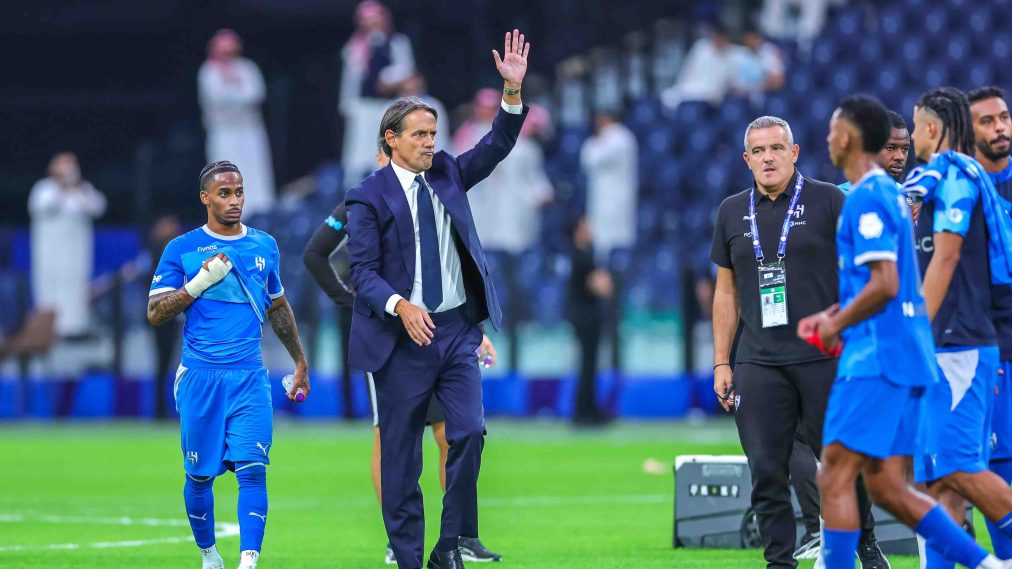
Inzaghi’s Al Hilal seek more attacking answers
Al Hilal have shown clear signs of Simone Inzaghi’s preference for organisation and counter-attacking football. The Italian coach applied that approach effectively during periods of last season, but it has not entirely satisfied supporters who expected a more aggressive attacking team from a squad containing so many forward players.
Al Hilal made a strong start to the current campaign, winning six of their first seven matches. However, their 6-0 victory over Al Taawoun alone cannot be treated as proof that the attacking structure is complete, given that Al Taawoun were in the relegation places and had not won a match at that stage.
The team’s 0-2 defeat by Neom offered a different picture. Despite having three prominent forwards, Al Hilal struggled to create attacking solutions and lacked effectiveness in the final third.
The issue is not whether Al Hilal can score when an opponent’s resistance collapses. It is whether they can break down a well-organised side that closes spaces and forces them to operate in crowded areas. That has prompted the central question from supporters: is this still the Al Hilal that attacks, or a team seeking security first and waiting for opportunities to transition?
Al Ahly’s attacking problems
In Cairo, the concerns have been more visible under Hussein Ammouta, who took charge of Al Ahly at the start of the current season. Results have given him some protection, but the team’s attacking performances have raised questions over its slow build-up, limited clear attacking patterns and frequent dependence on individual ability.
Al Ahly began the league season positively before drawing 1-1 with Al Mokawloon Al Arab. They struggled to penetrate their opponents despite dominating possession in the second half, eventually scoring from a penalty.
Al Ahly also left significant space behind their defence and between the two centre-backs, areas Al Mokawloon Al Arab repeatedly exploited. Even the win over Abu Qir Fertilizers in the previous round was secured largely through individual efforts.
The frustration is therefore about more than one draw or missed chance. Al Ahly have players capable of deciding matches, but the team is not consistently building attacks that put them in the best positions. Individual brilliance is becoming a repeated rescue option rather than an additional weapon.
Mourinho’s challenge at Real Madrid
At Real Madrid, the scrutiny is intensified by the scale of expectation surrounding Jose Mourinho’s return. The club has high-profile players in every area of the pitch, but its identity remains under examination.
Mourinho has said he wants a side able to press high, win the ball back and defeat opponents within seconds during transitions. He has also stressed the need for Real Madrid to defend deeper when matches demand it.
The problem was exposed in the 1-2 derby defeat by Atletico Madrid. Real Madrid lost control and attacking effectiveness, while Atletico Madrid dictated the game for long periods.
Real Madrid possess players capable of producing decisive individual moments, but the system has not provided enough space or attacking continuity. The concerns also extend to pressing: the team does not always press as a cohesive unit, and when it drops back, it can struggle to control the spaces between the lines.
Across Madrid, Riyadh and Cairo, the issue is the same. Inzaghi, Ammouta and Mourinho have considerable individual quality, but must show that organisation and transitions can coexist with the attacking personality their supporters demand. Fans do not simply want teams that wait for matches to unfold; they want teams that impose themselves on them.
-
 Cameroon begin 2027 Africa Cup of Nations qualifying campaign against Comoros Sep 24, 2026
 -
Africa Cup of Nations 2027 qualifiers: Cote d’Ivoire v Ghana headlines opening day Sep 24, 2026
-
Kevin Denkey confident Togo will qualify for CAN 2027 ahead of Burundi opener Sep 24, 2026
-
DR Congo U23s arrive in Casablanca ahead of Mauritania qualifiers Sep 24, 2026




-
AFCON 2025: Fixtures, Results, Scores and Standings Jan 18, 2026
-
Leadership and long-term vision key to rescuing Zamalek and inspiring Egyptian football – Hany Abou Rida Nov 5, 2025
-
Match hero Taiwo Awoniyi reflects on team effort after Chelsea triumph May 5, 2026
-
South African giants Orlando Pirates set to lose influential forward Monnapule Saleng Mar 19, 2025




-
Atletico Madrid vs Real Madrid: Derby date, kick-off time and where to watch Sep 18, 2026
-
Atletico Madrid v Real Madrid: Mbappe backed to score in key La Liga derby Sep 17, 2026
-
Marseille face PSG in Ligue 1’s latest Classique: kick-off time, TV details and form guide Sep 19, 2026
-
Barcelona face Sevilla seeking seventh straight league win Sep 17, 2026