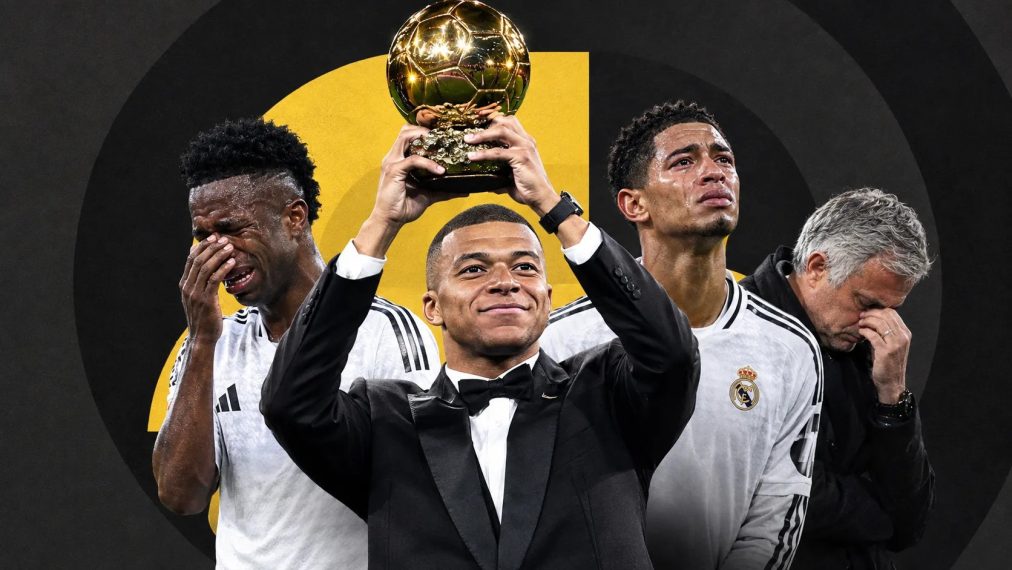
Kylian Mbappe’s reaction after Real Madrid’s derby defeat by Atletico de Madrid has intensified criticism that his personal ambitions matter more to him than the Spanish club’s pursuit of trophies.
Mbappe was ineffective in the 90-minute defeat, failing to score or provide an assist. He did not register a shot on target and posed little genuine threat as Real Madrid suffered another disappointing result.
Rather than apologising or avoiding attention after the loss, Mbappe’s remarks focused on his own status. He presented himself as the world’s best player, highlighted his goalscoring record and argued that he deserved the Ballon d’Or.
The criticism directed at the France forward is that Real Madrid’s failure to win a major trophy has become secondary to his individual ambitions. After two barren seasons, supporters had expected a stronger response from a player signed to help restore the club to the top of the game.
Mbappe’s confidence in his own ability has been evident since his emergence at Monaco. Even before establishing himself fully at the highest level, he regarded himself as the next global superstar and the likely successor to Lionel Messi and Cristiano Ronaldo.
His goals and performances for Monaco led Paris Saint-Germain to make him the most expensive teenager in football history. He received a salary and benefits beyond what he had previously imagined, before winning the World Cup at a young age and strengthening the belief that he could surpass the records of Messi and Ronaldo and even inherit Pele’s status.
At Paris Saint-Germain, Mbappe remained the leading figure despite playing alongside Neymar and Lionel Messi. He held significant influence in contract negotiations and repeatedly used Real Madrid’s interest to secure improved terms, including higher wages and a substantial signing-on bonus.
Paris Saint-Germain also provided a favourable environment for him, according to the criticism. The club regularly recruited star names, offered them special treatment and competed in a league where there was little sustained domestic challenge. When Luis Enrique spoke to Mbappe and referred to his idol, Michael Jordan, who had played for the team, Mbappe chose not to remain at a club that placed the collective structure above individual players.
His move to Real Madrid was therefore portrayed not as an attempt to revive a club in need of success, but as a step towards winning personal recognition. Real Madrid had already achieved almost everything possible with a generation that had collected major honours, while Mbappe arrived seeking the Ballon d’Or.
He may have wanted to win the Champions League and La Liga, but the greater objective was to return to Paris with the Ballon d’Or and prove his superiority. After failing to secure individual recognition, he waited another year and appeared to hope the World Cup would provide the answer. It did not.
With Real Madrid having gone two seasons without lifting the Champions League or another major trophy, Mbappe’s outspoken approach has been interpreted as revealing his priorities: personal glory, greater financial rewards and the Ballon d’Or, regardless of the club’s fortunes.
-
Mourinho absence delays first meeting with Flick as Simeone calls for caution Sep 22, 2026
-
 Nigeria’s Super Eagles begin AFCON 2027 preparations ahead of Madagascar clash Sep 22, 2026
 -
Pablo Franco Martín emerges as leading candidate for Espérance de Tunis job Sep 22, 2026
-
Mamelodi Sundowns set sights on Paris Saint-Germain after Al Ahli victory Sep 22, 2026

-
AFCON 2025: Fixtures, Results, Scores and Standings Jan 18, 2026
-
Leadership and long-term vision key to rescuing Zamalek and inspiring Egyptian football – Hany Abou Rida Nov 5, 2025
-
Match hero Taiwo Awoniyi reflects on team effort after Chelsea triumph May 5, 2026
-
South African giants Orlando Pirates set to lose influential forward Monnapule Saleng Mar 19, 2025




-
Atletico Madrid vs Real Madrid: Derby date, kick-off time and where to watch Sep 18, 2026
-
Atletico Madrid v Real Madrid: Mbappe backed to score in key La Liga derby Sep 17, 2026
-
African Stars choose Botswana’s Lucas Moripe Stadium to host Orlando Pirates in CAF Champions League Sep 16, 2026
-
Europa League: AC Milan, Benfica and Lyon begin new league phase Sep 16, 2026