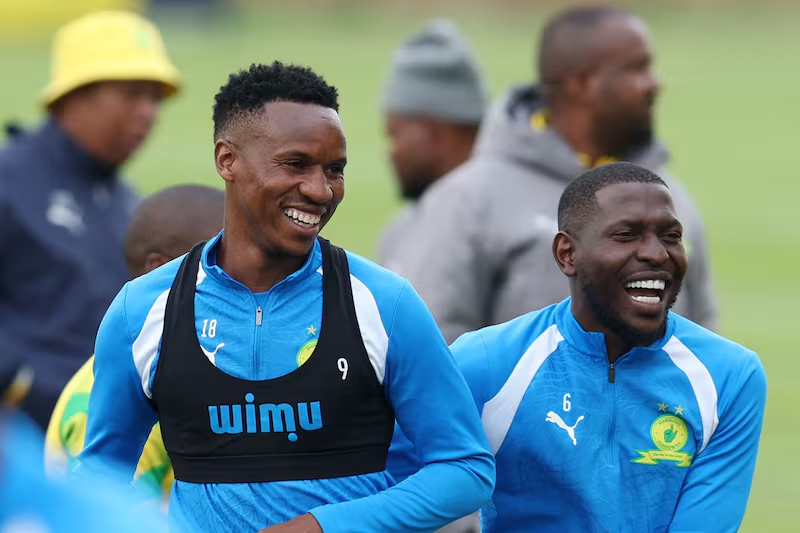
In a football culture where club loyalties often shape opinions of the national team, Themba Zwane’s inclusion in Pitso Mosimane’s 30-man Bafana Bafana squad has prompted more debate than most selections.
There is rarely complete agreement when a squad is announced, and Mosimane’s first selection since beginning his second spell in charge has been no different. However, most of the choices have been welcomed, with Puso Dithejane’s call-up attracting little dispute.
The 22-year-old has earned his opportunity after producing a series of impressive performances for Chicago Fire in the United States. The match against Guinea at Orlando Stadium on Saturday could see Dithejane win his first cap for South Africa.
Relebohile Mofokeng’s selection was equally straightforward. The Sharpeville-born player has made a strong impression since joining Royale Union Saint-Gilloise two months ago, producing performances that have quickly challenged Hugo Broos’s prediction that it would take him at least six months to establish himself.
There is also growing evidence of a younger generation developing abroad. Ime Okon, Olwethu Makhanya and Thapelo Maseko are all below 22, while Shandre Campbell, aged 19, is the youngest member of the squad.
Those players are gaining experience in Germany, Scotland, Denmark and Belgium, developing in demanding overseas environments as they move towards senior football.
Why Zwane still matters
That is where the discussion around Zwane becomes more complicated. Broos was previously questioned for leaving him out before the midfielder forced his way back into contention. Mosimane’s decision to select him has raised similar questions.
At 37, the Mamelodi Sundowns captain would acknowledge that he is no longer a player expected to complete every match, while his recent form has not been at its strongest. Form remains a major consideration in selection, but a coach must also assess what an experienced player contributes away from the pitch.
Zwane may have a limited playing role. His wider influence, however, could be significant.
He is no longer expected to be the creative heartbeat of Bafana Bafana, with Mofokeng appearing to have been given that responsibility as South Africa look to shape their attacking play for a new era. Mosimane has long valued experienced players setting standards for younger teammates, dating back to his early coaching career.
Zwane offers an example of professionalism for the squad to follow. There have been no scandals involving violence against women, drugs, excessive drinking or other forms of indiscipline that have damaged the careers of many footballers.
South Africa has a painful history of players unable to manage fame and wealth, with poor decisions and a failure to resist temptation bringing promising careers to an early end. There is no need to reopen those old wounds by listing the examples.
This group of young players deserves protection as it attempts to build a different future for Bafana Bafana and for themselves beyond football. Zwane, known as “Mshishi”, has spent 15 years at the highest level, winning multiple domestic league titles and two Champions League trophies. He is well placed to pass on the lessons of that journey.
-
 Injury forced Liverpool to abandon Yankuba Minteh pursuit Sep 19, 2026
 -
Timothy Weah set for Marseille-PSG clash after USMNT snub Sep 19, 2026
-
CAF sounds out Morocco and two other countries over 2027 Africa Cup of Nations Sep 19, 2026
-
Algeria selection: Saadi Radouani call-up questioned amid Anthar Yahia claims Sep 19, 2026




-
AFCON 2025: Fixtures, Results, Scores and Standings Jan 18, 2026
-
Leadership and long-term vision key to rescuing Zamalek and inspiring Egyptian football – Hany Abou Rida Nov 5, 2025
-
South African giants Orlando Pirates set to lose influential forward Monnapule Saleng Mar 19, 2025
-
Match hero Taiwo Awoniyi reflects on team effort after Chelsea triumph May 5, 2026




-
African Stars choose Botswana’s Lucas Moripe Stadium to host Orlando Pirates in CAF Champions League Sep 16, 2026
-
Europa League: AC Milan, Benfica and Lyon begin new league phase Sep 16, 2026
-
Atletico Madrid vs Real Madrid: Derby date, kick-off time and where to watch Sep 18, 2026
-
Besiktas and Marseille reveal probable line-ups for Europa League opener Sep 15, 2026