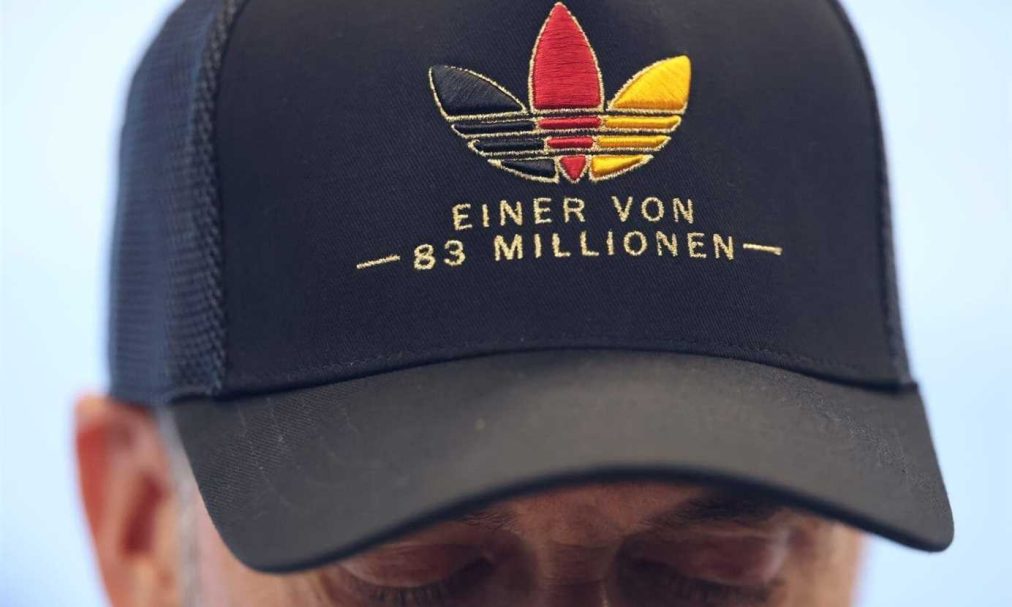
Jurgen Klopp wore a cap bearing the words “one of 83 million” in Germany’s colours as he announced his first squad as the new Germany manager.
Klopp named 44 players for Germany’s forthcoming Nations League matches, with the squad selection coming shortly after the far-right Alternative for Germany (AfD) secured a major electoral victory in Saxony-Anhalt.
The party’s anti-immigration and nationalist message has also gained support in other parts of the country, particularly areas affected by industrial decline, according to The Athletic.
The AfD has attracted significant popularity at both state and federal level for several years, a development that has caused deep concern and become a source of anger and division.
Addressing the issue at his news conference, Klopp said: “We have to rediscover the joy in all of this. I hope I will not have to talk about political matters in the future. But I want to reclaim our flag, so that people feel happy and grateful to live in this wonderful country.”
He added: “I do not want to leave national pride to the wrong people. I am filled with pride at doing this job. When we spend time focusing on football, it is about strengthening our sense of community and improving our mood. We have to create that atmosphere. But we also need people who embrace it.”
The first squad will face the Netherlands on 24 September and Greece on 27 September. It includes Marc-Andre ter Stegen, Joshua Kimmich, Serge Gnabry and Kai Havertz, as well as several younger players.
Lennart Karl is set to make his first official appearance for Germany, while Bambas Conte and Hennes Behrens are also included.
Klopp will continue to experiment in the next two matches against Serbia on 1 October and Greece on 4 October, naming an entirely different squad. Goalkeeper Finn Dahmen is the only player selected for both groups, with Klopp choosing to give the rest of the squad different opportunities during the next international break.
The second group again combines experience with players at the beginning of their Germany careers. It includes Karim Adeyemi and Maximilian Mittelstadt, alongside potential debutants Finn Jeltsch, Tom Bischof and Derry Scherhant.
Klopp’s aim is to develop a broader understanding of his available options while giving as many players as possible the chance to prove themselves.
First squad: Netherlands and Greece
Goalkeepers: Marc-Andre ter Stegen (Ajax Amsterdam), Alexander Nubel (Besiktas), Finn Dahmen (Augsburg).
Defenders: Yann-Aurel Bisseck (Inter), Jonathan Tah (Bayern Munich), Nico Schlotterbeck (Borussia Dortmund), Hennes Behrens (Augsburg), Nathaniel Brown (Bayern Munich), Max Rosenfelder (Freiburg), Philipp Treu (Freiburg), Josha Vagnoman (Stuttgart).
Midfielders: Serge Gnabry (Bayern Munich), Lennart Karl (Bayern Munich), Joshua Kimmich (Bayern Munich), Jamal Musiala (Bayern Munich), Felix Nmecha (Borussia Dortmund), Nadiem Amiri (Mainz), Kevin Schade (Brentford), Bambas Conte (Hoffenheim), Yannick Engelhardt (Freiburg), Chris Fuhrich (Stuttgart), Anton Stach (Leeds United).
Forwards: Kai Havertz (Arsenal), Younes Ben Taleb (Eintracht Frankfurt).
Second squad: Serbia and Greece
Goalkeepers: Finn Dahmen (Augsburg), Noah Atubolu (Eintracht Frankfurt), Jonas Urbig (Bayern Munich).
Defenders: Malick Thiaw (Newcastle United), Waldemar Anton (Borussia Dortmund), Ridle Baku (RB Leipzig), Finn Jeltsch (Stuttgart), Maximilian Mittelstadt (Stuttgart), David Raum (RB Leipzig).
Midfielders: Karim Adeyemi (Barcelona), Florian Wirtz (Liverpool), Mika Baur (Celtic), Tom Bischof (Bayern Munich), Aleksandar Pavlovic (Bayern Munich), Said El Mala (Cologne), Brajan Gruda (RB Leipzig), Vitaly Janelt (Brentford), Felix Keidel (Elversberg), Derry Scherhant (Freiburg).
Forwards: Nick Woltemade (Juventus), Jonathan Burkardt (Frankfurt).
Germany were eliminated from the 2026 World Cup in the last 32 after losing to Paraguay on penalties.
Klopp will remain in charge of Germany until the 2030 World Cup.
-
 Jaouen Hadjam recovers from injury ahead of Arsenal clash Sep 18, 2026
 -
Rafiki Saïd and Myziane Maoulida ruled out of Comoros AFCON qualifier Sep 18, 2026
-
Algeria’s Ibrahim Maza sparks transfer battle between Arsenal, Manchester clubs and Atletico Madrid Sep 18, 2026
-
South Africa’s Mofokeng makes Europa League history with opening goal of 2026/27 league phase Sep 18, 2026




-
AFCON 2025: Fixtures, Results, Scores and Standings Jan 18, 2026
-
Leadership and long-term vision key to rescuing Zamalek and inspiring Egyptian football – Hany Abou Rida Nov 5, 2025
-
South African giants Orlando Pirates set to lose influential forward Monnapule Saleng Mar 19, 2025
-
Match hero Taiwo Awoniyi reflects on team effort after Chelsea triumph May 5, 2026




-
African Stars choose Botswana’s Lucas Moripe Stadium to host Orlando Pirates in CAF Champions League Sep 16, 2026
-
Europa League: AC Milan, Benfica and Lyon begin new league phase Sep 16, 2026
-
Besiktas and Marseille reveal probable line-ups for Europa League opener Sep 15, 2026
-
Hakimi, Amrabat among nine Morocco absentees for AFCON qualifiers Sep 11, 2026