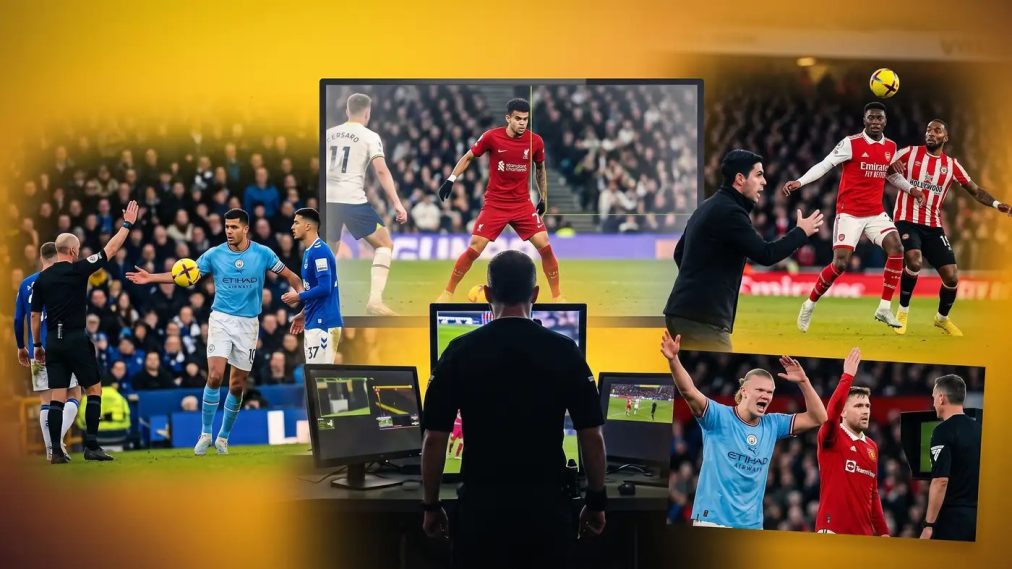
The Premier League’s latest refereeing controversy has reopened questions about the reliability of VAR after the officials’ body admitted that Manchester City’s winning goal against Manchester United should have been reviewed differently.
Erling Haaland scored the only goal of the latest Manchester derby in the 60th minute after his effort was initially ruled out for offside. A review showed the Norway striker was onside, with Manchester United’s Patrick Dorgu playing him on.
The dispute instead concerned Enzo Fernandez, the Manchester City player who was offside and attempted to reach the ball without touching it. The video assistant referee decided that Fernandez had not interfered with play and therefore did not invalidate the goal.
The officials’ body later acknowledged that assessment of his impact was wrong and that the referee should have been sent to the pitchside monitor to review the incident.
The decision has added another chapter to a series of high-profile Premier League errors in the VAR era.
During the 2021-22 season, Everton were denied a penalty against Manchester City after Rodri handled the ball inside the area. VAR did not intervene, and Mike Riley, then head of the referees’ body, apologised to Everton afterwards, admitting the decision was incorrect and that a penalty would have given them a chance to recover.
The timing was significant. Everton were fighting relegation, while Manchester City were involved in a close title race with Liverpool, eventually winning the championship by one point.
The following season brought further controversy. Ivan Toney equalised for Brentford against Arsenal despite Christian Norgaard being in an offside position during the attack. VAR official Lee Mason failed to draw the offside lines and review the incident correctly. The officials’ body admitted a clear error and apologised to Arsenal, who were competing strongly for the title.
Brighton and Hove Albion also had a goal by Pervis Estupinan ruled out against Crystal Palace after the lines were drawn against the wrong player. In another disputed match, Manchester United’s Bruno Fernandes scored against Manchester City despite Marcus Rashford being offside. VAR ruled that Rashford had not interfered with play, a decision that drew criticism because of his direct run towards the ball.
A review at the end of the 2022-23 campaign identified 38 VAR-related errors, making it one of the most controversial seasons since the technology was introduced.
One of the most notorious incidents came in 2023-24, when Liverpool’s Luis Diaz had a legitimate goal disallowed for offside against Tottenham Hotspur. A communication failure in the VAR room meant officials believed the goal had been awarded and did not intervene. The referees’ body admitted the mistake and apologised to Liverpool.
That season also included Liverpool’s unsuccessful penalty appeal against Arsenal after Martin Odegaard handled the ball in the area. Howard Webb, the referees’ chief, later said Liverpool should have been awarded a penalty. The season’s review recorded 31 VAR errors.
In 2024-25, Bruno Fernandes was sent off against Tottenham Hotspur for a challenge on James Maddison, but the Football Association overturned the dismissal on appeal. Webb admitted VAR should have recommended a review. Other disputed incidents included James Tarkowski’s challenge on Alexis Mac Allister in the Merseyside derby, although not every controversial decision was officially classified as an error. The number of recorded VAR mistakes fell to 18.
It rose again to 25 in 2025-26, compared with 18 the previous season, 31 in 2023-24 and 38 in 2022-23.
One officially acknowledged error came in May 2026, when Manchester United played Nottingham Forest. Matheus Cunha scored after an attack that began with a handball by Bryan Mbeumo. VAR sent referee Michael Salisbury to the monitor, but he kept his original decision and allowed the goal. The officials’ body later said it should have been disallowed and apologised to Nottingham Forest.
There is no reliable evidence that officials deliberately make mistakes to create controversy, making a conspiracy theory unjustified. But the repeated errors raise a legitimate question about how they continue in a competition with such extensive resources.
VAR is intended to reduce human error: referees have replays, offside decisions can be supported by technology, and red-card incidents can be reviewed. Yet Diaz’s valid goal was disallowed because of communication, Toney’s goal stood because lines were not drawn, Everton’s penalty was missed, Fernandes’ red card was later overturned and Cunha’s goal survived even after VAR prompted a review.
The overall figures suggest improvement, but the numbers do not tell the whole story. One mistake in a title, relegation or European qualification race can matter more than several marginal errors.
When Arsenal are told they lost two points against Brentford, Everton are told they deserved a penalty against Manchester City, or Liverpool are told Diaz’s goal was valid, the outcome is not restored. Nor are the minutes Manchester United played with 10 men against Tottenham, and the league table does not change after Cunha’s goal is judged to have been wrongly allowed.
The central issue is how many mistakes a league that calls itself the strongest in the world can accept from a technology designed to prevent them. The problem may lie in the laws, their interpretation, or the standard of refereeing and VAR failing to match the level of the Premier League.
-
 Algeria: Four contenders emerge to replace suspended Rafik Belghali Sep 14, 2026
 -
Thuso Moleleki completes permanent move from Orlando Pirates to Kruger United Sep 14, 2026
-
CAF Champions League: Mazembe face Club Africain as second qualifying round is confirmed Sep 14, 2026
-
Congo striker Simon Banza completes move to PAOK Sep 14, 2026




-
AFCON 2025: Fixtures, Results, Scores and Standings Jan 18, 2026
-
Leadership and long-term vision key to rescuing Zamalek and inspiring Egyptian football – Hany Abou Rida Nov 5, 2025
-
South African giants Orlando Pirates set to lose influential forward Monnapule Saleng Mar 19, 2025
-
Full schedule for 2025 Africa Cup of Nations in Morocco confirmed Feb 12, 2025




-
Porto v Manchester City: Probable line-ups for Champions League opener Sep 7, 2026
-
African trio Vozinha, Bounou and Eduard Mendy nominated for 2026 Men’s Goalkeeper of the Year award Sep 8, 2026
-
Bayern Munich begin Champions League campaign against unbeaten Bodø/Glimt Sep 9, 2026
-
Bayer Leverkusen prepare bumper contract for Cameroon forward Christian Kofane Sep 7, 2026