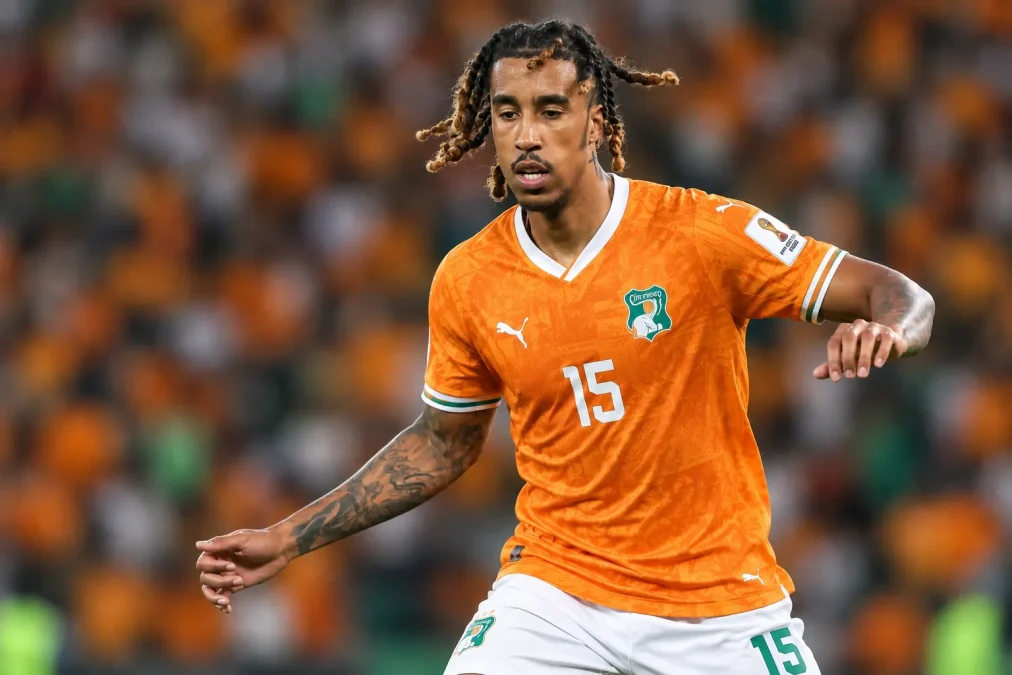
A social media rumour claiming Manchester United defender Leny Yoro has decided to represent Cote d’Ivoire rather than France has not been confirmed by the player, his representatives or the Ivorian Football Federation.
The speculation emerged at the end of August and suggested that Yoro, who was born in France to an Ivorian father, had chosen to play for the country of his heritage. However, no recognised media organisation has supported the claim, meaning it should be treated with considerable caution.
A switch remains possible under international eligibility rules. Yoro has represented France from under-17 level through to the under-21s, and last played for the France under-21 team in March. In total, he has made 19 appearances for France’s youth sides but has not played for the senior team.
That means the 20-year-old could still change his international allegiance and join the Elephants, provided he completes the necessary procedures with FIFA.
Yoro’s current position at Manchester United also offers some context. The defender joined from Lille in 2024 for a fee of about 62m euros, but injuries have interrupted his progress and he has yet to establish himself as a clear first-choice player.
During the opening three matches of this Premier League season, Michael Carrick has given him only about 20 minutes of playing time. Rio Ferdinand, a strong admirer of the France international, believes Yoro’s development has been «plus lente que prevu » while remaining confident that the defender’s considerable potential will eventually be realised.
Despite Yoro’s current difficulties, persuading him to turn away from France would represent a significant achievement for Cote d’Ivoire. The country has already successfully recruited several players who appeared for France at youth level.
Seko Fofana, Jeremie Boga, Maxwel Cornet and Jean-Philippe Gbamin all represented France’s younger teams before choosing the Elephants. The example of Evan Ndicka is especially relevant. Like Yoro, the AS Roma defender played for France’s youth sides without appearing for the senior team. He eventually opted for Cote d’Ivoire and has since become an important member of the national side.
Wilfried Zaha followed a different route. He played twice for England in friendly matches before changing his international allegiance.
Yoro would not be arriving to solve an immediate defensive problem for Cote d’Ivoire. The national team already has a strong selection of defenders, including Ndicka, Odilon Kossounou, Ousmane Diomande, Wilfried Singo and Emmanuel Agbadou.
His arrival would instead be viewed as a long-term investment and would increase competition for places. That is unlikely to concern new head coach Herve Renard, who would welcome the opportunity to work with another highly rated young defender.
Yoro’s potential remains considerable at the age of 20, despite his difficulties at Manchester United. But any suggestion that Cote d’Ivoire is about to secure another major international capture must wait for evidence stronger than an unverified claim circulating on social media.
-
 Leny Yoro to choose Cote d’Ivoire? Manchester United defender linked with switch Sep 9, 2026
 -
Manchester United begin Champions League return against debutants Sabah Sep 9, 2026
-
Adam Tahaui’s rapid rise faces fierce Morocco competition Sep 9, 2026
-
African goalkeepers make history with three Yachine Trophy nominations Sep 9, 2026



-
AFCON 2025: Fixtures, Results, Scores and Standings Jan 18, 2026
-
Leadership and long-term vision key to rescuing Zamalek and inspiring Egyptian football – Hany Abou Rida Nov 5, 2025
-
South African giants Orlando Pirates set to lose influential forward Monnapule Saleng Mar 19, 2025
-
Full schedule for 2025 Africa Cup of Nations in Morocco confirmed Feb 12, 2025




-
From Abidjan streets to Real Madrid: Ivory Coast star Yan Diomande on learning from Mbappe and Vinicius Sep 2, 2026
-
PSG v Monaco: Where to watch Friday’s Ligue 1 clash and why the visitors feel confident Sep 3, 2026
-
Chido Obi: Manchester United’s Danish-Nigerian striker joins Willem II on season-long loan Sep 2, 2026
-
PSG aim to break league stalemate as unbeaten Monaco arrive in Paris Sep 2, 2026