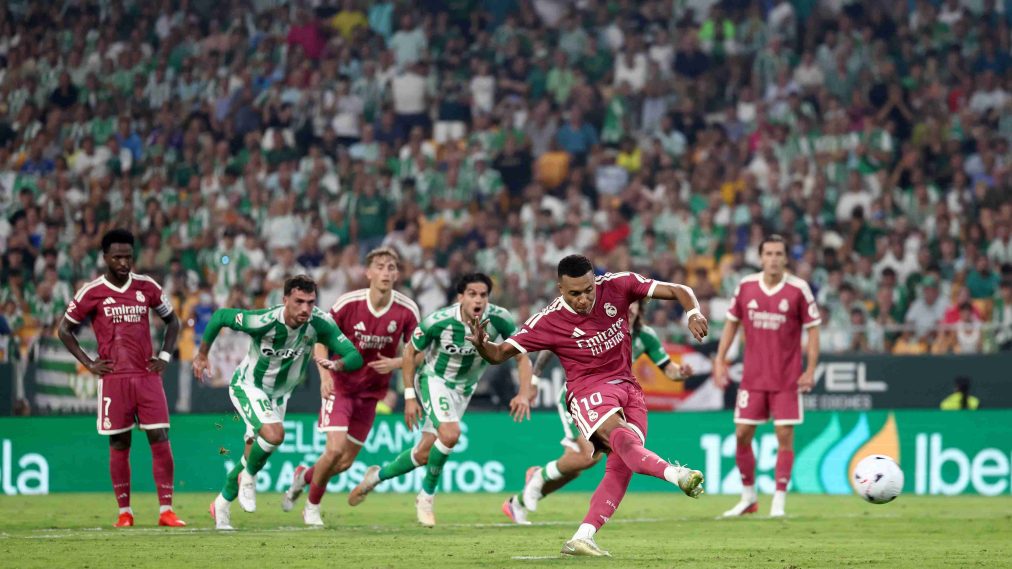
Real Madrid’s late penalty appeal was rejected after Kylian Mbappe missed from the spot against Real Betis, with Marc Bartra’s position at the moment of the kick judged not to represent an offence under the laws of the game.
Real Madrid suffered their first La Liga defeat of the season on Friday evening, losing 1-0 away to Real Betis in the fourth round of the campaign. The decisive moment came in the 94th minute, when Mbappe failed to convert a penalty.
Attention quickly turned to whether Real Betis defender Bartra had entered the penalty area too early. Referee Jose Maria Sanchez Martinez reviewed the incident with the assistance of the video assistant referee and appeared close to ordering the kick to be retaken. However, he ultimately allowed play to continue.
🚨 MAJOR BREAKING: The Real Betis players entered the box too soon!But the penalty will NOT be re-taken!pic.twitter.com/D8ozemEKXR
The Spanish refereeing committee and the International Football Association Board’s (IFAB) laws for the 2026-27 season state that the decision was consistent with the regulations.
An infringement known as encroachment occurs when a player other than the penalty taker or goalkeeper enters the penalty area or its arc before the kick is taken, or moves in front of the ball.
However, entering the area early does not automatically mean that an offence has been committed. The player must have had a direct effect on the taking of the penalty or subsequently become involved in play.
For a defending player, encroachment is penalised if it clearly affects the penalty taker, or if the defender plays or challenges for the ball after it rebounds, preventing a goal, a shot or an opportunity to create a chance.
If the player who encroaches is an attacker, an offence is committed when their position clearly affects the goalkeeper, or when they become involved after the ball rebounds and then score, attempt to score or create a goalscoring opportunity.
The rules also explain how a player’s position is assessed at the instant the penalty is taken. Officials consider the position of the player’s feet, or any part of the body that is touching the ground.
An offence is recorded if either foot, or both feet, are inside the penalty area or touching the line marking it. The same interpretation applies to the penalty arc.
Body parts that are in the air are not taken into account, nor is their vertical projection on to the pitch, except when the player’s entire body is off the ground.
If a player is airborne when a restart is taken (e.g. at a penalty kick), their position is now determined by the projected position of their feet if they were touching the ground. ‘Airborne’ only applies when the whole of the body is off the ground.In other cases, a player’s…pic.twitter.com/kM5zwYXwbG
The wording approved for the 2026-27 season specifies that “the projected position in the air only applies when the whole of the body is off the ground”.
In Bartra’s case, one of his feet was still in contact with the ground outside the penalty area when Mbappe struck the ball. That detail was decisive in determining that his position did not constitute encroachment requiring the penalty to be retaken.
The ruling left Real Madrid with a 1-0 defeat at Real Betis and ended their unbeaten start to the league season.
-
 Mexico and Benin set for Women’s U20 World Cup Group A opener Sep 5, 2026
 -
Oswin Appollis, Gamphani Lungu headline six-man Orlando Pirates Player of the Month race Sep 5, 2026
-
Haaland target and goals market headline Saturday’s football betting picks Sep 5, 2026
-
South Africa seek 2-1 series advantage against All Blacks at historic FNB Stadium Sep 5, 2026




-
AFCON 2025: Fixtures, Results, Scores and Standings Jan 18, 2026
-
Leadership and long-term vision key to rescuing Zamalek and inspiring Egyptian football – Hany Abou Rida Nov 5, 2025
-
South African giants Orlando Pirates set to lose influential forward Monnapule Saleng Mar 19, 2025
-
Full schedule for 2025 Africa Cup of Nations in Morocco confirmed Feb 12, 2025




-
Jordy Makengo set to stay at SC Freiburg Aug 29, 2026
-
Younes Ebnoutalib scores Bundesliga hat-trick on Frankfurt debut Aug 29, 2026
-
Bayern Munich’s Saibari turns substitute role into instant Bundesliga impact Aug 29, 2026
-
Ballon d’Or holder Ousmane Dembélé agrees to extend PSG contract until 2030 Aug 31, 2026