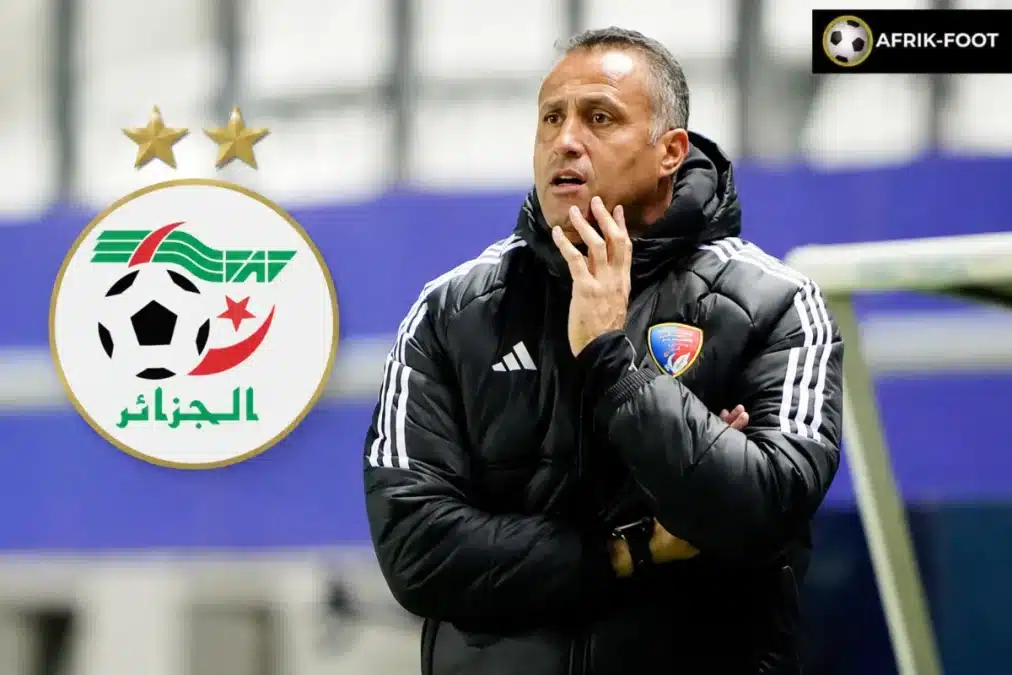
Brahim Hemdani is expected to become Algeria’s new head coach, but his proposed promotion has already prompted questions over his experience, international past and ability to manage two teams at the same time.
The Algerian Football Federation (FAF) is reportedly preparing to place Hemdani in charge of the senior national side alongside Anthar Yahia. The pair are expected to oversee Algeria’s opening two matches in the 2027 Africa Cup of Nations qualifying campaign, against Zambia on 25 September and Burundi on 29 September.
Hemdani, who holds a Uefa Pro licence, would officially take the role of head coach, while Yahia – who is still working towards his CAF A licence – would play a significant supporting role. The arrangement could initially be temporary, with the team’s early results likely to determine whether the FAF continues with the partnership or appoints a more established coach at a later stage.
The decision follows Hemdani’s success with Algeria’s Under-21 side. Only a few days ago, the 48-year-old coach guided the team to Algeria’s first gold medal at the Mediterranean Games in 51 years. His handling of the tournament and the development shown by his players have considerably strengthened his standing.
However, questions remain over whether that achievement alone justifies an immediate move into the senior role. Hemdani’s main experience as a first-team manager came at Marignane-Gignac in the lower divisions of French football, where he helped the club win promotion to the National division.
Leading Algeria would represent a significant step up. The senior squad includes players competing in major European leagues, while the position carries enormous public and media pressure. Hemdani’s limited experience at that level is therefore likely to be closely examined from the outset.
His history with the national team is another source of debate. Hemdani did not make his Algeria debut until 2008, when he was 30, and finished his international career with only four caps. Samir Nasri recently said his former Marseille team-mate had given him a highly critical account of the national side when Nasri asked why he had not represented Algeria.
Hemdani disputed that version of events, although he acknowledged that he had chosen to join the national team late and said he had no regrets. While opinions may differ over his explanation, some Algeria supporters retain a strong memory of players who delayed or turned down the opportunity to represent the country. A poor result could quickly bring that episode back into focus.
The most immediate practical issue concerns the Under-20 team, for which Hemdani remains officially responsible. His work with that group has only just begun, and it already faces an important assignment at the UNAF tournament in Egypt, which runs from 24 September to 6 October and serves as a qualifier for the Under-20 Africa Cup of Nations.
Algeria are scheduled to play Tunisia on 24 September, Libya on 27 September, Morocco on 30 September and Egypt on 6 October. Those fixtures overlap completely with the senior team’s matches against Zambia and Burundi.
That clash was already viewed as the biggest obstacle to Hemdani taking an interim role with the senior side. Unless another coach is appointed to lead the Under-20s, he will not be able to continue the project he has only recently started. Disrupting a promising young team for an interim spell that might last only two matches is a decision that has drawn understandable reservations.
The concerns do not amount to a final judgement on Hemdani’s suitability. He knows the Algeria set-up, has the required qualification and has just shown that he can unite a group in an international competition. A number of coaches have reached the highest level without possessing an outstanding reputation when they were first appointed.
But Algeria is a demanding environment in which periods of learning are rarely tolerated for long. Hemdani’s opening matches will show whether he is ready for the national-team job, rather than simply benefiting from a successful spell with Marignane-Gignac.
In a country where millions of people see themselves as national-team coaches, few appointments receive universal approval. Hemdani begins this challenge with more doubts to settle than many of his predecessors.
-
 Elyaz Zidane refuses to rush decision on Algeria international future Oct 17, 2026
 -
Kanalelo: Marumo Gallants move offers coaching environment suited to his methods Oct 17, 2026
-
Bafana Bafana to host Benni McCarthy’s Kenya in Johannesburg AFCON qualifier Oct 17, 2026
-
Maghreb de Fes and ASEC Mimosas reveal probable line-ups for CAF Champions League tie Oct 17, 2026



-
AFCON 2025: Fixtures, Results, Scores and Standings Jan 18, 2026
-
Match hero Taiwo Awoniyi reflects on team effort after Chelsea triumph May 5, 2026
-
Leadership and long-term vision key to rescuing Zamalek and inspiring Egyptian football – Hany Abou Rida Nov 5, 2025
-
South African giants Orlando Pirates set to lose influential forward Monnapule Saleng Mar 19, 2025




-
Real Betis v Barcelona: kick-off time, TV details and match preview Oct 16, 2026
-
Roma v Real Madrid: home side tipped to score first in Champions League clash Oct 12, 2026
-
Atletico Madrid v Manchester United: probable line-ups for Champions League clash Oct 12, 2026
-
Celta Vigo v Juventus: Probable line-ups for Europa League encounter Oct 14, 2026