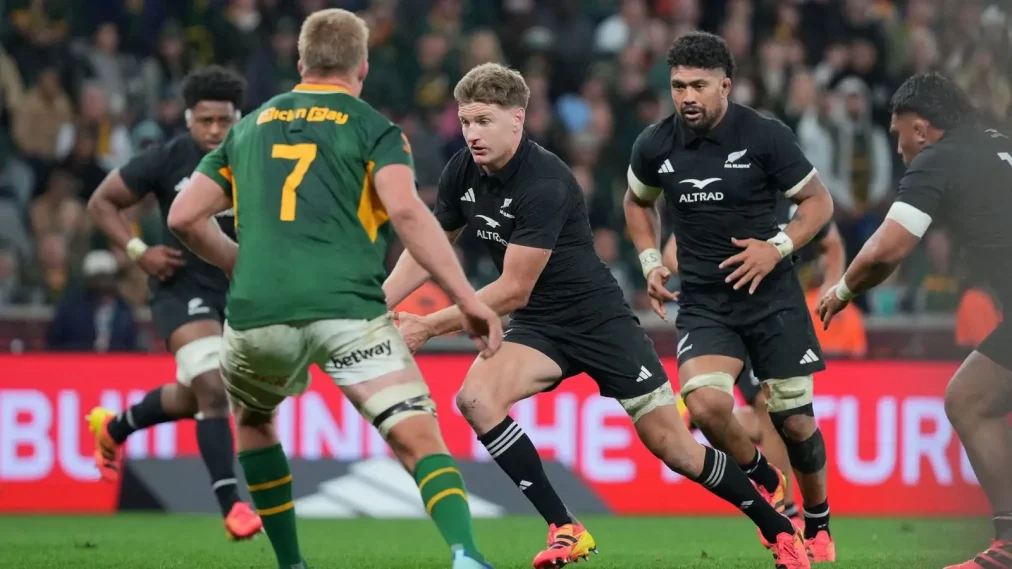
New Zealand centre Jordie Barrett says the All Blacks must improve their defence against South Africa’s aerial game and limit the Springboks’ opportunities to use their physical power in Saturday’s decisive third Test at FNB Stadium in Soweto.
The four-Test Greatest Rivalry series is level at 1-1 after South Africa won 33-26 in Cape Town last Saturday, having lost the opening match. The result has increased the sense of occasion around the next meeting, according to Barrett.
“It certainly feels like a knockout stage in a World Cup at the moment, and it’s a game of chess really,” Barrett told reporters on Monday.
“Like, we beat the Boks week one, they change a few things, and we try to change a few things. We lose, the series is one-all, so it’s about trying to implement the best plan possible to try and get a result on Saturday, and they’ll be doing the same.”
Asked where the third Test might be decided, Barrett said South Africa’s successful approach in Cape Town had provided a clear indication of what New Zealand must address.
“Good question. Very good question,” he replied.
“Like South Africa, the blueprint that got them, I guess, a victory on the weekend was their power game and they went to the air a lot, so we’re going to have to tidy up a lot of stuff around the air, winning the scraps on the ground and trying to minimize their entries into our half so they can’t get their power game on. And then getting our own game on too, trying to use the ball within reason.”
Barrett acknowledged that the All Blacks had struggled to deal with high kicks in the second Test, while arguing that the current laws make the task more difficult for the team receiving the ball.
“If you just looked at the last Test, we kicked very little contestables,” Barrett said. “The ones we did kick, we did win back.
“They kicked quite a lot and they’re often a lot shorter, so our full-back or 10 in the back field, it’s not his job to get it. It’s kind of in that zone where they want to make it messy and get scraps.
“Unfortunately, the laws of the game at the moment don’t, I guess, help a receiving team. We saw how Tupou (Vaa’i) was penalised. You have got to get up and contest. You can’t stand around the area or protect your catcher, so it turns into a bit of a lottery.
“We’ve got plans and ways around that in terms of trying to win as many of those as possible. But yeah, we practice it a lot. Trust me, it’s a lot harder than it probably looks on the telly.
“So yeah, we’re working really hard. A lot of our energy and planning is going towards it, and hopefully we can win a few more on Saturday because that’s what’s coming.”
Unlike South Africa, who travelled north to Johannesburg and have spent the full week preparing there, New Zealand have stayed in Cape Town. Barrett said the physical effects of the previous Test were still being felt, although he expected the squad to recover fully by the weekend.
“Like, I’m physically sore but by the time you get to Saturday, you’re fresh mentally and physically and ready to go, so everything you do in your week is just geared towards making sure you’re mentally on the money and physically raring to go against the best team in the world.
“So, look, we felt like we got to that spot on Saturday night. We’re going to have to go there again if we want to get a good result. So, it’s exciting, but these are the Test matches you want to be a part of.”
The All Blacks created more attacking opportunities than they had in the first Test, but Barrett said that improvement counted for little without victory. New Zealand were also forced to defend for much of the opening half-hour in Cape Town, particularly after conceding pressure through defensive errors and indiscipline.
“When you’re a team that creates a lot and uses the ball a lot, there’s a perception that you leave a few more out on the park and that’s reality. You create a lot of opportunities; you’re going to leave more out there, but we also finished a lot of opportunities.
“Our attacking numbers are a lot better than the first Test, but we didn’t win the game of rugby. And that’s strange how test rugby works, and unfortunately we probably didn’t start as well as we wanted to. Particularly defensively and we were chasing for the first half an hour of that game.”
Barrett said New Zealand’s priority would be to keep South Africa out of their half, while reproducing the fearless and aggressive approach that had produced the best passages in the opening two Tests.
“If you look at the parts of the game and specific moments from the past two Test matches, the good moments we’ve had is the stuff we really pride ourselves on, so it’s about going deeper at that sort of part of the game.”
South Africa were more clinical in the second Test when they reached the All Blacks’ 22, converting pressure into points more consistently than they had in the series opener.
“And they were a lot better at that area this Test match. They converted a lot more points when they got into our 22, where they were a little bit off in the first Test. So yeah, I guess you got one crack, and you don’t get a whole lot of, I guess, moments to ice games at this level, so we’re going to have to make sure we’re right on the money.”
-
 Sunderland land Belgian-Guinean winger Malick Fofana in €30m Lyon deal Sep 2, 2026
 -
Adama Boiro joins West Ham as Athletic Club defender switches to Championship Sep 2, 2026
-
FC Utrecht hand Nordin Amrabat European return at the age of 39 Sep 2, 2026
-
Myron Boadu joins Watford after PSV title-winning season Sep 2, 2026




-
AFCON 2025: Fixtures, Results, Scores and Standings Jan 18, 2026
-
Leadership and long-term vision key to rescuing Zamalek and inspiring Egyptian football – Hany Abou Rida Nov 5, 2025
-
South African giants Orlando Pirates set to lose influential forward Monnapule Saleng Mar 19, 2025
-
Full schedule for 2025 Africa Cup of Nations in Morocco confirmed Feb 12, 2025




-
Hugo Broos reveals emotional cost of Bafana Bafana exit Aug 27, 2026
-
Fenerbahce weigh move for Frankfurt’s French-Cameroonian winger Bahoya Aug 26, 2026
-
FC Barcelona partner with Egypt’s EGYPTAIR in three-season deal Aug 27, 2026
-
Equatorial Guinea legend Emilio Nsue announces retirement from football Aug 26, 2026