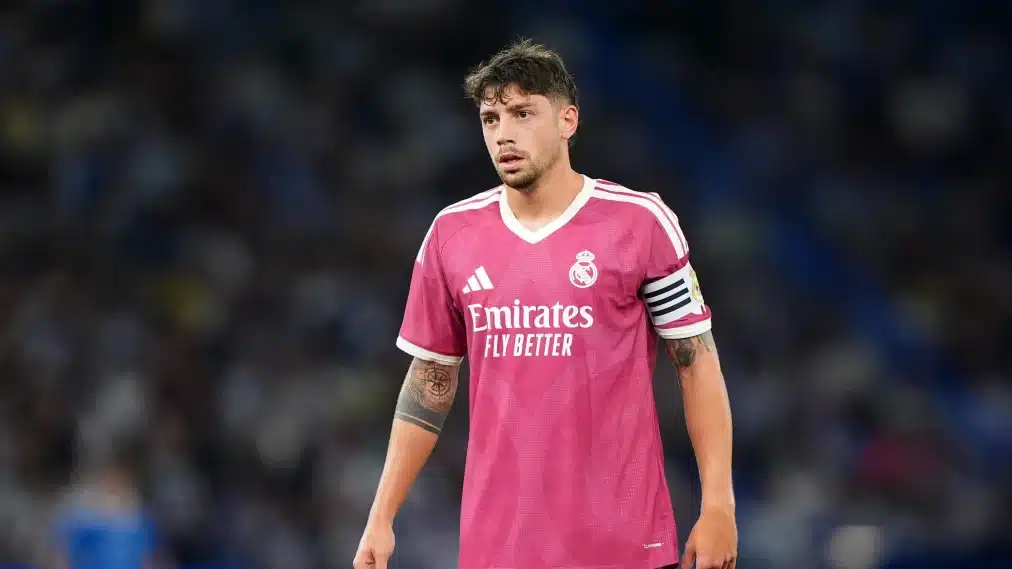
Fede Valverde has become Jose Mourinho’s key on-field link at Real Madrid, with the Uruguay midfielder receiving and relaying tactical instructions during the club’s opening two league matches.
According to Spanish newspaper AS, Valverde was the player Mourinho repeatedly targeted when he wanted to make adjustments during both games. On each occasion, the midfielder moved towards the bench to receive the Portuguese manager’s instructions before passing them on to his team-mates.
Playing in a deeper role has given Valverde influence across the pitch. He has contributed defensively, helped build attacks and taken on greater leadership responsibility. After creating a goal across the two matches, he has also emerged as a central figure in providing balance to a Real Madrid side with a formidable forward line.
Mourinho made his preference clear before the second league fixture against Real Sociedad.
“I don’t want Fede to play on the wing or at full-back, I want him to be a midfielder,” he said.
That is precisely how Valverde has been used. The Real Madrid number eight has become an important part of the team’s build-up from the back and, with Aurelien Tchouameni injured, has also been asked to provide defensive protection.
His partnership with Bernardo Silva in midfield appears capable of giving Real Madrid greater fluency while helping the side contain opposition attacks. Valverde’s ability to operate in every midfield position also allows Mourinho to shape the partnership according to the needs of each match.
He can play alongside Bernardo Silva while taking primary responsibility for defensive duties, or line up with Tchouameni or Eduardo Camavinga and enjoy greater freedom to move from one end of the pitch to the other.
A clear role in Mourinho’s system
The first two matches have shown that Mourinho’s in-game instructions have a specific recipient. After Espanyol’s goal and following Kylian Mbappe’s second goal, the manager called Valverde over to receive further directions and communicate them to the rest of the side.
For a manager who makes such frequent interventions during matches, having a trusted player perform that role is essential. Mourinho has selected Real Madrid’s captain for the task, seeking to place greater responsibility on a player whose leadership was criticised by supporters last year.
The new demands, both on and off the pitch, appear to have affected Valverde positively. He has shown a stronger captain’s personality in the opening two games, combining a defensive focus in his holding role with the energy that has long been one of his defining qualities.
Mourinho has traditionally been regarded as a manager capable of bringing the best out of midfielders, and Valverde appears particularly suited to his approach.
Statistics underline Valverde’s influence
Valverde received an average rating of eight from Flashscore across the first two matches. His passing success rate was 93% in one league game and 97% in the other.
Against Espanyol, he won four duels and completed three tackles. One of his efforts from outside the penalty area also struck the post.
His performance against Real Sociedad was even more complete. Valverde created a goal, supplied two key passes, hit the target with one shot, won three duels and recorded a 100% success rate from his tackles.
The Uruguay international continues to offer a little of everything, as he has done since arriving in Madrid. His commitment in every match has made him a favourite among supporters, with his performances reflecting his passion for the club.
Following Dani Carvajal’s departure, Valverde has inherited the captain’s armband. He must now show that he has learned from the senior leaders with whom he shared the dressing room and can guide Real Madrid’s next generation towards success.
Mourinho has made Valverde an important part of that process. In the first two league matches, the midfielder moved towards the bench after Real Madrid goals to take instructions from the manager, underlining the expanded leadership role the Portuguese coach wants his captain to embrace.
-
 CAF Champions League: CFFA face Young Africans in crucial second-round first leg Oct 17, 2026
 -
CAF Champions League: RS Berkane face Star Sport Academy test in Liberia Oct 17, 2026
-
CR Belouizdad’s CAF Confederation Cup tie postponed after CAS ruling Oct 17, 2026
-
CAF Champions League: FC San Pedro and FC Nouadhibou meet in crucial first-leg test Oct 17, 2026



-
AFCON 2025: Fixtures, Results, Scores and Standings Jan 18, 2026
-
Match hero Taiwo Awoniyi reflects on team effort after Chelsea triumph May 5, 2026
-
Leadership and long-term vision key to rescuing Zamalek and inspiring Egyptian football – Hany Abou Rida Nov 5, 2025
-
South African giants Orlando Pirates set to lose influential forward Monnapule Saleng Mar 19, 2025




-
Real Betis v Barcelona: kick-off time, TV details and match preview Oct 16, 2026
-
Roma v Real Madrid: home side tipped to score first in Champions League clash Oct 12, 2026
-
Atletico Madrid v Manchester United: probable line-ups for Champions League clash Oct 12, 2026
-
Celta Vigo v Juventus: Probable line-ups for Europa League encounter Oct 14, 2026