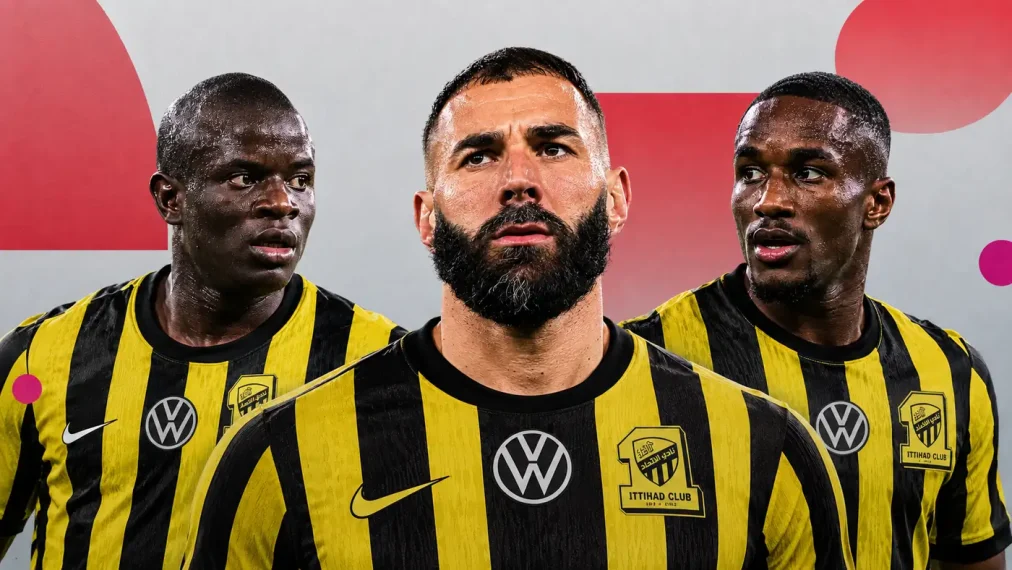
Al-Ittihad are moving away from the star-led project built around Karim Benzema and a strong French influence, with manager Jens Wissing overseeing a new era based on collective strength, tactical discipline and team-first football.
The Saudi club’s previous project began when Benzema arrived, with his signing viewed as part of a wider plan rather than an isolated move for a global superstar. Al-Ittihad subsequently added several players with clear links to French football.
Laurent Blanc was appointed manager, while Moussa Diaby and Houssem Aouar joined a squad that already included N’Golo Kante. Together, they gave the club a distinctly French identity on and off the pitch.
Al-Ittihad later strengthened their European profile by signing Dutch forward Steven Bergwijn and Portugal international Danilo Pereira, a player known for his time at Paris Saint-Germain. The mix of established names and elite European experience helped the club restore its status and return to the top of Saudi football.
That project delivered silverware. Al-Ittihad won the Roshn Saudi League and the King’s Cup, building a squad with enough quality to decide matches and enough experience to compete on several fronts.
However, the club’s direction changed significantly when a new administration began work in July 2025. Performances declined and a major restructuring followed, bringing the departure of many of the players who had formed the backbone of the previous project.
Blanc left first, followed by Benzema and Kante. Fabinho then departed, before Diaby recently moved to Bayer Leverkusen. The French influence has consequently been reduced to Aouar and Bergwijn.
This represents more than a change in personnel. It signals a fundamental shift in the way Al-Ittihad are being built. The club is no longer pursuing the same model of collecting globally recognised stars and placing them at the centre of its sporting identity.
Under the young German coach Wissing, Al-Ittihad are instead developing a more uncompromising footballing character. His apparent priority is to establish a side built around structure rather than individual reputation, with collective responsibility taking precedence over headline names.
Wissing is not seen as a manager who grants players special treatment because of their status. His approach focuses on role execution, discipline and movement within a unified system. His tactical instructions and firm decisions reflect the belief that the interests of the group must come first.
That philosophy is a major departure from the team supporters saw during the period of the so-called “French campaign”, but it also has a clear sporting logic. Al-Ittihad need more than famous players; they require a squad capable of following the same plan for 90 minutes in a league that demands consistency, physical power and tactical commitment.
Wissing also appears willing to make difficult decisions to establish his methods, even when that means losing players who were previously regarded as among the club’s most important stars. The approach gives his project a clear identity, but it also creates significant pressure because supporters will judge it by results, regardless of how convincing the underlying idea may be.
Since Wissing took charge, Al-Ittihad have beaten United Arab Emirates side Al Jazira 4-1 in the AFC Champions League Elite play-off. They drew 1-1 with Al-Kholood in their opening Roshn Saudi League match, then defeated Al-Qadsiah 1-0 and Al-Hazem 3-2. They also won 3-0 against Al-Najma in the King’s Cup.
Al-Ittihad now face a decisive point in their development. The administration must show that the sweeping changes can become the foundation of a stable and sustainable project, rather than leave a gap that proves difficult to fill after the departure of the previous stars.
Success will not be measured by the number of famous names in the squad. It will depend on whether Wissing and the club’s leadership can create a team with a clear identity, a defined purpose and the ability to compete without relying entirely on one or two players to produce moments of brilliance.
The French-led era appears to be nearing its end. In its place is an Al-Ittihad defined by discipline, toughness and collective football. The central question is whether that new thinking can produce a stronger team than the one built around its stars.
Only performances on the pitch will determine whether Al-Ittihad have abandoned a successful project or finally begun constructing a side capable of lasting for years without having to reinvent itself in every transfer window.
-
 Olwethu Makhanya attracts interest from Brentford and Sunderland Oct 17, 2026
 -
CAF Champions League: Full schedule for Saturday, 17 October Oct 17, 2026
-
Elyaz Zidane refuses to rush decision on Algeria international future Oct 17, 2026
-
Kanalelo: Marumo Gallants move offers coaching environment suited to his methods Oct 17, 2026




-
AFCON 2025: Fixtures, Results, Scores and Standings Jan 18, 2026
-
Match hero Taiwo Awoniyi reflects on team effort after Chelsea triumph May 5, 2026
-
Leadership and long-term vision key to rescuing Zamalek and inspiring Egyptian football – Hany Abou Rida Nov 5, 2025
-
South African giants Orlando Pirates set to lose influential forward Monnapule Saleng Mar 19, 2025




-
Real Betis v Barcelona: kick-off time, TV details and match preview Oct 16, 2026
-
Roma v Real Madrid: home side tipped to score first in Champions League clash Oct 12, 2026
-
Atletico Madrid v Manchester United: probable line-ups for Champions League clash Oct 12, 2026
-
Celta Vigo v Juventus: Probable line-ups for Europa League encounter Oct 14, 2026