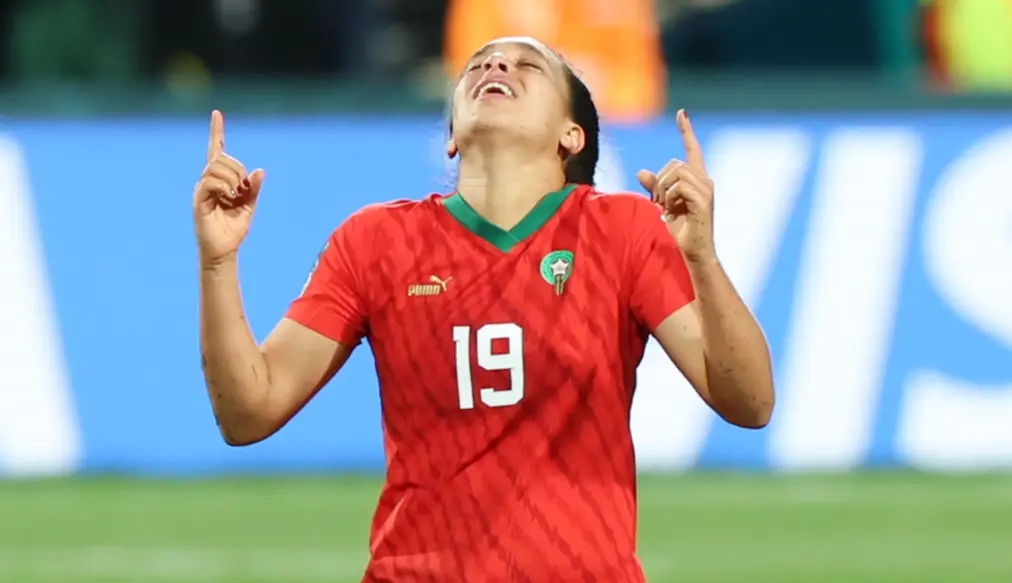
Sakina Ouzraoui has urged Morocco, Senegal and Algeria to preserve mutual respect despite their political and sporting rivalries during the 2026 Women’s Africa Cup of Nations.
The Morocco forward delivered her message after the Atlas Lionesses drew 0-0 with Senegal, saying football should remain a force for unity even when tensions between countries extend beyond the pitch.
Ouzraoui was speaking in the mixed zone after Morocco’s second group-stage meeting of the tournament. The Barcelona-born player highlighted the sense of fraternity that should exist between African national teams, regardless of the history or circumstances surrounding their encounters.
Morocco had already faced Algeria in the competition, beating them 1-0 before sharing the points with Senegal. Those two fixtures carried particular significance because both opponents have complicated relationships with Morocco.
Meetings between Morocco and Senegal have become more sensitive since controversies surrounding the final of the 2025 men’s Africa Cup of Nations. Relations between Morocco and Algeria remain especially strained at political level, notably because of the dispute over Western Sahara.
Against that backdrop, Ouzraoui’s intervention represented a direct appeal for calm. Her message was that rivalries, whether sporting, historical, identity-based or political, should not turn into hostility between players or peoples.
The midfielder’s comments also underlined the wider role football can play across the continent. Matches between national teams can bring together countries that may be distant or divided in other areas, while creating a shared language through sport.
For Morocco, that principle has been tested throughout the tournament. The Atlas Lionesses overcame Algeria in their opening meeting with a 1-0 victory, then held Senegal to a goalless draw.
Their attention now turns to the knockout stages and another demanding challenge. Morocco will face South Africa in the quarter-finals on Saturday, with a place in the semi-finals at stake.
The fixture gives Ouzraoui and her team the opportunity to continue their campaign on the field, while the player’s message has added a broader dimension to Morocco’s progress in the competition.
With regional rivalries never far from the background, she has insisted that competition should not erase solidarity. Her appeal is for the Women’s Africa Cup of Nations to remain a meeting point between African nations, rather than another arena in which political tensions are allowed to dominate.
The quarter-final against South Africa will therefore determine whether Morocco can reach the last four, but Ouzraoui’s intervention has already offered one of the tournament’s clearest reminders that sporting rivalry does not have to mean hatred.
-
 CAF Champions League: Egyptian sides win as preliminary round first legs conclude Oct 19, 2026
 -
Yan Diomande stars as Real Madrid beat Sevilla FC 4-1 in La Liga Oct 19, 2026
-
Morocco book place at 2026 Beach Soccer Africa Cup of Nations in Senegal Oct 19, 2026
-
Yan Diomande shines again as Real Madrid starlet sets Liga record Oct 19, 2026


-
AFCON 2025: Fixtures, Results, Scores and Standings Jan 18, 2026
-
Match hero Taiwo Awoniyi reflects on team effort after Chelsea triumph May 5, 2026
-
Leadership and long-term vision key to rescuing Zamalek and inspiring Egyptian football – Hany Abou Rida Nov 5, 2025
-
South African giants Orlando Pirates set to lose influential forward Monnapule Saleng Mar 19, 2025




-
Real Betis v Barcelona: kick-off time, TV details and match preview Oct 16, 2026
-
Morocco to face New Zealand as FIFA U-17 Women’s World Cup kicks off in Rabat Oct 16, 2026
-
Roma v Real Madrid: home side tipped to score first in Champions League clash Oct 12, 2026
-
Atletico Madrid v Manchester United: probable line-ups for Champions League clash Oct 12, 2026