Super Falcons carry ‘Mission X’ pressure as Nigeria chase another WAFCON crown
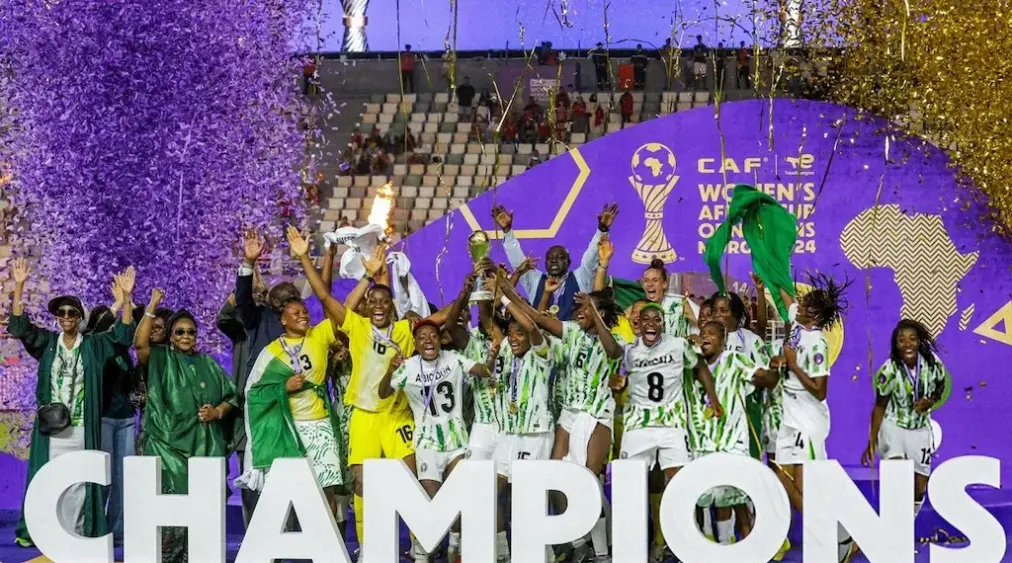
Nigeria’s Super Falcons have arrived in Morocco for the 2026 Women’s Africa Cup of Nations (Wafcon) carrying the weight of expectation that comes with being Africa’s most successful women’s football nation.
The defending champions return to the North African kingdom after securing a record-extending 10th continental title last year in a campaign famously dubbed “Mission X”.
Their dramatic 3-2 victory over Morocco in the final cemented Nigeria’s position as the benchmark of African women’s football, but the challenge now is even greater – defending their crown against a growing number of ambitious rivals.
Nigeria last achieved that feat in 2018, when they completed a hat-trick of consecutive Wafcon titles. Head coach Justin Madugu, who guided the team to glory last year, admits the target on their backs has grown bigger.
“Now that we are champions, every other team will want to draw you down,” Madugu told BBC Sport Africa.
“It’s not going to be easy. We are quite aware of that and we are going to be fully ready.”
The Super Falcons begin their title defence against tournament debutants Malawi on Tuesday before facing Zambia and Egypt in Group C.
Assistant coach Ann Chiejine, a four-time Wafcon winner during her playing career, believes Nigeria must raise their standards because of their status as champions.
“Every country wants to beat Nigeria,” said Chiejine.
“That is why we must up our game by making sure we train harder.”
Experience and youth combine in Nigeria’s title charge
Nigeria’s squad features some of the biggest names in African women’s football, with captain Rasheedat Ajibade, goalkeeper Chiamaka Nnadozie and six-time African Player of the Year Asisat Oshoala expected to provide leadership.
Ajibade was named the best player at last year’s tournament, while Nnadozie enters the competition as Africa’s reigning goalkeeper of the year.
However, Madugu has also blended the experienced stars with emerging talents, including Swedish-based striker Joy Omewa.
The youngster watched Nigeria’s triumph from afar last year but is now part of the squad hoping to create another memorable campaign.
“The last one was really exciting to watch. All the games were really good,” Omewa said.
“I think this year it’s going to be even bigger.”
Nigeria’s dominance at Wafcon is unmatched. The Super Falcons have won 10 of the 13 editions of the tournament since it began in 1998, with only Equatorial Guinea and South Africa managing to break their grip on the trophy.
But the landscape has changed, with the competition expanded from 12 to 16 teams and more countries making significant progress.
World Cup qualification remains Nigeria’s first priority
Although defending their continental crown is the ultimate ambition, Nigeria’s immediate focus is securing qualification for the 2027 FIFA Women’s World Cup in Brazil.
The four semi-finalists at Wafcon will earn automatic places at next year’s global tournament, making advancement from the group stage a crucial objective.
“Our first target is to qualify for the World Cup. After that we can think of defending our title,” winger Francisca Ordega told BBC Sport Africa.
“We are not under any kind of pressure. We can hold our own against any team across Africa.”
Nigeria have featured at every Women’s World Cup since the inaugural tournament in 1991, maintaining their position as Africa’s most consistent representative on the global stage.
The continent’s improvement has been evident in recent years, with more teams competing strongly against established powers.
“We have come of age,” Chiejine said when discussing the growth of African women’s football.
“If we are now being beaten by penalty shootout, or 1-0, 2-0, it means that the graph is rising.”
Malawi and Zambia provide serious threats
Nigeria may be favourites, but their Group C opponents present genuine challenges.
Malawi, making their first appearance at the tournament, arrive with one of Africa’s most dangerous attacking partnerships in sisters Tabitha and Temwa Chawinga.
Tabitha played a key role in Lyon’s success in France last season, while Temwa has established herself as one of the biggest stars in the United States after winning both the National Women’s Soccer League Golden Boot and MVP awards during her two full seasons with Kansas City Current.
Zambia will also provide a major test, with experienced forwards Barbra Banda and Racheal Kundananji offering significant attacking quality.
Madugu insists Nigeria cannot afford to underestimate any opponent.
“You don’t want to undermine or underestimate what anybody can do,” he said on the eve of the opening fixture.
Ajibade also highlighted Malawi’s progress, noting that their qualification demonstrates the continued growth of women’s football across the continent.
New generation embraces Nigeria’s winning mentality
Unlike previous Wafcon campaigns where preparation time was limited, Madugu and his technical team have enjoyed an extended build-up period.
Nigeria played a double-header against Cameroon earlier in the year, faced Senegal twice in June and defeated Tanzania in their final warm-up match before travelling to Morocco.
One of the new faces in the squad is goalkeeper Comfort Erhabor, who made her international debut against Cameroon.
Born in the Netherlands and raised in England, the Portsmouth goalkeeper says she has appreciated the trust placed in young players by Madugu.
“The trust he [Madugu] puts in us young players is something I respect a lot,” she said.
“I didn’t expect to get along so quickly and so well with the team. But they received me with open arms.”
Erhabor also explained why representing Nigeria was a natural decision despite being raised abroad.
“It’s in my blood, so I felt like there is no greater honour than to represent my roots, make my parents proud as well.
“I love the culture, and one big thing for me was how open everyone here is with Christianity and religion, because I felt that would allow me to come into the team, faith-based, and express myself.”
The Super Falcons will, however, be without defender Ashleigh Plumptre, who played a key role in last year’s title-winning campaign but misses the tournament due to a foot injury.
The squad was also disrupted after reports of theft following their arrival in Morocco, with forward Esther Okoronkwo reportedly among those affected.
With the prize money doubled and the winners set to receive $2 million, the tournament represents another major step in the growth of African women’s football.
But despite the increasing competition, Nigeria remain the side everyone wants to defeat — and the team everyone expects to deliver.
-
 Super Falcons carry ‘Mission X’ pressure as Nigeria chase another WAFCON crown Jul 27, 2026
 -
Nigeria outgun Ghana in six-goal U20 Wafu B opener to launch title defence Jul 27, 2026
-
FIFA appoints all-Egyptian officiating team for Al Ahli’s Intercontinental Cup opener Jul 27, 2026
-
Ajibade calls on Nigeria fans to lift Super Falcons as Women’s AFCON title defence begins against Malawi Jul 27, 2026



-
AFCON 2025: Fixtures, Results, Scores and Standings Jan 18, 2026
-
Leadership and long-term vision key to rescuing Zamalek and inspiring Egyptian football – Hany Abou Rida Nov 5, 2025
-
South African giants Orlando Pirates set to lose influential forward Monnapule Saleng Mar 19, 2025
-
Full schedule for 2025 Africa Cup of Nations in Morocco confirmed Feb 12, 2025




-
Morocco among first six nations to qualify for historic 2030 FIFA World Cup Jul 21, 2026
-
Yanga SC announce signing of two rising Tanzanian talents ahead of new campaign Jul 21, 2026
-
Bournemouth block Eli Junior Kroupi exit Jul 20, 2026
-
World Cup 2026: African stars feature as FIFA unveils 12 nominees for goal of the tournament Jul 21, 2026