Strict crackdown: FIFA introduces red card rule for mouth-covering gestures for 2026 World Cup
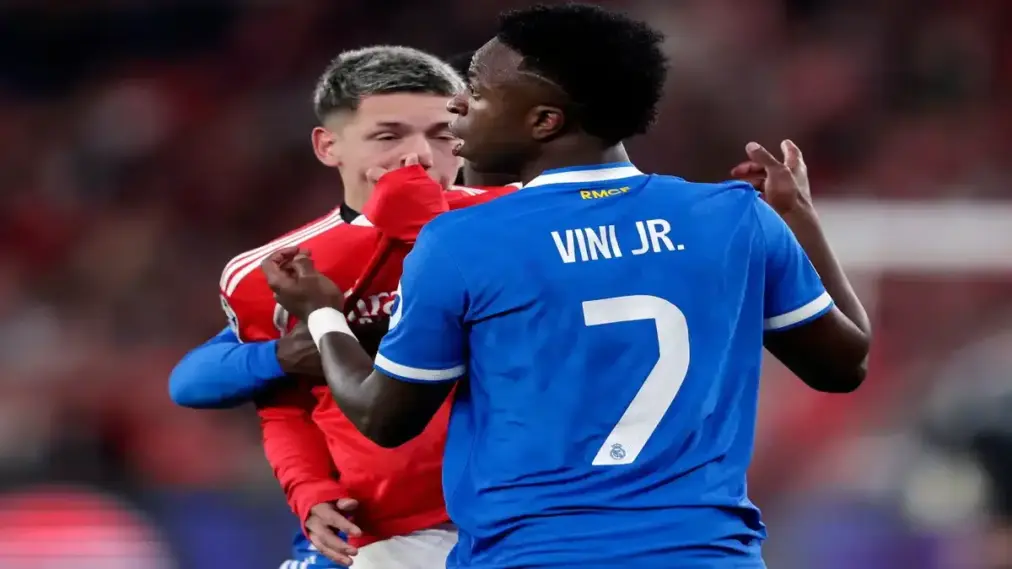
Players who cover their mouths during on-field confrontations could face red cards at the 2026 World Cup under new rules approved by football’s law-making body, IFAB.
The International Football Association Board confirmed the changes following a meeting in Vancouver, where it unanimously backed two amendments proposed by FIFA aimed at tackling discriminatory behaviour and excessive protests.
The measures will come into force at the expanded 2026 World Cup, which is scheduled to take place in the United States, Canada and Mexico.
Red cards for concealed communication
One of the most notable changes concerns the act of players covering their mouths while speaking during disputes on the pitch.
The practice, often used to prevent lip-reading, has been identified as a potential way to conceal inappropriate or discriminatory language.
Under the new framework, referees will have the authority to issue a red card to players who engage in such behaviour in certain situations.
The decision will be taken at the discretion of competition organisers and match officials, depending on the circumstances.
The aim is to discourage attempts to hide offensive remarks and to increase transparency during interactions between players.
Football’s governing bodies have indicated that the change is part of a broader effort to address discrimination within the game.
By introducing the possibility of immediate dismissal, the rule seeks to act as a deterrent against conduct that undermines the principles of respect and fairness on the field.
Crackdown on collective protests
A second amendment focuses on how players and officials respond to refereeing decisions.
The new rule states that any player who deliberately leaves the pitch to protest a decision may face expulsion.
The provision also extends to team officials who encourage or instigate such actions.
In cases where a team’s actions lead to a match being abandoned, that team will generally be declared the loser by forfeit.
These measures are intended to reinforce the authority of referees and prevent situations where games are disrupted by coordinated protests.
Instances of players leaving the field in protest have drawn increasing attention in recent competitions, prompting calls for clearer and stricter regulations.
By establishing firm consequences, IFAB and FIFA aim to ensure that matches proceed without interruption and that disputes are handled within the framework of the laws of the game.
Context of recent incidents
The introduction of these rules comes against the backdrop of incidents that have raised concerns within football.
One such case involved an exchange between Vinícius Júnior and Gianluca Prestianni during a Champions League play-off match between Real Madrid and Benfica in February 2026.
Following the incident, Prestianni received a six-match suspension on 24 April after being accused of making discriminatory remarks.
The case contributed to renewed discussions about how best to address similar situations and prevent them from occurring in future competitions.
While the new regulations are not limited to any single incident, they reflect a growing emphasis on tackling both discriminatory behaviour and actions that disrupt matches.
Implementation at the 2026 World Cup
The rules approved in Vancouver will apply at the 2026 World Cup, which will feature 48 teams in an expanded format.
Participating nations are expected to be informed of the changes in the lead-up to the tournament.
The introduction of these measures represents a significant development in how disciplinary issues are handled on football’s biggest stage.
Referees will be given additional authority to enforce the rules, with the expectation that players and officials will adapt accordingly.
The timing of the decision highlights the intention of football’s governing bodies to address these concerns ahead of a major global event, ensuring that standards are clearly defined.
Message from governing bodies
Through these amendments, IFAB and FIFA are signalling a stricter approach to behaviour both on and off the pitch.
The focus on transparency and accountability reflects an effort to maintain the integrity of the sport while protecting those involved.
The combination of sanctions for concealed communication and penalties for collective protests is designed to address two areas that have generated debate in recent years.
By introducing clear consequences, the governing bodies aim to deter misconduct and reinforce expectations around player behaviour.
As preparations continue for the 2026 World Cup, the new rules underline a broader commitment to ensuring that the competition is conducted in line with principles of fairness, respect and order.
-
 Football betting tips: Kane, Haaland and PSG corners among Saturday’s best picks Oct 17, 2026
 -
Ghana appoint Kim Lars Björkegren to lead Black Stars interim technical team Oct 17, 2026
-
Ghana’s Black Starlets secure top spot after powerful unbeaten run at WAFU B U17 Championship Oct 17, 2026
-
Elyaz Zidane opens up on pressure of living in father Zinédine’s shadow Oct 17, 2026




-
AFCON 2025: Fixtures, Results, Scores and Standings Jan 18, 2026
-
Match hero Taiwo Awoniyi reflects on team effort after Chelsea triumph May 5, 2026
-
Leadership and long-term vision key to rescuing Zamalek and inspiring Egyptian football – Hany Abou Rida Nov 5, 2025
-
South African giants Orlando Pirates set to lose influential forward Monnapule Saleng Mar 19, 2025




-
Real Betis v Barcelona: kick-off time, TV details and match preview Oct 16, 2026
-
Roma v Real Madrid: home side tipped to score first in Champions League clash Oct 12, 2026
-
Atletico Madrid v Manchester United: probable line-ups for Champions League clash Oct 12, 2026
-
Celta Vigo v Juventus: Probable line-ups for Europa League encounter Oct 14, 2026