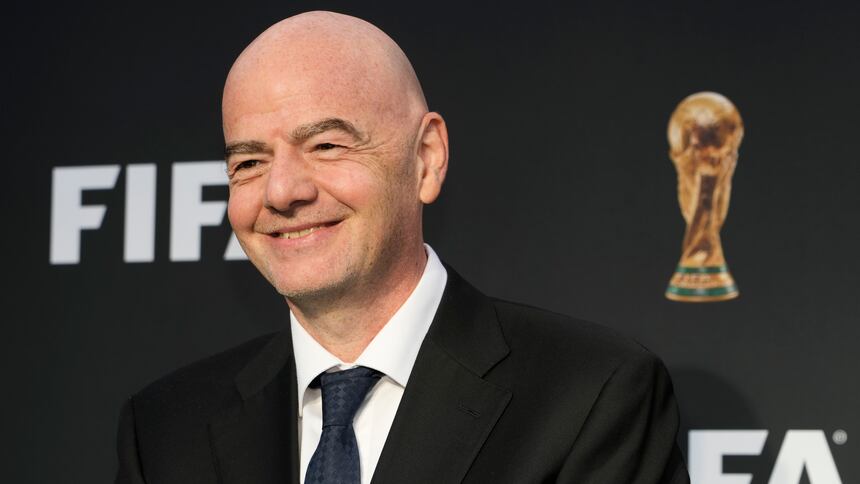
● Gianni Infantino confirms that “we have brought football back to FIFA and FIFA back to football” since he was elected on 26 February 2016
● FIFA’s Member Associations have followed a new path built on reform, transparency and development.
● Mr Infantino says FIFA is the glue that holds the sport together
On the 10th anniversary of his election as FIFA President, Gianni Infantino has written to the presidents of each of the 211 FIFA Member Associations (MAs), thanking them for their support and for helping FIFA transform the governance of the world’s most popular sport.
Listing 11 key achievements since he was elected at the Extraordinary Congress in Zurich, Switzerland, on 26 February 2016, Mr Infantino said:
“I believe we have successfully brought football back to FIFA and FIFA back to football. And we have done so together.”
Mr Infantino recalled that when he was elected, FIFA faced a crisis that threatened its very existence and that, by voting for him, the FIFA Congress chose to chart a new path forward “built on reform, transparency and development”.
He emphasised that unity between FIFA and the MAs had been a key to football’s transformation. “It is therefore with a great sense of unity that I would like to extend my deepest thanks for your work, your dedication and, of course, your unwavering support in making this possible and for your role in bringing FIFA back to football over the last 10 years,” the FIFA President said.
He also spoke of the importance of a strong, functioning FIFA to the sport. “FIFA is the glue that binds the footballing pyramid and the wider footballing ecosystem together,” he said, adding that they had also transformed how FIFA was viewed as an institution.
“This is why a strong, trusted and unified FIFA is not only desirable, but also in fact necessary for our sport to continue to flourish.”
He concluded: “Thank you for keeping the best interests of football at heart and recognising that although we live in a world marked by division and conflict, football is still the great power that unites us all.”
The key achievements are:
- More direct funding to FIFA Member Associations via the FIFA Forward Programme introduced in 2016. Funding has increased sevenfold since then and MAs decide how best to invest in football development in their own territories.
- More development of young talent at FIFA Member Associations thanks to the FIFA Talent Development Scheme. This aims to ensure that every young player is given the chance to develop their talent regardless of their financial circumstances or where in the world they live.
- More capacity building within FIFA Member Associations in key administrative fields including legal, finance, infrastructure, medical, IT, safeguarding and security, plus dedicated programmes targeting women in leadership positions in football.
- More involvement in decision-making by FIFA Member Associations who gather in open forums, known as the FIFA Executive Summits, to share and discuss ideas about the future of the game, together with the newly introduced FIFA Standing Committees
- More fairness on the field for FIFA Member Associations thanks to the introduction of the Video Assistant Referee (VAR) system in 2018, now implemented in 83 MAs. FIFA has sought to further democratise these benefits firstly through the development of VAR Light and, more recently, through the introduction of Football Video Support. In addition, in 2024, FIFA took a Global Stand Against Racism, with the unanimous support of all 211 FIFA MAs.
- More transparency off the field for FIFA Member Associations with annual accounts delivered to the highest standards (International Financial Reporting Standards (IFRS)), a central review programme covering all development funds and transparency brought to the bidding and appointment processes for major tournaments.
- Providing more playing opportunities for men’s national teams with the expansion of the FIFA World Cup™ to 48 teams, giving more nations the chance to dream of playing on the global stage and the introduction of the FIFA Series, which in 2026 will feature 36 teams from six continents.
- Similarly, there are more women’s national team opportunities for FIFA Member Associations with the FIFA Women’s World Cup™ expanded to 32 teams for the 2023 edition and 48 teams from 2031 onwards. Over 1,700 women’s development projects have been delivered across 204 FIFA MAs.
- More youth national team opportunities for FIFA Member Associations, creating clearer pathways from grassroots football to elite performance. The expansion of the FIFA U-17 World Cup™ – at both girls’ and boys’ level – has exposed many more players from all around the world to international competition at a much younger age. Meanwhile, thousands of young lives will be transformed by the introduction of a new festival-style FIFA U-15 Youth World Cup open to all 211 FIFA MAs.
- More relief in times of hardship to FIFA Member Associations including the COVID-19 Relief Plan, which made USD 1.5 billion available, and emergency disaster relief funding, which is provided by the FIFA Foundation to aid recovery from natural disasters. In December 2025, a post-conflict recovery fund was approved by the FIFA Council to provide much needed support for those that experience the horrors of war and ensure football remains a vector for peace in troubled times.
- More focus on club football alongside FIFA Member Associations, including the historic first-ever FIFA Club World Cup™ in 2025, with the new FIFA Women’s Club World Cup™ set to follow suit in 2028, plus the annual FIFA Intercontinental Cup™ and the FIFA Women’s Champions Cup™, respectively. FIFA has also increased the distribution and widened the scope of the FIFA Club Benefits Programme.
-
 Morocco face Argentina with Women’s Under-17 World Cup place at stake Oct 23, 2026
 -
MC Alger need a historic comeback to keep African Champions League hopes alive Oct 23, 2026
-
Barcelona and Real Madrid tracking Aston Villa midfielder Johan Manzambi Oct 23, 2026
-
Nagida shines as Rennes hold Juventus to 2-2 draw Oct 23, 2026



-
AFCON 2025: Fixtures, Results, Scores and Standings Jan 18, 2026
-
Match hero Taiwo Awoniyi reflects on team effort after Chelsea triumph May 5, 2026
-
Leadership and long-term vision key to rescuing Zamalek and inspiring Egyptian football – Hany Abou Rida Nov 5, 2025
-
South African giants Orlando Pirates set to lose influential forward Monnapule Saleng Mar 19, 2025




-
PSG v Barcelona: fiery attacks set up Champions League classic at Parc des Princes Oct 18, 2026
-
Champions League: PSG beat Barcelona as Liverpool complete comeback against Villarreal Oct 20, 2026
-
Real Betis v Barcelona: kick-off time, TV details and match preview Oct 16, 2026
-
PSG beat Barcelona 4-2 in Champions League thriller Oct 21, 2026