Senegal federation fumes as Morocco jails 18 fans after AFCON final unrest
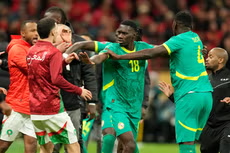
The Senegalese Football Federation has strongly criticised Moroccan authorities after 18 Senegal supporters were handed prison terms over disturbances during last month’s Africa Cup of Nations final in Rabat.
The federation described the ruling as excessively severe, arguing that the punishment does not reflect the scale of the incidents that marred a tense and emotionally charged decider.
The verdict, delivered on Thursday, saw the group sentenced to jail terms ranging from three months to a year, alongside financial penalties.
The supporters had been held in custody since January 18, the night Senegal edged hosts Morocco 1-0 to lift the continental crown on Moroccan soil. The closing stages of that encounter descended into disorder as tempers flared inside the stadium.
Television footage captured several Senegal fans attempting to breach security barriers and enter the pitch. Objects, including a chair, were hurled toward the playing surface.
The match itself was halted for nearly 20 minutes when Senegal’s players protested a late penalty awarded to Morocco, a decision that heightened tensions among sections of the travelling support.
Prosecutors in Rabat pursued charges of hooliganism against the defendants. The accusations included acts of violence, notably against law enforcement officers, damage to stadium infrastructure, pitch invasion and the throwing of projectiles.
Nine supporters received 12-month custodial sentences and fines of 5,000 Moroccan dirhams. Six were jailed for six months and fined 2,000 dirhams, while three were given three-month terms accompanied by smaller financial penalties.
Reacting to the outcome, Bacary Cisse, who heads the federation’s communications committee, voiced the governing body’s frustration. “We express our profound dismay and distress following the verdict,” he said. “This incomprehensibly harsh decision has provoked widespread outrage.”
Cisse questioned the proportionality of the sanctions, pointing out that stadium disturbances are not uncommon in global football. “Clashes occur in numerous stadiums around the world, including every weekend in Morocco, without resulting in such sanctions,” he said. “The treatment of these supporters therefore appears disproportionate.”
Defence counsel Patrick Kabou also rejected the ruling, branding it “incomprehensible” and insisting his clients were “victims.”
-
 Adama Traoré eyes first Deportivo La Coruña starting role after improved form Oct 26, 2026
 -
Lamine Yamal strengthens Ballon d’Or 2026 case with goals, assists and titles Oct 26, 2026
-
Congo name preliminary squad for 2027 Africa Cup of Nations qualifiers Oct 26, 2026
-
Botswana name squad for crucial Uganda double-header in 2027 Africa Cup of Nations qualifiers Oct 26, 2026


-
AFCON 2025: Fixtures, Results, Scores and Standings Jan 18, 2026
-
Match hero Taiwo Awoniyi reflects on team effort after Chelsea triumph May 5, 2026
-
Leadership and long-term vision key to rescuing Zamalek and inspiring Egyptian football – Hany Abou Rida Nov 5, 2025
-
South African giants Orlando Pirates set to lose influential forward Monnapule Saleng Mar 19, 2025




-
Barcelona v Real Madrid: Catalans backed at 1.65 to win October Clasico Oct 23, 2026
-
Barcelona and Real Madrid meet in pivotal 265th Clasico Oct 23, 2026
-
Champions League: PSG beat Barcelona as Liverpool complete comeback against Villarreal Oct 20, 2026
-
Inter Milan v Fiorentina: probable line-ups for San Siro clash Oct 24, 2026