Senegal FA takes responsibility for CAF sanctions
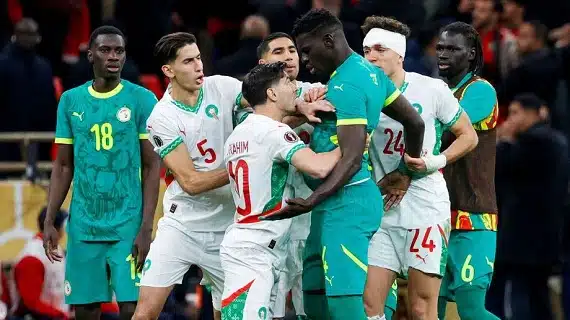
Senegal’s Football Federation has confirmed it will not challenge the sporting and financial sanctions imposed by the Confederation of African Football following disciplinary proceedings linked to the Africa Cup of Nations.
In a statement issued on Saturday, the Senegalese Football Federation (FSF) said it had taken note of the ruling delivered on 28 January by CAF’s Disciplinary Committee and had decided to bring the matter to a close.
The decision comes three days after CAF announced penalties affecting head coach Pape Bouna Thiaw, players Iliman Ndiaye and Ismaila Sarr, as well as the national governing body itself.
The FSF said it “officially acknowledges the decision” taken by CAF and confirmed that it would not pursue an appeal.
By doing so, the federation has chosen to end what had become a sensitive and closely watched dispute at continental level during the AFCON 2025 campaign.
In the same statement, the FSF made clear that it would shoulder the full financial consequences of the sanctions. It stated that it “confirms that it assumes full financial responsibility for the fines imposed on its association, its technical staff and its players.”
The federation did not provide further detail on the amounts involved, but the declaration signals a willingness to resolve the matter internally rather than prolong the process through legal channels.
While accepting the disciplinary outcome, the FSF also sought to underline its broader position within African football governance. The organisation, led by Abdoulaye Fall, insisted that accepting the sanctions does not amount to a waiver of its institutional stance.
It said it “reaffirms its determination to defend its legitimate rights and interests within the governing bodies of football (…).”
The wording suggests that, although no appeal will be lodged in this specific case, the federation remains attentive to how Senegalese football is treated within CAF structures.
The episode has drawn significant attention at home, where the national team’s conduct and treatment during AFCON is a subject of intense public interest.
By opting not to appeal, the FSF appears keen to draw a line under the controversy and refocus attention on sporting matters.
The decision closes the disciplinary chapter surrounding the sanctions, while leaving open the federation’s intention to remain actively engaged in future discussions and debates within African football’s decision-making bodies.
Communiqué FSF : Réponse de la FSF suite à la décision rendue par le jury disciplinaire de la CAF pic.twitter.com/BdnyUvoX8T
— FSF (@Fsfofficielle) January 31, 2026
-
 Azam FC edge ZED FC to reach next round of CAF Confederation Cup Oct 24, 2026
 -
CAF Confederation Cup: Azam FC and ZED FC go into half-time level Oct 24, 2026
-
CAF Champions League: How to watch Zamalek SC v APR FC second leg live Oct 24, 2026
-
CAF consults member federations over return to biennial Africa Cup of Nations Oct 24, 2026


-
AFCON 2025: Fixtures, Results, Scores and Standings Jan 18, 2026
-
Match hero Taiwo Awoniyi reflects on team effort after Chelsea triumph May 5, 2026
-
Leadership and long-term vision key to rescuing Zamalek and inspiring Egyptian football – Hany Abou Rida Nov 5, 2025
-
South African giants Orlando Pirates set to lose influential forward Monnapule Saleng Mar 19, 2025




-
Barcelona v Real Madrid: Catalans backed at 1.65 to win October Clasico Oct 23, 2026
-
Barcelona and Real Madrid meet in pivotal 265th Clasico Oct 23, 2026
-
PSG v Barcelona: fiery attacks set up Champions League classic at Parc des Princes Oct 18, 2026
-
Champions League: PSG beat Barcelona as Liverpool complete comeback against Villarreal Oct 20, 2026