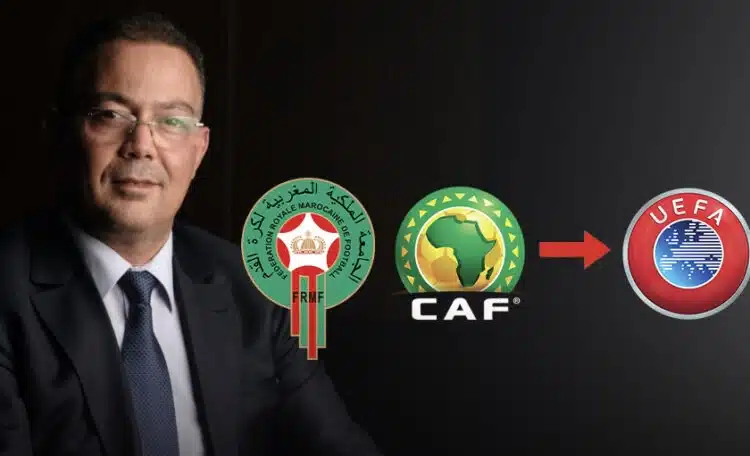
Is Morocco really leaving CAF for UEFA after AFCON heartbreak?
The immediate fallout from the recent Africa Cup of Nations final created fertile ground for misinformation. As emotions spilled over following the decisive match, social media platforms were flooded not only with heated reactions but also with misleading narratives that blurred the line between frustration and fact.
Moments of collective disappointment often invite simplified explanations, and this episode was no exception.
For many Moroccan supporters, the aftermath of the final appeared to confirm a long-standing sentiment of marginalization within African football. This feeling is paradoxical.
Morocco has consistently invested in continental competitions, modernized infrastructure, and positioned itself as a welcoming host for major African sporting events. Yet, when controversy arises, a perception quickly takes hold that the country stands apart, bound structurally to the same system but emotionally estranged from it.
It is within this psychological space that withdrawal fantasies begin to replace legal and institutional realities. Rather than engaging with the complex governance mechanisms of international football, online discourse gravitated toward symbolic exits and imagined alternatives, offering emotional relief rather than practical solutions.
How a rumor turned into a viral “fact”
Among the most widely shared claims were posts asserting that Morocco had officially applied to leave the Confederation of African Football and seek membership in the Union of European Football Associations. Some went further, confidently announcing that the Atlas Lions would feature at UEFA Euro 2028.
These claims appeared in multiple forms. Some were framed as impassioned appeals from ordinary fans, others masqueraded as breaking news attributed vaguely to “Moroccan media.” Repeated often enough, the narrative took on the appearance of legitimacy, gradually transforming anger into alleged fact.
What made the rumor particularly potent was its ability to merge sporting disappointment with legal misinformation. In an environment already charged with emotion, the distinction between institutional action and popular sentiment became increasingly blurred.
Elitism, exclusion, and competing narratives
The online debate did not stop at rumors of confederation switching. Certain elitist narratives lamented what they described as a widening gap between Morocco’s advanced infrastructure and organizational capacity and what critics portrayed as an African football culture slow to evolve beyond entrenched practices.
In its most extreme articulation, this argument suggested that Africa, in its current footballing culture, did not “deserve” Morocco. Some commentators framed Morocco’s heavy investment in stadiums, training centers, and governance reforms as having raised standards beyond what the continental environment could absorb.
On the opposite end of the spectrum, hardline Africanist voices contributed their own exclusionary rhetoric. Some argued that continental football should remain exclusively Black, depicting North African participation as an intrusion. Within this logic, Morocco’s withdrawal, or even exclusion, was presented as acceptable, if not desirable.
Together, these opposing extremes revealed how football frustration can quickly morph into broader cultural and political disputes, far removed from the regulatory realities of the sport.
Separating emotion from institutional reality
So, what is the truth behind the headlines and hashtags? Simply put, Morocco is not leaving CAF for UEFA.
There has been no official request, no formal procedure initiated, and no confirmation from any competent football authority. Despite claims attributing the story to Moroccan media, the Royal Moroccan Football Federation has issued no statement indicating any intention to change confederations.
Likewise, major Moroccan newspapers, recognized international news agencies, FIFA, and UEFA have all remained silent. In the absence of official documentation or acknowledgment, the story remains a rumor with no factual foundation.
What did occur, and has often been overlooked, is a formal response to events surrounding the AFCON final. Following incidents during the match against Senegal, the FRMF submitted an official complaint to CAF and FIFA, requesting an investigation.
This step was procedural, not political, and firmly rooted in existing governance mechanisms. The leap from that complaint to a supposed UEFA application exists only in the realm of online speculation.
What FIFA regulations actually say
Understanding why the rumor lacks credibility requires a closer look at football’s regulatory framework. FIFA statutes clearly establish confederation membership as mandatory, stating that an association may only be a FIFA member if it also belongs to a confederation.
FIFA does allow for exceptional circumstances. Under its statutes, the world governing body may authorize a confederation to admit an association that geographically belongs to another continent, but only after consultation with the relevant confederation. This is not a unilateral decision by a national federation, nor is it driven by short-term sporting grievances.
For Morocco, any such move would require FIFA authorization and formal consultation with CAF, given its geographic location in Africa. Even at this initial stage, the process is complex, political, and highly restrictive.
UEFA’s even narrower door
UEFA’s own statutes present additional barriers. Membership is generally limited to national associations located within Europe and recognized internationally. While a conditional exception exists for non-European associations, the criteria are stringent.
An applicant must not be a member of another confederation and must receive explicit approval from FIFA. Even then, acceptance is not automatic. UEFA’s Congress retains final authority and bases its decision on organizational, sporting, and political considerations.
Such a process would likely take years, even under favorable conditions. It is a governance-heavy procedure involving multiple stakeholders, not a symbolic gesture born of frustration or a reactionary online campaign.
Rare precedents, exceptional contexts
Football history offers only a handful of examples of confederation switching, each shaped by unique circumstances. Australia’s move from the Oceania Football Confederation to the Asian Football Confederation in 2006 was driven by the need for stronger competition and more stable World Cup qualification pathways.
Kazakhstan joined UEFA in 2002 after leaving the Asian confederation, following extensive political and sporting deliberations. Israel represents another exceptional case, having been expelled from the Asian confederation in 1974 and admitted to UEFA two decades later amid complex geopolitical realities.
These precedents underline a key point. Confederation switching is theoretically possible but practically rare, deeply contextual, and dependent on factors far more substantial than dissatisfaction with refereeing decisions or tournament outcomes.
Morocco’s strategy remains anchored in Africa
Beyond regulatory hurdles, Morocco’s broader strategic priorities make a UEFA switch particularly implausible. The country is preparing to co-host the 2030 World Cup alongside Spain and Portugal, marking the first time Africa and Europe will jointly stage football’s premier tournament.
This historic arrangement derives much of its strength from Morocco’s unique position as a bridge between continents. Abandoning its African affiliation would weaken that strategic role at a critical moment.
In an interview with France Football last December, FRMF President Fouzi Lekjaa articulated a clear vision. He emphasized Morocco’s intention to contribute to African football by sharing expertise, circulating experience, and promoting improved organizational practices across the continent.
Rather than advocating separation, Lekjaa proposed deeper cooperation. Within the context of the 2030 World Cup, he floated the idea of joint Euro-African competitions, arguing that the real question is not whether cooperation is possible, but how it can be organized intelligently and fairly.
Cooperation, not withdrawal
This perspective aligns with Morocco’s long-term approach to football diplomacy. Joint competitions and structured collaboration could raise the competitive level of African football, enhance player development, and strengthen intercontinental relationships. Such initiatives reflect an outward-looking strategy, not an escapist one.
Another source of confusion lies in the distinction between confederation membership and participation in competitions outside one’s confederation. FIFA treats these as separate matters, both subject to strict conditions and multiple approvals. An invitation to participate elsewhere does not equate to a change in confederation status.
Against this backdrop, claims that Morocco will appear at UEFA Euro 2028 are unfounded. The tournament, scheduled for June and July 2028 and co-hosted by England, Scotland, Wales, and the Republic of Ireland, is restricted to UEFA member associations.
The reality behind the noise
The conclusion is unequivocal. Morocco has not applied to leave CAF. It has not requested UEFA membership. No legal or institutional process exists to that effect.
What does exist is a surge of fan anger amplified by social media and detached from regulatory reality. Morocco remains firmly embedded within the African football framework, pursuing its grievances through official channels and engaging in broader conversations about reform and cooperation rather than withdrawal.
In doing so, the country continues to reflect a long-standing vision that positions Morocco as an active pan-African partner, committed not to abandoning the continent, but to shaping its footballing future through engagement, investment, and institutional dialogue.
Article originally published by Morocco World News
-
 USM Alger to play both CAF Confederation Cup legs at home Oct 18, 2026
 -
Inter Milan assess Udinese goalkeeper Maduka Okoye as January target Oct 18, 2026
-
Brahim Diaz could leave Real Madrid in January as playing time dwindles Oct 18, 2026
-
Africa football news: Ibrahima Sory Bangoura extends KRC Genk contract to 2030 Oct 18, 2026



-
AFCON 2025: Fixtures, Results, Scores and Standings Jan 18, 2026
-
Match hero Taiwo Awoniyi reflects on team effort after Chelsea triumph May 5, 2026
-
Leadership and long-term vision key to rescuing Zamalek and inspiring Egyptian football – Hany Abou Rida Nov 5, 2025
-
South African giants Orlando Pirates set to lose influential forward Monnapule Saleng Mar 19, 2025




-
Real Betis v Barcelona: kick-off time, TV details and match preview Oct 16, 2026
-
Morocco to face New Zealand as FIFA U-17 Women’s World Cup kicks off in Rabat Oct 16, 2026
-
Roma v Real Madrid: home side tipped to score first in Champions League clash Oct 12, 2026
-
Atletico Madrid v Manchester United: probable line-ups for Champions League clash Oct 12, 2026