FIFA knowledge exchange workshop in Rabat highlights pathways for football development
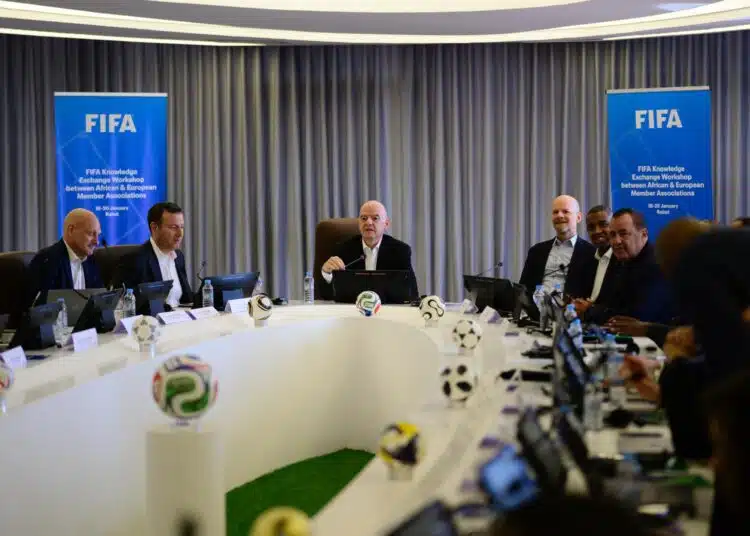
The FIFA office in Rabat hosted a Knowledge Exchange Workshop on Monday, bringing together sports officials and football representatives from Africa and Europe to promote shared learning and collaboration in football development.
The event formed part of FIFA’s broader initiative to encourage the exchange of expertise and best practices among member associations.
The workshop gathered delegates from 10 member associations, including Morocco, Côte d’Ivoire, Madagascar, and Cabo Verde, alongside European representatives from Turkiye, Iceland, Switzerland, Poland, and Croatia.
It provided a platform for in-depth discussions on national team development through presentations, panel discussions, and practical site visits, including a tour of Morocco’s Mohammed VI National Technical Center.
Throughout the sessions, participants exchanged experiences and strategic insights, with contributions from the Royal Moroccan Football Federation offering perspectives on high-performance structures and long-term planning.
Discussions centred on best practices in national team development, the hosting of international football events, and the effective management of elite training centres.
FIFA President Gianni Infantino welcomed the participants from Africa and Europe, describing the FIFA office in Rabat as beautiful.
He underlined football’s status as a global game that presents unique challenges, stressing that maintaining an open mind and open spirit is essential to driving the sport forward. Infantino also praised Morocco’s hosting of the Africa Cup of Nations, describing the facilities used during the tournament as modern stadiums.
“It made me very proud to see first-hand the progress in African football infrastructure and experience the wonderful hospitality,” he said.
The positive sentiment was echoed by Stipe Pletikosa, Technical Director of the Croatian Football Federation, who described the workshop as a “great initiative.”
He noted the value of such exchanges in fostering cooperation and growth within the global football community.
“These knowledge exchanges help us build bridges, including football bridges, to make the game more successful and truly global. It is extremely valuable to hear the experiences of other member associations, especially on different topics, and equally important is the bonding we are creating together,” Pletikosa said.
Robert Breiter, General Secretary of the Swiss Football Federation, also highlighted the importance of the discussions, particularly those focused on technical centres. He pointed to Switzerland’s ongoing plans to build a national technical centre and explained how learning from federations at different stages of similar projects proved insightful.
“We had an exchange, for example, about national technical centres, and here in Switzerland we are in the process of building one; so it’s very interesting to listen to federations that are also going through the same process or those that have already completed theirs,” Breiter stated.
Reflecting on the visit to the National Technical Centre at the Mohammed VI Complex of the Royal Moroccan Football Federation, Breiter described it as a magnificent showcase that offered fresh perspectives.
“That too gives us new ideas and opens up perspectives,” he concluded.
-
 Morocco v Senegal: TAS decision on CAN 2025 title expected in October Oct 9, 2026
 -
Chelsea look to secure Josh Acheampong’s future amid Premier League interest Oct 9, 2026
-
Anis Hadj Moussa named Eredivisie player of the month for September Oct 9, 2026
-
CFFEB and Majestic SC secure 1-0 wins in Fasofoot Ligue 1 Oct 9, 2026




-
AFCON 2025: Fixtures, Results, Scores and Standings Jan 18, 2026
-
Match hero Taiwo Awoniyi reflects on team effort after Chelsea triumph May 5, 2026
-
Leadership and long-term vision key to rescuing Zamalek and inspiring Egyptian football – Hany Abou Rida Nov 5, 2025
-
South African giants Orlando Pirates set to lose influential forward Monnapule Saleng Mar 19, 2025




-
Croatia face Spain with Nations League hopes on the line in Split Oct 5, 2026
-
France v Belgium: Probable line-ups for Nations League clash Oct 3, 2026
-
Morocco coach Mohamed Ouahbi refuses to single out player after Mali draw Oct 4, 2026
-
Manchester United host winless Tottenham in Premier League clash Oct 7, 2026