AFCON 2025: Samuel Eto’o calls for calmer images and stronger institutions
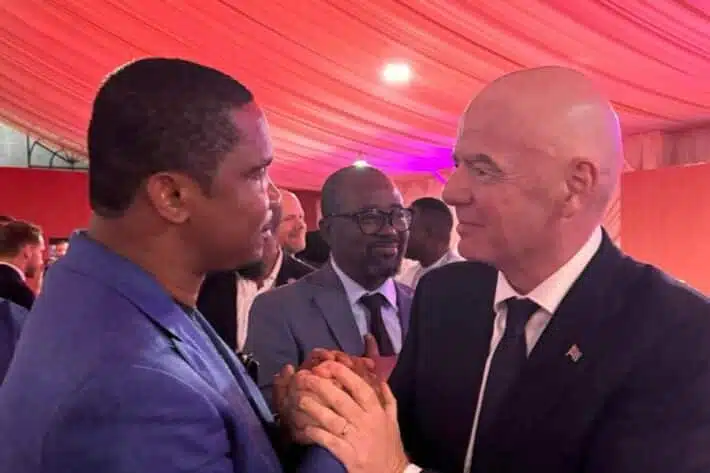
Samuel Eto’o has called for greater restraint and institutional progress in African football after conceding that the 2025 Africa Cup of Nations final was overshadowed by incidents that detracted from the spectacle.
Speaking to France 24 following the conclusion of the tournament, the president of the Cameroonian Football Federation began by paying tribute to Senegal, who secured the continental title after a tense final against hosts Morocco.
Eto’o stressed that the Lions of Teranga’s triumph was no accident, describing it as the product of sustained effort and collective commitment, and hailing it as an important moment for West African football.
However, the former African Footballer of the Year did not shy away from addressing the controversies that marked the match.
As the interview unfolded, Eto’o turned his attention to the refereeing decisions and heated scenes that drew widespread reaction, offering a measured but candid assessment of what went wrong.
” Let me congratulate Senegal; it’s well-deserved for the entire team. Regarding the incidents that marked this final, I hope we will work to improve these images, and I think we could have avoided them.
We need to continue improving our institution; otherwise, congratulations to the Moroccans for the organization, the infrastructure, and everything else. Returning to the incidents, let’s not forget that referees are human beings like everyone else.”
Eto’o’s remarks underlined what many observers see as a contradiction at the heart of African football’s recent progress.
While the continent has made visible strides in infrastructure and tournament organisation, questions remain over match management and governance during high-pressure encounters.
The Cameroonian legend was keen to single out Morocco’s role as hosts, praising the standard of stadiums and overall logistics.
In his view, the material conditions are now in place for African competitions to rival the best on the global stage.
Yet he warned that physical infrastructure alone is not enough to elevate the game’s reputation.
Central to Eto’o’s intervention was his defence of match officials, coupled with a clear call for higher refereeing standards.
By reminding audiences that “ referees are human beings like everyone else,” he appealed for understanding from players and supporters, while implicitly urging the Confederation of African Football to strengthen training, support and decision-making structures.
For Eto’o, the “ images ” left by disputes and interruptions during a showpiece final risk undermining the progress African football has made.
He argued that protecting referees and reducing flashpoints are essential steps if the continent is to project a mature and professional image.
Positioning himself as both a leader and a reform-minded figure, Eto’o suggested that the next phase of African football’s development must focus on institutional strength.
Talent on the pitch and modern venues, he implied, must now be matched by calm leadership, consistency and credibility if future tournaments are to be remembered for football rather than controversy.
-
 Sekhukhune United’s lack of finishing proves costly again against Orlando Pirates Aug 26, 2026
 -
Orlando Pirates boss Ouaddou backs Mokobodi to become key player Aug 26, 2026
-
PSG winger Quentin Ndjantou at centre of Le Havre transfer rumour Aug 26, 2026
-
Maswanganyi bids emotional farewell to Orlando Pirates before Bahrain move Aug 26, 2026


-
AFCON 2025: Fixtures, Results, Scores and Standings Jan 18, 2026
-
Leadership and long-term vision key to rescuing Zamalek and inspiring Egyptian football – Hany Abou Rida Nov 5, 2025
-
South African giants Orlando Pirates set to lose influential forward Monnapule Saleng Mar 19, 2025
-
Full schedule for 2025 Africa Cup of Nations in Morocco confirmed Feb 12, 2025




-
Ajax close in on Franco-Guinean youngster Abdoulaye Camara Aug 19, 2026
-
DR Congo star Fiston Mayele joins Al Ahli Tripoli on two-year deal Aug 20, 2026
-
Manchester United close in on Carlos Baleba agreement Aug 19, 2026
-
Ibrahim Maza ‘untouchable’ at Bayer Leverkusen unless two conditions are met Aug 19, 2026