Panenka Penalty Explained: Why Brahim Diaz’s miss changed the Afcon final
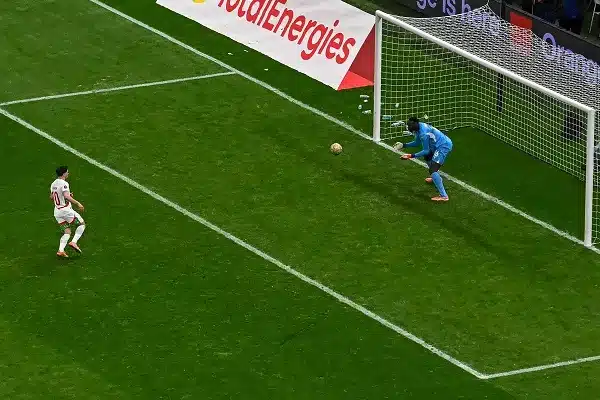
Brahim Diaz’s failed Panenka penalty in the Africa Cup of Nations final has reopened one of football’s most enduring arguments: is a chipped penalty down the middle ever the right decision when everything is on the line?
In a final already dominated by controversy, interruptions and tension, Diaz’s attempt to outthink Senegal goalkeeper Edouard Mendy instead became the defining moment of Morocco’s heartbreak.
Awarded deep into stoppage time after a lengthy VAR review, the penalty came with enormous pressure — and an unusually long delay.
Around 17 minutes passed between the referee pointing to the spot and Diaz beginning his run-up. During that time, emotions boiled over, players protested, and momentum evaporated.
When the Real Madrid midfielder finally approached the ball, he slowed his stride and delicately chipped his effort straight down the middle.
Mendy did not dive.
The Senegal goalkeeper remained rooted to the spot and comfortably caught the ball, immediately extinguishing Morocco’s hopes of settling the final in regulation time.
The match went to extra time, where Senegal ultimately secured victory, leaving Diaz devastated and the Panenka penalty once again under intense scrutiny.
A moment that defined the final
The miss was particularly cruel for Diaz, who had enjoyed an outstanding tournament.
He finished as the competition’s top scorer and was later handed the Golden Boot by Fifa president Gianni Infantino — a moment that only underlined the contrast between individual brilliance and collective disappointment.
It was not the first time in recent weeks that a Panenka had failed.
Earlier this month, Sunderland midfielder Enzo Le Fee attempted a similar penalty in a Premier League match at Brentford, only to see it easily saved by Caoimhin Kelleher.
Each miss fuels the perception that Panenkas are unnecessary risks, especially in high-stakes matches.
Yet history tells a more complex story.
Where the Panenka comes from
The technique takes its name from Antonin Panenka, who famously chipped his penalty down the middle to win the 1976 European Championship for Czechoslovakia.
With West Germany’s Uli Hoeness having blasted his spot-kick over the bar, Panenka calmly floated the ball past goalkeeper Sepp Maier to claim the trophy.
That moment transformed a clever idea into football folklore. Since then, some of the game’s greatest players — including Lionel Messi, Thierry Henry and Francesco Totti — have used the Panenka successfully.
Zinedine Zidane’s chipped penalty in the 2006 World Cup final remains one of the most audacious moments ever seen on the sport’s biggest stage.
But the margins are unforgiving. For every iconic success, there are painful failures.
When Panenkas go wrong
Gary Lineker famously missed an attempted Panenka for England in a friendly against Brazil in 1992, denying himself a chance to equal Sir Bobby Charlton’s goal record at the time.
Manchester City striker Sergio Aguero, usually reliable from the spot, saw a Panenka saved in 2021 — by none other than Edouard Mendy.
That history matters because it shapes perception. When a penalty struck firmly into the corner is saved, it is accepted as part of the game.
When a Panenka fails, criticism is harsher, often framed as arrogance rather than calculation.
Former Bristol City and Swansea striker Lee Trundle believes that reaction is unfair.
“You will get people moaning because they see it as something different,” Trundle told BBC Sport.
“My thinking of it is that it’s just another way to score a penalty,” he said.
“If you put it left or right and the keeper dives and guesses the right way and he saves it, that’s the same if you do a Panenka and he stays in the middle and saves it.”
What the statistics say
Data suggests that penalties struck down the middle are not as reckless as commonly believed.
At World Cups since 1966 and European Championships since 1980, 84% of penalties hit straight down the middle have been scored.
That compares favourably with penalties aimed left (78%) and right (74%).
The trend continued at this year’s Africa Cup of Nations.
Six of the eight penalties taken down the middle were converted — a higher success rate than those aimed at either corner.
But timing and psychology are crucial.
Why Diaz’s decision failed
Trundle argues that Panenkas are more effective later in games, when goalkeepers are conditioned to dive.
“You could be playing really well and have that confidence,” he said. “I think later on in the game as well, I think that’s where it’s better because the keeper will usually dive.”
Diaz may have assumed exactly that — that Mendy would feel compelled to commit. Instead, the Senegal goalkeeper read the body language, sensed hesitation in the run-up and trusted his instincts.
“He’s probably changed his mind many a time in that situation,” Trundle added. “The more time for a penalty to be taken, the more I think it goes in the keeper’s favour.”
In that prolonged delay, the Panenka lost its greatest weapon: surprise.
Genius or gamble?
The Panenka remains one of football’s most divisive techniques. When it works, it humiliates goalkeepers and shifts momentum.
When it fails, it becomes a symbol of excess confidence and poor judgment.
For Brahim Diaz, the theory offers little comfort. His miss did not simply cost Morocco a potential title — it ensured that one of the most dramatic Afcon finals in history will be remembered through a single, delicate touch that never fooled the goalkeeper.
And once again, football is left asking whether the Panenka is brilliance in disguise — or a gamble that only works when everything else is already going right.
-
 Kylian Mbappe apologises to Chinese people after Mao Zedong controversy Oct 27, 2026
 -
Harry Kane’s Ballon d’Or win hailed as reward for consistency and impact Oct 27, 2026
-
‘Harry Kane didn’t deserve it’ – Lamine Yamal’s uncle blasts Ballon d’Or decision Oct 27, 2026
-
Vincent Kompany comeback date remains uncertain after Bayern Munich coach’s hospitalisation Oct 27, 2026



-
AFCON 2025: Fixtures, Results, Scores and Standings Jan 18, 2026
-
Match hero Taiwo Awoniyi reflects on team effort after Chelsea triumph May 5, 2026
-
Leadership and long-term vision key to rescuing Zamalek and inspiring Egyptian football – Hany Abou Rida Nov 5, 2025
-
South African giants Orlando Pirates set to lose influential forward Monnapule Saleng Mar 19, 2025




-
Barcelona v Real Madrid: Catalans backed at 1.65 to win October Clasico Oct 23, 2026
-
Barcelona and Real Madrid meet in pivotal 265th Clasico Oct 23, 2026
-
Sevilla FC v Osasuna: probable line-ups for Monday’s La Liga meeting Oct 25, 2026
-
Champions League: PSG beat Barcelona as Liverpool complete comeback against Villarreal Oct 20, 2026