Djamel Benlamri highlights Senegal protest as lesson after AFCON 2025 debates
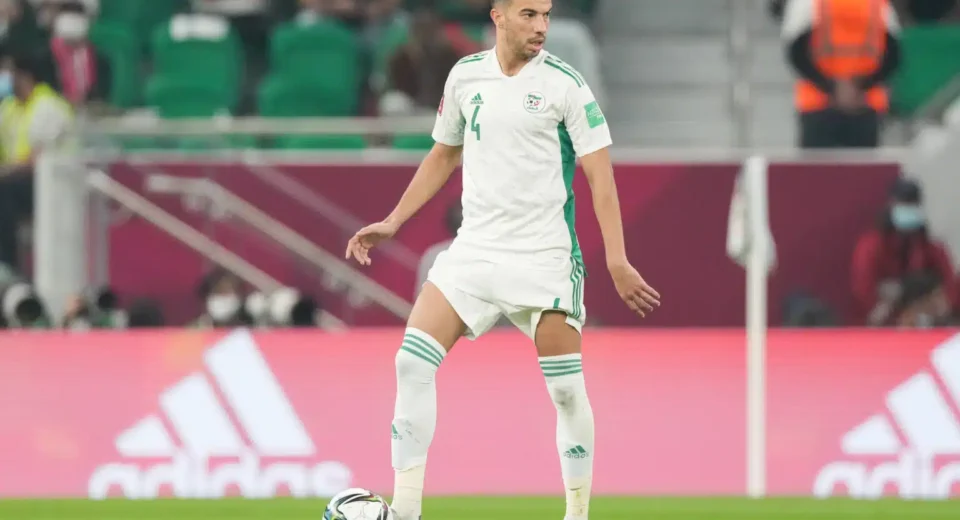
Djamel Benlamri has argued that Algeria failed to respond firmly enough to controversial refereeing decisions at the 2025 Africa Cup of Nations, saying his former side could have taken inspiration from Senegal’s reaction in the final against Morocco.
Speaking a day after Senegal’s dramatic victory over the hosts, the former Algeria international and 2019 African champion reflected on the incidents that dominated the closing stages of the final.
His comments came as debate continued across the continent over refereeing standards and the way teams respond under extreme pressure.
Benlamri focused on the decisive moment when Senegalese players temporarily left the pitch in protest at late decisions, an action he believes altered the tone of the match.
In his view, the collective stance taken by the Lions of Teranga had a clear impact on how the game was subsequently managed.
“After the Senegalese players left the pitch to protest the referee’s decisions, he became much more consistent in the remainder of the match. That’s exactly what you have to do in these kinds of situations, while remaining professional,” Benlamri said.
He suggested that the show of unity sent a message that could not be ignored, without crossing the line into indiscipline.
The former central defender then turned his attention to Algeria’s own tournament, drawing comparisons with their quarter-final exit against Nigeria.
That match remains a sore point for many Algerian supporters, having been overshadowed by a series of disputed decisions, including an early penalty appeal that went unanswered.
According to Benlamri, the frustration felt by the Greens was evident, but the response lacked the collective edge shown by Senegal.
He argued that silence or passive acceptance can sometimes be interpreted as weakness in high-stakes matches.
“Algeria should have adopted the same attitude against Nigeria to make a point. It wasn’t necessarily about actually leaving the pitch, but above all about expressing strong protest,” he added.
For Benlamri, the issue was not confrontation for its own sake, but asserting presence and demanding consistency.
His remarks highlight a broader debate within African football about how teams can protect themselves against perceived injustice while staying within the rules.
Benlamri insisted that professionalism and protest are not mutually exclusive, and that experienced players have a responsibility to manage such moments intelligently.
As discussion around the 2025 AFCON continues, Benlamri’s comments underline the fine margins that can define knockout football.
For him, Senegal’s example offered a lesson in collective resolve — one he believes Algeria may reflect on as they look ahead to future tournaments.
-
 Java United add Senegalese-French midfielder Christian Gomis in Indonesia move Aug 26, 2026
 -
Getafe seek to complete Conference League progress against Partizan in Belgrade Aug 26, 2026
-
Real Madrid unveil Yan Diomande as new signing on contract until 2033 Aug 26, 2026
-
Getafe aim to protect first-leg lead as Partizan prepare for Belgrade test Aug 26, 2026




-
AFCON 2025: Fixtures, Results, Scores and Standings Jan 18, 2026
-
Leadership and long-term vision key to rescuing Zamalek and inspiring Egyptian football – Hany Abou Rida Nov 5, 2025
-
South African giants Orlando Pirates set to lose influential forward Monnapule Saleng Mar 19, 2025
-
Full schedule for 2025 Africa Cup of Nations in Morocco confirmed Feb 12, 2025




-
Ajax close in on Franco-Guinean youngster Abdoulaye Camara Aug 19, 2026
-
DR Congo star Fiston Mayele joins Al Ahli Tripoli on two-year deal Aug 20, 2026
-
Babacar Bousso: Senegal striker makes UAE switch to Al-Wasl Aug 19, 2026
-
Ibrahim Maza ‘untouchable’ at Bayer Leverkusen unless two conditions are met Aug 19, 2026