Samuel Eto’o sets his sights on redemption as Cameroon look beyond AFCON heartache
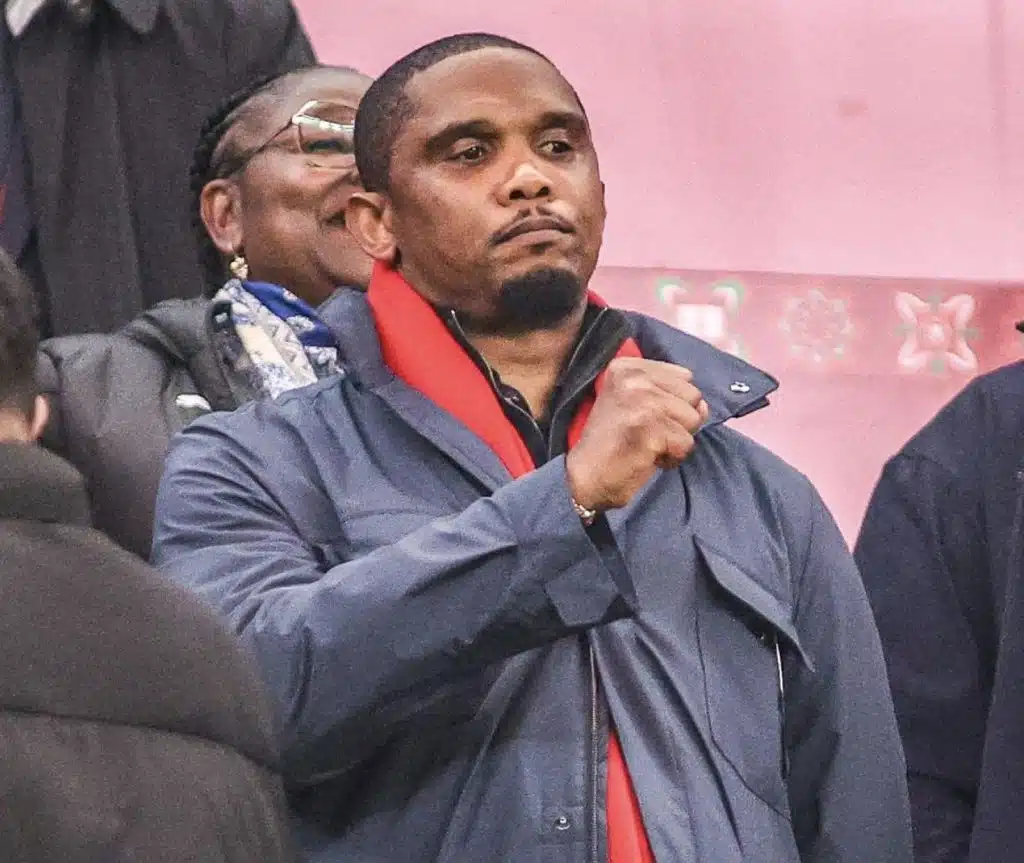
Samuel Eto’o told Cameroon’s stunned players “We’re coming to win the next AFCON” after their quarter-final exit in Morocco, a statement delivered in the dressing room moments after a 2-0 defeat that ended the Indomitable Lions’ 2025 campaign.
It was not a line intended for consolation.
The FECAFOOT president, once the symbol of Cameroon’s golden era on the pitch, was already shifting the narrative from disappointment to ambition.
For a squad still processing elimination, the words landed with weight — and with purpose.
Eto’o’s confidence may sound bold, but it is not without foundations.
Behind the early departure lies the outline of a project that has begun to take shape, offering reasons to believe that Cameroon’s next chapter could be far more compelling.
A team identity rediscovered under David Pagou
In a matter of weeks, head coach David Pagou succeeded in reawakening a sense of collective pride that had been absent for several tournaments.
Cameroon’s campaign was defined less by star names and more by cohesion, resilience and a visible hunger to compete.
From a hard-fought draw against Ivory Coast to the elimination of South Africa, the Lions rediscovered their traditional fighting spirit — the “hemle” that once defined them.
🎙️🇨🇲 David Pagou répond à nos questions sur le manque de performance de Mbeumo et le penalty litigieux, après l’élimination à la CAN, face au Maroc 2-0 :
🗣️ « Mbeumo dispute sa première CAN. Il a voulu bien faire, peut-être que l’adaptation avec ses nouveaux coéquipiers n’était… pic.twitter.com/TDNdX3r5eR
— Afrik-Foot (@afrikfoot) January 9, 2026
Even in defeat, the side appeared organised, disciplined and united, hallmarks of a group rediscovering its footballing DNA.
A generation ready to take ownership
The tournament also introduced a wave of youthful talent that hints at a changing of the guard.
Christian Kofane, Carlos Baleba, Arthur Avom, Karl Etta Eyong, Aboubakar Nagida, Danny Namaso and Enzo Boyomo, though not always first-choice, were emblematic of a squad in transition.
This emerging core offers more than potential.
It brings energy, athleticism and technical quality that suggest Cameroon’s future will not depend solely on established figures.
The rebuilding phase is no longer theoretical; it is already under way.
Time, finally, to plan properly
Preparation for this AFCON was widely regarded as rushed and unstable, shaped by late changes and uncertainty.
The next edition, however, offers something Cameroon have rarely enjoyed in recent years: time.
With continuity in the technical staff and clarity in direction, the federation can now plan methodically — building cohesion, testing systems and refining roles without the constant pressure of last-minute adjustments.
For a side long plagued by instability, that alone could be transformative.
Freedom from immediate World Cup demands
Missing out on the next World Cup has unexpectedly altered the rhythm of the project.
With no global qualifiers looming, Cameroon have almost two full years to experiment, develop chemistry and define a playing identity free from relentless short-term pressure.
It is an environment that encourages growth rather than survival — and one that suits a squad still learning to evolve together.
Eto’o’s instinct for bold calls
Eto’o has never shied away from decisive action.
His late coaching change before this tournament raised eyebrows, but it ultimately reshaped the team’s trajectory.
Marc Brys is now part of the past, and Cameroon leave Morocco with something that extends beyond results: renewed direction.
They may have fallen short in 2025, but they depart with a clearer vision, a younger spine and a leader unafraid to dream aloud.
In two years’ time, Eto’o believes Cameroon will not return as hopefuls — but as contenders.
-
 Senegal winger Moustapha Fanné joins Jaraaf on two-year deal after Finland spell Oct 23, 2026
 -
CAF Champions League: African Stars coach Güther backs team to challenge Orlando Pirates Oct 23, 2026
-
Amine Adli scores stunning free-kick as Bournemouth thrash AC Milan 3-0 in Europa League Oct 23, 2026
-
Ethiopia Bunna vs Mebrat Hayl: Hosts aim to start season with a win Oct 23, 2026




-
AFCON 2025: Fixtures, Results, Scores and Standings Jan 18, 2026
-
Match hero Taiwo Awoniyi reflects on team effort after Chelsea triumph May 5, 2026
-
Leadership and long-term vision key to rescuing Zamalek and inspiring Egyptian football – Hany Abou Rida Nov 5, 2025
-
South African giants Orlando Pirates set to lose influential forward Monnapule Saleng Mar 19, 2025




-
PSG v Barcelona: fiery attacks set up Champions League classic at Parc des Princes Oct 18, 2026
-
Champions League: PSG beat Barcelona as Liverpool complete comeback against Villarreal Oct 20, 2026
-
PSG beat Barcelona 4-2 in Champions League thriller Oct 21, 2026
-
Bayern Munich host Arsenal in heavyweight Champions League clash Oct 19, 2026