Candas Fiogbé’s Benin choice sparks questions over Atalanta exclusion
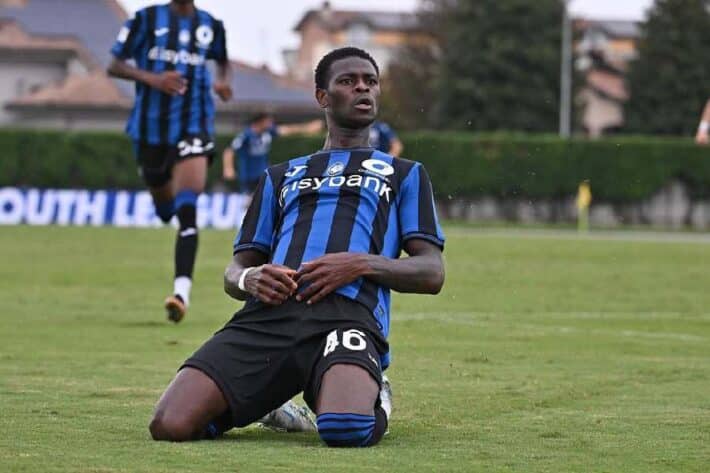
Candas Fiogbé’s once-promising trajectory at Atalanta Bergamo appears to have hit a puzzling standstill.
The young forward, long regarded as one of the club’s brightest emerging talents, has not featured in a single match for the U23 side since the start of the 2025–26 season.
The timing of his absence — following his decision to represent Benin internationally instead of Italy — has raised serious questions about whether his patriotic choice has come at a professional cost.
Fiogbé, who enjoyed an impressive campaign last season and earned a promotion to the U23 squad, was widely expected to take another step forward in his development this year.
Yet despite his previous performances and growing reputation, he has found himself completely frozen out of competitive action.
His omission comes in the wake of his announcement that he would play for Benin, the country of his heritage, turning down the opportunity to compete for a place with Italy — where he was born and trained.
While Atalanta has offered no official explanation for the player’s absence, the silence surrounding the matter has only deepened suspicions that his decision to represent Benin may have influenced his current situation.
Observers note that Fiogbé’s case highlights the complex challenges often faced by dual-national players across European football.
Many young talents of African descent develop within European academies but later choose to honour their ancestral roots by representing their countries of origin.
While this decision is deeply personal, it can sometimes lead to subtle repercussions, especially within clubs that may view such choices as limiting a player’s potential international visibility or commercial value.
The entirely Italian coaching staff at Atalanta’s youth setup has not commented publicly, leaving room for speculation and frustration among supporters who have followed Fiogbé’s rise.
For many, his absence is both unjustified and detrimental to a team that has built its identity on nurturing young players.
Despite the uncertainty, Fiogbé’s determination remains unquestioned.
Those close to him describe a player proud of his heritage and ready to fight for his place, regardless of the obstacles.
His decision to stand by Benin reflects a growing trend among young footballers who seek to balance ambition with identity.
Whether coincidence or consequence, Fiogbé’s situation has become a talking point that extends beyond Atalanta — a reminder of how deeply intertwined football, nationality, and opportunity can be in modern sport.
-
 Emmanuel Petit challenges Bradley Barcola to improve mentality after Liverpool struggles Oct 23, 2026
 -
Rayan Ait-Nouri on the brink: How Manchester City outcast can win over Enzo Maresca and revive his career Oct 23, 2026
-
Ivorian attacker Oumar Diakité continues remarkable scoring run for Sturm Graz Oct 23, 2026
-
Brian Baloyi exposes Kaizer Chiefs’ transfer weakness amid Seluleko Mahlambi pursuit Oct 23, 2026



-
AFCON 2025: Fixtures, Results, Scores and Standings Jan 18, 2026
-
Match hero Taiwo Awoniyi reflects on team effort after Chelsea triumph May 5, 2026
-
Leadership and long-term vision key to rescuing Zamalek and inspiring Egyptian football – Hany Abou Rida Nov 5, 2025
-
South African giants Orlando Pirates set to lose influential forward Monnapule Saleng Mar 19, 2025




-
PSG v Barcelona: fiery attacks set up Champions League classic at Parc des Princes Oct 18, 2026
-
Champions League: PSG beat Barcelona as Liverpool complete comeback against Villarreal Oct 20, 2026
-
PSG beat Barcelona 4-2 in Champions League thriller Oct 21, 2026
-
Bayern Munich host Arsenal in heavyweight Champions League clash Oct 19, 2026