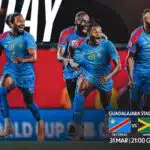
2026 WCQ: Nigeria petitions FIFA over eligibility dispute after play-off exit
Nigeria has formally asked FIFA to review the outcome of its World Cup qualifying play-off against the Democratic Republic of Congo, reigniting a dispute many believed had already been settled on the pitch.
The Nigerian Football Federation (NFF) confirmed on Tuesday that it has lodged an official complaint with world football’s governing body, alleging that several Congolese players who featured in the decisive match were ineligible.
The move follows Nigeria’s elimination by DR Congo in the final of the African play-offs for the 2026 World Cup, played in Morocco in November, which ended 1-1 before the Leopards prevailed after extra time.
That victory secured DR Congo a place in the intercontinental play-offs, where they are scheduled to face either Jamaica or New Caledonia on March 31 for a place at the finals.
However, Nigeria’s intervention has now cast uncertainty over that progression, with FIFA required to examine the claims and determine whether any regulations were breached.
At the centre of the complaint are allegations that up to six Congolese players did not complete the full nationality change process required under Congolese law.
Nigeria’s argument hinges on domestic legislation in DR Congo, which does not allow dual nationality.
The NFF contends that some players involved in the match retained European passports, including French and Dutch documents, and had not formally renounced their previous citizenship, a step Nigeria argues is mandatory.
While FIFA had authorised the players to represent DR Congo, Nigeria maintains that the approval was granted on the basis of information supplied by the Congolese authorities, which it believes may have been inaccurate or incomplete.
The federation insists that this distinction is critical, arguing that FIFA’s clearance does not override national legal requirements.
NFF Secretary General Dr Mohammed Sanusi outlined Nigeria’s position, stressing that the complaint was made only after a detailed review of the relevant regulations.
We are waiting. Congolese rules state that you cannot have dual citizenship or nationality. Wan-Bissaka has a European passport; some of them have French passports, some have Dutch passports. The rules are very clear, and we have submitted our complaint, he said, according to Vanguard.
Sanusi acknowledged that FIFA had initially deemed the players eligible but suggested that the governing body may have been misled during the process.
That’s why FIFA allowed them. FIFA rules say that once you have passports from your country, you are eligible; as far as FIFA is concerned, they are eligible, and that’s why they were allowed, he explained.
He added, But right now, our concern is that FIFA was misled into allowing them. It’s not FIFA’s responsibility to ensure that Congo’s regulations are respected. FIFA follows its own regulations, and it was on the basis of what was submitted to FIFA that they authorized them. What we’re saying is that it was fraudulent.
🚨| OFFICIEL : Le Nigeria dépose un recours contre la RDC !
En effet, par voie de presse via le secrétaire général de la Fédération Nigériane de Football (NFF) Sanusi Mohammed, le Nigeria annonce avoir soumis une pétition à la FIFA à l’encontre de la RD Congo concernant… pic.twitter.com/hhRmJ0iLKF
— Joueurs Congolais 🐆🇨🇩 (@JoueursCD) December 16, 2025
FIFA has confirmed receipt of the complaint and is expected to review the submissions before reaching a decision.
Any ruling could have significant consequences, not only for DR Congo’s immediate World Cup ambitions but also for Nigeria, which could be reinstated into the qualifying pathway if the complaint is upheld.
For now, the fate of both nations rests with FIFA’s disciplinary and legal bodies, whose judgment will determine whether the result stands or whether the qualification picture is dramatically reshaped at a late stage.
Popular News




-
AFCON 2025: Fixtures, Results, Scores and Standings
Jan 18, 2026 -

Leadership and long-term vision key to rescuing Zamalek and inspiring Egyptian football – Hany Abou Rida
Nov 5, 2025 -

South African giants Orlando Pirates set to lose influential forward Monnapule Saleng
Mar 19, 2025 -

Full schedule for 2025 Africa Cup of Nations in Morocco confirmed
Feb 12, 2025
-
LIVE UPDATES: D.R Congo 1-0 Jamaica – 2026 FIFA World Cup Playoffs
Mar 31, 2026 -

Cameroon defeat China 2-0 in FIFA Series clash
Mar 31, 2026 -

Africa’s 2026 World Cup Teams: Fixtures and Results for March friendly games
Apr 1, 2026 -

Zimbabwe defender Teenage Hadebe dropped after code of conduct breach
Mar 30, 2026